A projector replaces a TV only if it survives Saturday at noon
Most projectors look great at 9 p.m. with the lights off. The ones worth swapping your TV for look good at 1 p.m. with the blinds open.
Quick answer: A projector replaces a TV if it's bright enough for the room you'll actually use it in, paired with a screen that fights daylight, and with real speakers. An ultra short throw laser projector on an ambient-light-rejecting screen can do it in a living room. A cheap projector with a big lumen number on the box can't. It's a movie-night gadget, not a TV.
The test that settles it
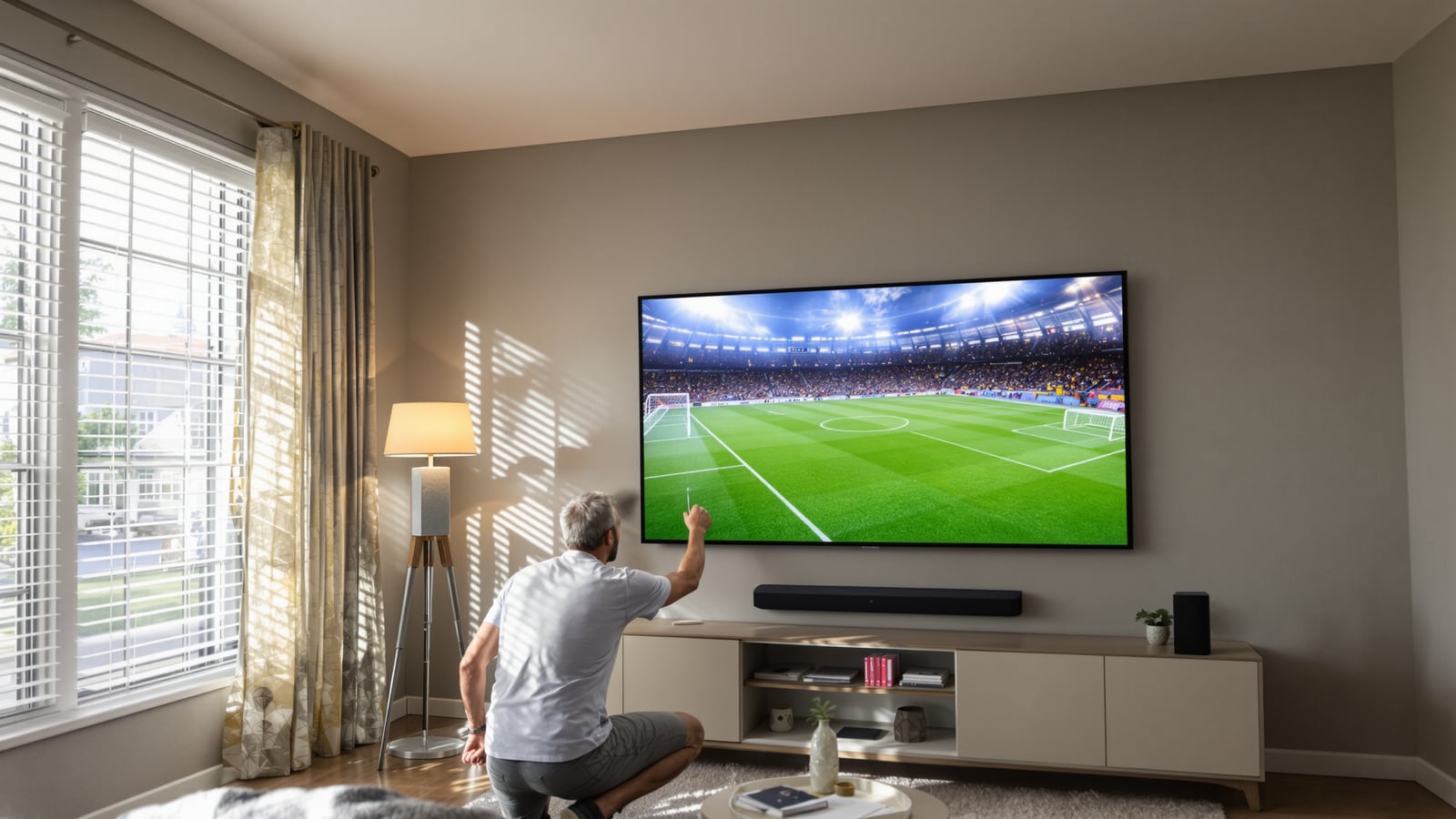
Pick a Saturday. Football's on at one o'clock, the blinds are open, somebody's frying bacon, and the lamp in the corner is on because nobody ever turns it off.
Now picture a 100-inch image on the wall. If you can still read the score bug and tell the teams apart, the projector replaces your TV. If the picture looks like a faded poster, it doesn't. Your TV could handle that room without breaking a sweat.
That's the whole question. Reviews are shot in dark rooms. Your house is not a dark room.
Why a projector loses to daylight
A TV makes its own light and its own darkness. A projector only adds light to a surface. The black on a projected image is just the wall, so it can never be darker than the room around it. Turn a lamp on and the blacks turn gray, and the picture goes flat.
So brightness is the first thing to check. Look for ANSI lumens, the standardized measurement. Bargain projectors often advertise "9,000 lumens" or "12,000 lumens," and that's usually a made-up number from a different, looser measure. If the spec sheet doesn't say ANSI, assume the number is decoration.
As a rough rule of thumb, a projector that's fine at about 1,500 to 2,000 ANSI lumens in a dark basement needs far more for a living room with daylight. Even then you'll be happier with the lights dimmed. Read the ANSI figure on the manufacturer's own spec page, not the shopping listing.
The two kinds that can actually replace a TV
1. Ultra short throw (UST) laser projector with an ambient-light-rejecting (ALR) screen.
This is the one built to live in a living room. The projector sits on a low console just inches from the wall and shoots up at the screen, so there's nothing to hang from the ceiling and nobody walks through the beam. Epson, Hisense, LG, Samsung and Optoma all sell this kind. Lineups change every year, so check the current spec sheet.
The screen is what makes it work. An ALR screen is designed to reflect light coming from the projector below and reject light coming from the windows and ceiling lights. Skip it, and a UST projector on a bare white wall is just a very expensive way to see a washed-out picture.
The trade-offs are real. The screen can cost as much as the projector. It needs a flat, solid mount. And the setup has to be precise, because a few degrees of tilt makes straight lines bow.
2. A good standard or short-throw projector in a room you control.
A basement, a finished garage, a den with real curtains. If you can get the room dark at will, you don't need the expensive screen or the extreme brightness. A solid 1080p or 4K-input projector with decent ANSI lumens will give you a picture a TV can't match at 100 inches or more. That's the case for a projector, and it's a good one.
The ones that don't replace a TV
Be honest with yourself about these.
- The marketplace special. It says "4K supported," which usually means it accepts a 4K signal and displays it at lower resolution. Check the native resolution.
- The pocket projector. Great for a campsite, a backyard, or a bedroom wall after dark. Not a primary screen.
- Any projector in a bright, open room with no screen plan. You'll hate it by March.
Know what the number on the box means before you pay. And keep the receipt.
The parts nobody puts in the ad
Sound. Built-in speakers are thin. Plan on a soundbar or a pair of real speakers from day one, and check that the projector has an HDMI ARC or eARC port or an audio output you can use. If somebody in the house sleeps early, the right headphones for your week settle the late-night problem.
Fan noise. Every projector has a fan. In a dead-quiet room during a quiet scene, you'll hear it. Read owner reviews specifically for noise.
Warm-up and shutdown. A projector isn't instant. Give it a minute to come up, and don't yank the power while the fan's still cooling it.
Lamp versus laser. Lamps dim over time and need replacing. Laser light sources last far longer and reach full brightness quickly. For a main screen, laser is worth the extra money.
Gaming. If anybody games on it, check input lag in the specs. A beautiful picture that responds a beat late is miserable.
Streaming. A 4K stream on a big screen shows every flaw in your connection. If it stutters, the home internet numbers that matter will tell you whether it's the Wi-Fi or the plan.
The wife test
A TV works when anyone presses one button. A projector setup often doesn't. If your spouse, your teenager or your mother-in-law needs a lesson to watch the news, you've built a hobby, not a TV.
Before you commit, count the steps to get from off to picture. Lower the screen, power on the projector, switch inputs, turn on the soundbar. If it's more than two, program a universal remote or pick a model with built-in streaming apps. It should work for the least technical person in the house on the first try.
Lighting can help too. A few dimmable bulbs on a schedule or a single button do more for a projected picture than anything else you'll buy, and smart home kit that earns its place covers which ones are worth it.
Do the real math
Add it up: projector, screen, mount, speakers, cables, a surface to put it on. Then price a big TV, because 75-inch and 85-inch sets cost far less than they used to. A projector doesn't win on price. It wins on size, and on the feel of a room with a real picture in it.
If you don't need 100 inches, buy the TV and don't feel bad about it.
Before you buy
- Measure the distance from where the projector will sit to the screen. Check it against the throw ratio in the specs.
- Check the room at 1 p.m., not 9 p.m.
- Find the ANSI lumen figure and the native resolution.
- Confirm the audio output and the HDMI ports you need.
- Buy where you have at least a 30-day return window.
Then use your return window the way it's meant to be used. Put the thing up and watch a full Saturday of football with the family in the room, blinds open, lamp on, the least technical person holding the remote. If everybody's still watching the game and nobody's squinting, keep it.
If they're asking you to turn the old TV back on, you've got your answer. Pack the box.
Dean Shaw
Gear & Garage
Reads the warranty, the parts list and the long-term owner reviews before anything else. Trucks, tools, watches, and the cheap version that costs more.

Watch
Worth an hour of your evening
More from Gadgets.
From channels we rate. Plays on YouTube.