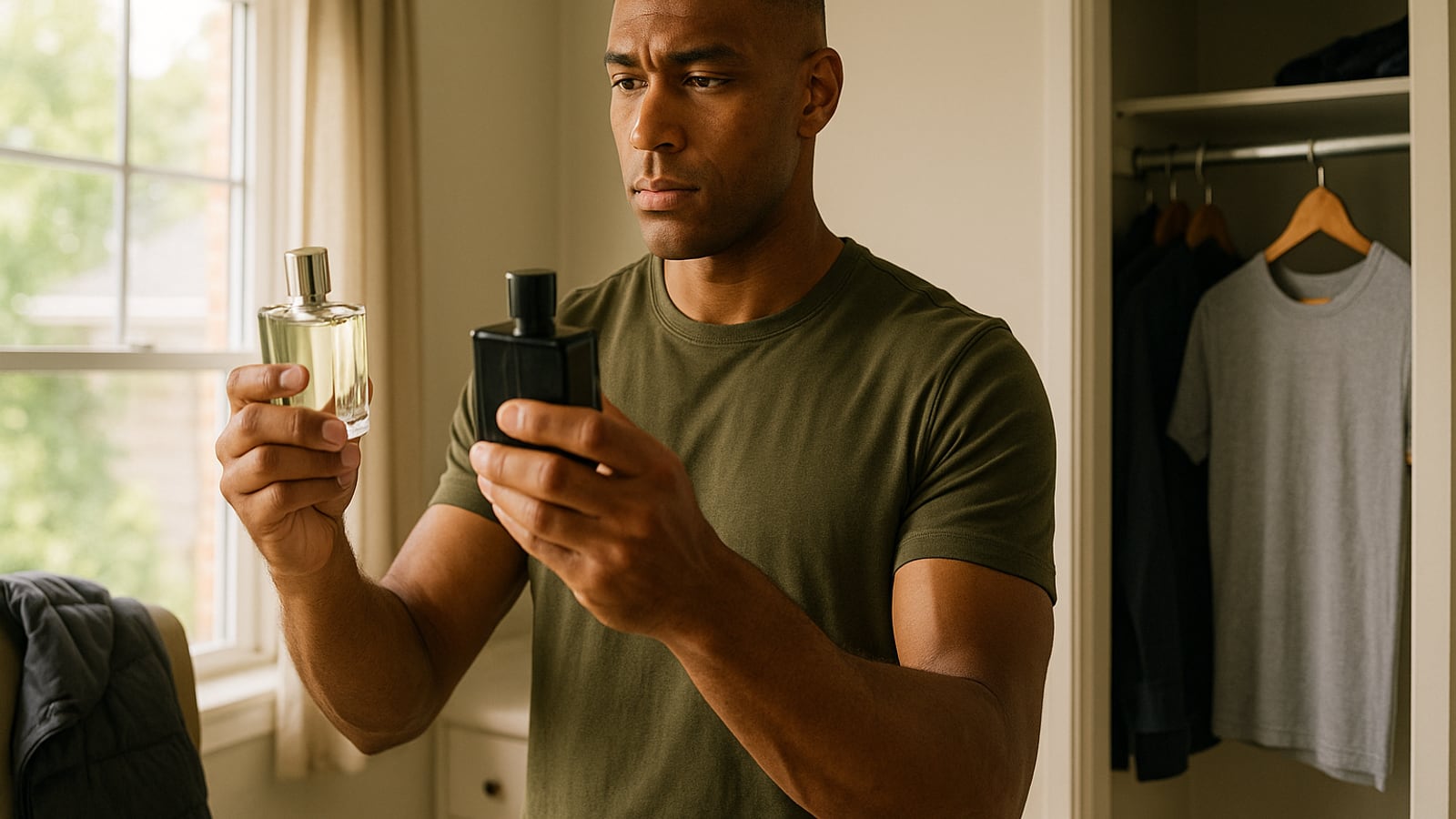
Buy two bottles. One bright and sharp for the months you sweat in, one warm and dense for the months you wear a coat. Then learn your spray count for each. That's the whole system, and it'll outperform the guy with fourteen decants and no plan.
The reason isn't marketing. It's temperature. Your skin sits around 98.6°F, and every degree above that in the air around you speeds up how fast the scent molecules leave your neck and get into somebody else's nose. In July, a fragrance that was polite in February turns into a fog. In January, the same three sprays of something light vanish before you've finished parking. Acqua di Gio launched in 1996 and Terre d'Hermès in 2006, and both are still on shelves because they solve two different problems in two different climates.
What "citrus" and "aquatic" actually mean on your skin
Citrus notes are built on small, light molecules. Limonene from lemon and orange peel, linalool, the green bite of bergamot. Small and light means volatile, which means they evaporate fast and hit hard on the way out. That's why a lemon cologne smells electric for twenty minutes and then feels like it left the building.
That's the flaw, and nobody selling it will tell you. Pure citrus is a 60 to 90 minute fragrance. If you want it to last past your commute, you need one where the citrus sits on a woody or musky base that hangs around underneath, or you accept the short life and carry a travel atomizer for a top-up at one o'clock.
Aquatics are a different animal. The clean, wet, just-came-out-of-the-ocean smell in most of them isn't seawater. It's a synthetic called calone, plus salty and melon-adjacent materials layered around it. Calone is why almost every blue bottle from the last thirty years smells related. It reads clean at high temperatures, which is exactly what you want when it's 92 degrees and you're standing on asphalt.
Both families share one useful trait in heat. They're loud without being heavy. Heat amplifies everything, and you'd rather have it amplifying grapefruit than vanilla and resin.
Why woods and spice earn their keep in the cold
Cold air is a muffler. It slows evaporation, keeps the scent hugging your skin, and kills the projection of anything delicate. Try wearing a fresh cologne in December and you'll notice you can smell it for ten minutes and then you can't, even though it's still technically there.
Heavy materials solve that. Sandalwood, cedar, patchouli, labdanum, tonka, incense resins, ambroxan. These are bigger molecules with lower volatility. They need body heat to lift, and in winter you're providing that heat under a wool coat and a scarf, which then act like a slow-release chamber every time you move.
Spices work the same way for a different reason. Cinnamon, clove, cardamom, black pepper. Your nose reads them as warm partly because some of them genuinely tingle. That's chemistry doing a psychological job.
The trap is obvious once you've made the mistake. That same spicy woody thing in August, sprayed at the same rate, becomes syrup. Warm air pushes it out three feet in every direction and holds it there. You won't notice. Everyone in the elevator will.
The spray count, which matters more than the bottle
A standard atomizer puts out roughly a tenth of a milliliter per press. A 100 ml bottle is about a thousand sprays. You're not going to run out, so stop rationing and start calibrating.
Summer, fresh fragrance, eau de toilette strength: three to four sprays. One on each side of the neck, one on the chest under the shirt. Fresh scents are weak but volatile, so you need volume to get any duration, and the heat will keep them moving anyway.
Winter, woody or spicy, eau de parfum strength: two sprays, maybe three. One on the chest, one on the back of the neck under the collar. That's it. The cold holds it close and the coat holds it closer. Three sprays of a good amber woody in a heated car is already more than the passenger signed up for.
Chest over neck is the single best adjustment most men can make. Skin on the chest is warmer, more consistent, and covered, so the scent releases gradually through the day instead of all at once at 7:15 a.m. Your neck is the blast radius. Your chest is the slow burn.
Never rub your wrists together. You're crushing the top notes and heating the whole thing at once. Spray and let it dry.
How to test one without getting fooled
The paper strip at the counter is a sales tool. It tells you what the fragrance smells like on paper, which is a surface with no oil, no heat, and no pH. Your skin has all three, and it'll shift the scent noticeably, especially in the base.
Spray it on the back of your hand or your inner forearm. One spray. Then walk out of the store, because the air inside a fragrance department is saturated and your nose is already compromised. Give it four hours. The first ten minutes are marketing. Hours two through four are what you're actually buying.
Test one at a time. Two at once and you can't tell which is which by lunch. And ask your wife or a friend around hour three, because you'll go nose-blind to your own scent long before anyone else does.
Storage, which is where most of the damage happens
The bathroom shelf is the worst place in your house for a fragrance. Heat from the shower, humidity, and light coming through the window all break down the oils. Citrus goes first. An old bottle of something bright will start smelling sour and metallic, and people blame the fragrance when they should blame the shelf.
Keep the bottles in a dresser drawer or a closed cabinet in a room that doesn't get steamy. Keep the box if you're the type who keeps boxes. Stored in the dark and reasonably cool, most fragrances hold up for years. Heavy woody, amber and spicy compositions last longest, and some of them improve a little. Citrus colognes are the ones with a clock on them.
Where the rule breaks
If you spend eleven months a year in a 71-degree office, seasonality matters less than the calendar suggests. Indoor climate control flattens most of the difference. Use the outdoor temperature as your guide anyway, because you're outside at the times people are closest to you, and because a heavy winter scent in an overheated conference room is worse than it's outdoors.
Some men wear one fragrance for thirty years and it becomes theirs. That's not wrong. It's a choice, and there's something to be said for a man his kids can smell the moment he walks in the door. If that's you, just cut the winter spray count by one in summer and you've solved 80 percent of it.
The other trap is buying the fresh one in January because the store put it on the front table. Buy the season you're in. You'll actually wear it, and you'll know within a week whether it works, instead of finding it half-full in a drawer next spring.
Tobias Reed
Style & Grooming
Spent a decade in menswear retail watching men buy the wrong size. Believes fit is ninety per cent of it and says so weekly.

Watch
Worth an hour of your evening
More from Grooming.
From channels we rate. Plays on YouTube.
Read next