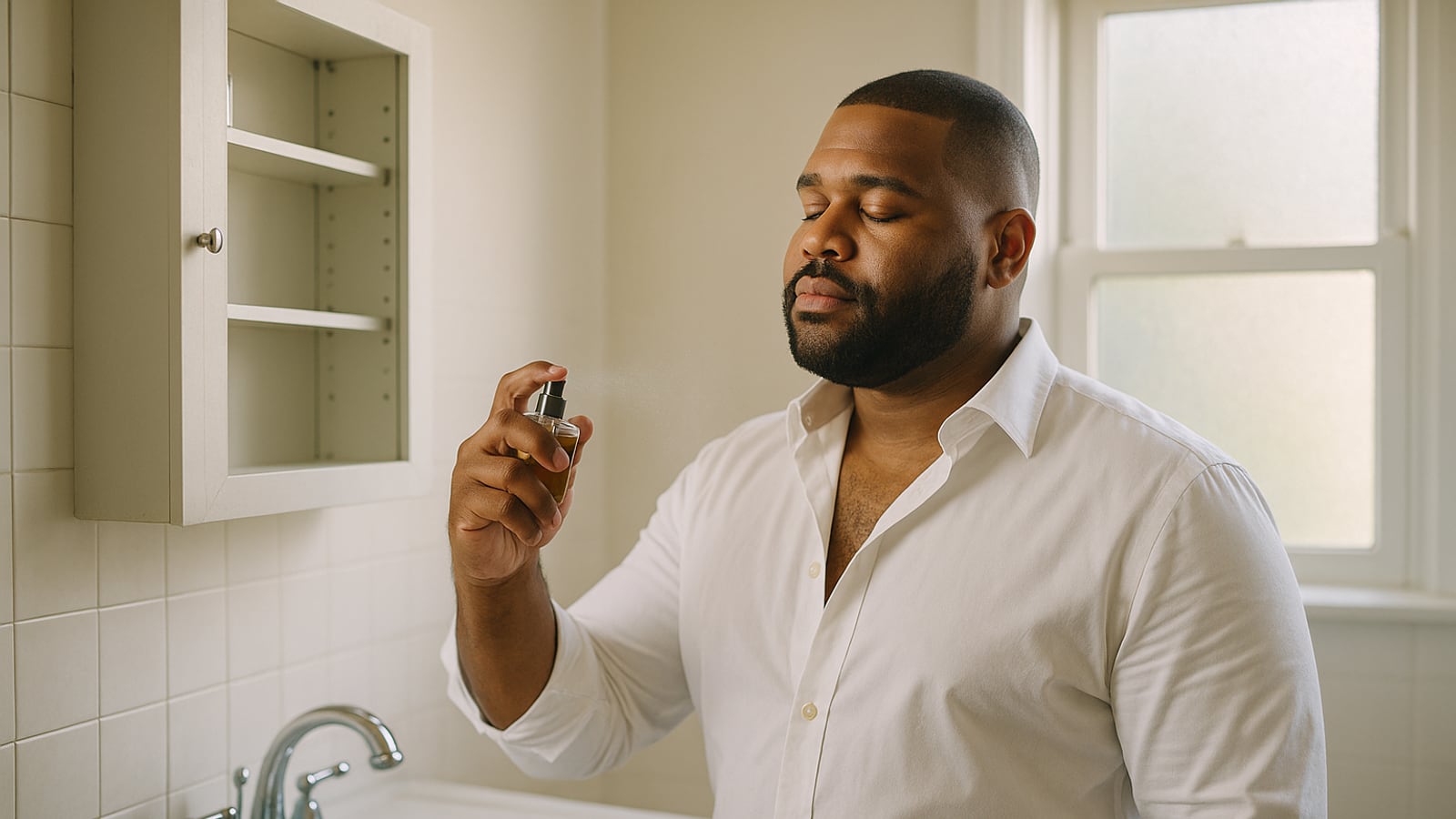
Do the arithmetic before you do anything else. A 3.4 oz bottle is 100 milliliters. A standard atomizer throws somewhere in the neighborhood of a tenth of a milliliter per pump, which puts most full-size bottles between 700 and 1,000 sprays. At six sprays every single morning, you're out in five or six months. At two sprays, four days a week, you're looking at four years.
Same bottle. Same money. The difference is entirely in your hand.
Most men don't decide to use six sprays. They drift there, because of a trick your nose plays that nobody warns you about.
Your nose quits on you in about ten minutes
Olfactory adaptation is real and it's fast. Spray something, and within a few minutes your brain files it under "background" and stops reporting it. You smell nothing. Everyone within four feet of you smells plenty.
So you add a spray. Next week, two. By spring you're at five and you genuinely believe you're wearing a modest amount, because you're the one person on earth who can't tell.
The fix costs nothing. Pick a number, write it down if you have to, and don't let it move. Two sprays for most eau de parfum. Three or four for a light eau de toilette or a citrus that burns off by lunch. Then ask your wife or a friend who'll be honest about it, once, in the car on the way somewhere. "Can you smell this?" If the answer is "yes, from here," you're already past where you need to be.
The compliment you're chasing happens when someone has to lean in slightly. Not when they can tell you walked past a room twenty minutes ago.
Where it actually goes when you waste it
Spray-and-walk-through is the single most expensive habit in men's grooming. You put roughly 0.3 ml of fragrance into a cloud of moving air and collect maybe a fifth of it on your shirt. The rest is on your bathroom floor, which now smells fantastic.
Spraying into a beard is close behind. Facial hair holds fragrance well, but the alcohol dries out both the hair and the skin under it, and the top notes flash off faster on a dry surface than on a slightly moisturized one.
Spraying from eight inches away scatters half of it. Three to five inches puts the cone where you aimed.
And the wrists thing. You've heard you shouldn't rub them together because it "crushes the molecules," which is chemically a bit silly. What actually happens is simpler: you're smearing, heating, and accelerating evaporation of the lightest, most volatile notes. Spray, let it dry, leave it alone. Not because of molecular damage. Because friction and warmth burn off the opening you paid for.
Dry skin is a leak
Fragrance oils need something to cling to. Skin that's stripped from a hot shower and nothing else gives them nowhere to sit, so the whole thing evaporates in an hour and you reach for the bottle again at noon.
An unscented lotion on the neck and chest before you spray fixes it, and it's the cheapest longevity trick there is. Plain petroleum jelly on one small spot works even better if you don't mind the feel. Either way you're extending a two-spray application to where a four-spray one used to land.
The order that survives a real morning: shower, towel off, unscented moisturizer, get dressed to the shirt, two sprays on the chest and one on the back of the neck under the collar, shirt on. Fifteen seconds. The shirt traps it, your body heat feeds it out all day, and you're not broadcasting at the person behind you in line.
The bathroom cabinet is killing your bottle
Three things degrade fragrance: heat, light, and oxygen. A bathroom shelf serves up the first two every morning, with a humidity swing thrown in for free. A room that goes from 68 degrees to 95 and back, twice a day, is running a slow cooking cycle on your citrus notes.
Bergamot, lemon, and most of the bright top notes go first. They turn sharp, then sour, then vaguely like nail polish remover. The base usually survives, which is why an old bottle can smell terrible for ten minutes and then almost normal.
Move everything to a bedroom drawer or a closet shelf. Keep the box. That printed cardboard box you were about to throw out is a light filter that came free with the purchase, and it's the reason collectors' bottles from the nineties still smell right.
The refrigerator is unnecessary for anything you use regularly. Steady room temperature in the dark does 95 percent of the job, and constant temperature matters more than low temperature. A bottle that lives at a steady 70 degrees beats one that bounces between the fridge and a warm dresser.
Air in the bottle, and the atomizer you should stop unscrewing
Oxygen matters less than people online claim, if you have a proper spray bottle. A crimped atomizer is close to sealed, and the tiny amount of air drawn in per spray isn't going to wreck anything. Splash bottles are the real problem. Every time you tip one, you're swapping liquid for air.
If you own a splash bottle you love, decant most of it into 5 ml or 10 ml glass atomizers and leave the big one mostly untouched.
Travel atomizers earn their keep for a different reason. A 5 ml sprayer holds around 50 sprays, which is two weeks of travel, and it means your 100 ml bottle never rides in a checked bag, never sits in a car in July, and never gets knocked off a hotel counter onto tile. Get the glass ones with metal collars. The plastic drugstore ones leak and the plastic can pick up the scent permanently.
Two bottles, not one
Rotation doesn't reduce your total consumption. But it stops the spray creep, because you never adapt fully to any single scent, and you keep noticing the amount you're putting on.
Two is enough. Something lighter and cleaner for work, something warmer for evenings and cold weather. If you like one enough to want a third, buy the 50 ml of a high-concentration parfum rather than the 100 ml of the eau de toilette. The smaller bottle at 20 percent concentration outlasts the bigger one at 8 percent, and it costs less per wearing even when the sticker price says otherwise.
When it's actually gone bad
Look at the color first. Darkening toward amber or brown in a fragrance that started pale is oxidation. Then smell the opening from an arm's length, not from the nozzle. A sour, vinegary, or solvent-heavy first thirty seconds means the top notes are finished.
That doesn't always mean the bottle's trash. Plenty of well-stored fragrances mellow into something better after a few years, with the sharp edges sanded off. There's a difference between aged and spoiled, and your nose can tell you which one you've got.
If it's spoiled, pour it out. Wearing an off bottle because you paid for it's how men end up smelling like a thrift store, and nobody will tell you.
The last thing: stop saving it. A bottle in a drawer for special occasions is a bottle slowly turning into vinegar while you wait for a wedding. Wear it Tuesday. Two sprays. You've got 900 left.
Dean Shaw
Gear & Garage
Reads the warranty, the parts list and the long-term owner reviews before anything else. Trucks, tools, watches, and the cheap version that costs more.

Watch
Worth an hour of your evening
More from Grooming.
From channels we rate. Plays on YouTube.
Read next