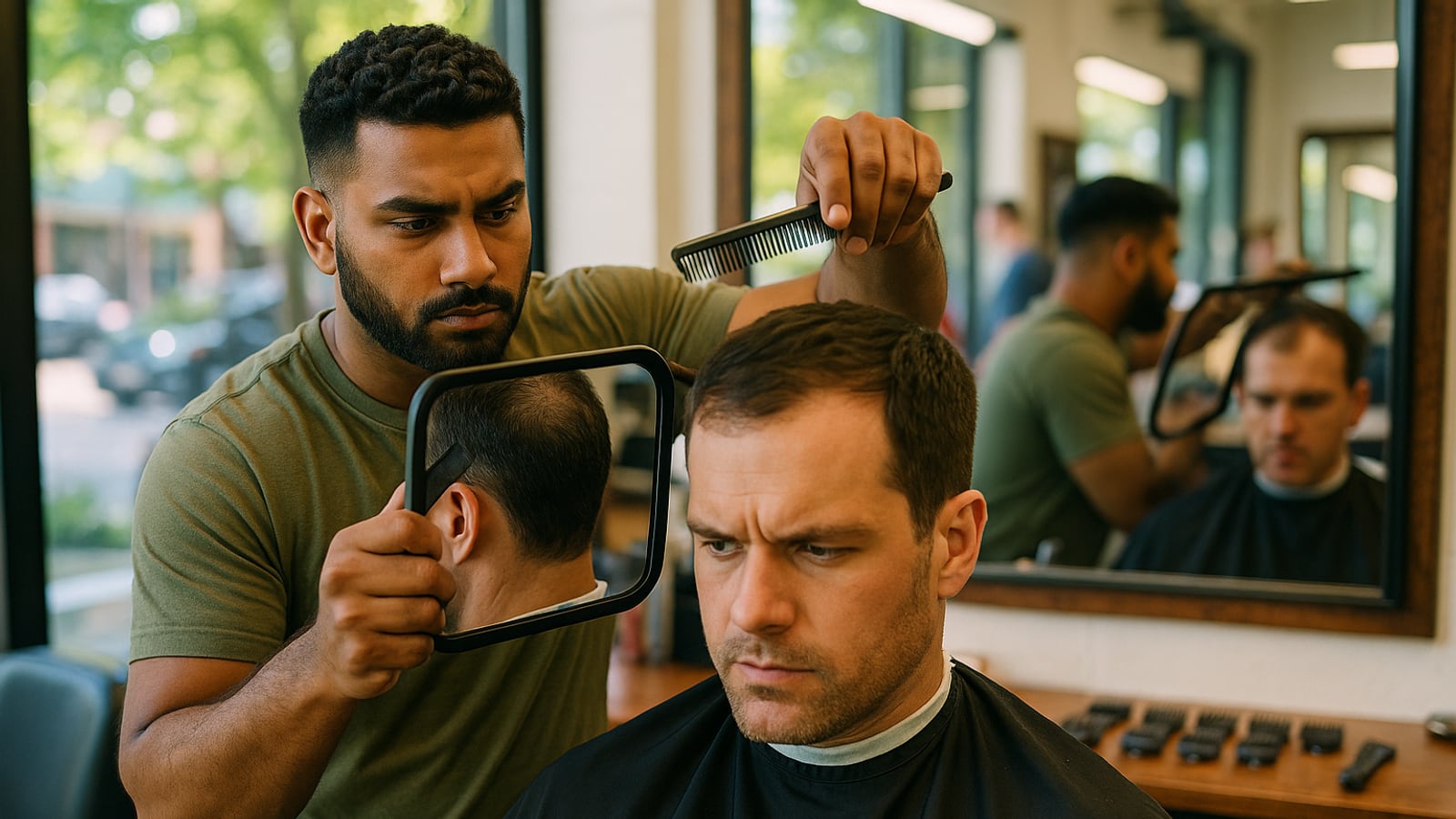
Most guys find out from the second mirror. The barber finishes, swivels you around, holds up the hand mirror, and there's a pale patch at the back of your head doing an impression of a full moon. You've been styling the front for fifteen years and the back has been quietly filing for divorce.
The good news is that a crown thins in a way that's unusually easy to disguise, for longer than you'd think. The bad news is that almost everything men instinctively do about it makes it look worse.
See it properly before you decide anything
Bathroom vanity lights sit above your head and aim straight down. That's the worst possible angle for judging density at the crown, and it's why guys panic. Get outside on an overcast day, or stand near a window with the light coming from the side. Have someone take three photos of the back of your head: hair dry and styled, hair dry and messed up, hair wet.
The wet photo is the honest one. Wet hair clumps and shows scalp, so if wet looks scary, that's normal. Compare it to the styled photo. The gap between those two pictures is exactly how much your haircut is doing for you.
Take the same three shots every six months and label them by date. Memory is a terrible instrument for slow change. A photo from March isn't.
Length is the enemy, and here's the physics of it
Hair at the crown grows out of a whorl, that spiral you can see in every toddler's cowlick. Growth radiates outward from a center point. So when hair up there gets long, it lies flat and falls away from the middle, and the strands separate like spokes. Light goes straight through to the scalp.
Shorter hair at the crown stands up. Standing hair casts shadow on the scalp instead of exposing it. That's the whole trick. Density is partly real and mostly optical, and shadow is the free ingredient nobody sells you.
Which means the classic move, growing the top out and combing it back over the thin spot, does the opposite of what you want. So does a hard side part, which opens a bright stripe of scalp and points at the problem like a runway light. So does any shiny product. Pomade with a wet finish turns individual strands into dark lines on a light background, and now a viewer can count them.
The cuts that actually work
Two haircuts do most of the heavy lifting.
The textured crop. Sides and back on a taper, roughly a 1 or 2 at the neck blending up to a 3 or 4, with the top left somewhere between an inch and two inches and cut with heavy texture. The fringe stays forward, a little ragged. The weight sits at the front, so the eye goes to your face and forehead, not the back of your skull. This is the single best cut for early to moderate crown thinning, and it looks intentional on a man of any age.
The soft, high taper with weight kept on top. Sides short, no skin, no sharp lines. Top left long enough to finger-style forward and up. Shorter than you'd like. Cutting the top short feels like giving up ground, but two inches of standing hair covers more scalp than four inches of hair lying down.
What to avoid: razored ends, which thin the hair further and split into transparent wisps. Heavy disconnection, where long top meets very short sides, because it makes the top look like a separate piece. And length past the collar, which drags everything flat.
Say this to your barber, word for word
Don't say "I'm going bald, do something." You'll get a buzz cut and a sympathetic nod.
Say: "I'm thinning at the crown. Leave the weight on top and take it out of the sides so there's less contrast. Point-cut the ends, don't razor them. No hard part. Keep the fringe forward."
Then ask one question at the end, while the mirror is still up: "How do I dry this so the crown stands up?" A barber who can answer that in thirty seconds is worth keeping. A barber who tells you to grow it out and sweep it over is giving you 1997.
Ninety seconds in the morning, and the dryer does most of it
This survives a real morning. I've done it with a kid hanging off my leg.
- Towel-dry until hair is damp, not wet. Ten seconds, rough, no gentleness required.
- Sea salt spray or a light texture spray at the crown and back. Two pumps. It adds grip and grit, which is what standing hair needs.
- Blow dryer on medium heat, low speed, aimed against the direction the hair wants to fall. At the crown that means pushing from the outside in, toward the whorl. Thirty to forty seconds. Use your fingers, not a brush.
- Warm a pea-sized amount of matte clay between your palms until it's almost invisible, then work it in from the roots with fingertips. A drugstore matte clay under twenty dollars does this job as well as anything on a salon shelf. Matte. Not pomade, not wax with shine.
- No comb. A comb lays it flat and undoes step 3.
The dryer is the part guys skip and it's the part that works. Air-dried crown hair lies exactly where gravity puts it.
The honest test for when to go short
Style it your best. Stand in indirect daylight. If you can see scalp through dry, finished hair from a normal conversational distance behind you, the disguise has stopped working, and everyone but you already knows.
At that point a 2 or 3 all over, with a soft taper at the neck and a clean edge, reads as a decision. A thin, over-managed hairstyle reads as a fight you're losing. That contrast is the whole game. Nobody has ever looked at a well-trimmed short cut and thought less of the man wearing it.
Two things make short work harder than you expect. Grow some stubble or a proper beard so your head isn't the only shape in the frame, because balance at the jaw does a lot. And put sunscreen on your scalp, every time, because a newly exposed crown burns fast and looks terrible peeling.
Fiber powders and scalp concealers are real and they do photograph well. They also run in rain, transfer to a pillow and onto a white collar, and I wouldn't wear one anywhere I might sweat. Wedding, sure. Work, no.
The part that isn't a haircut
If you actually want to slow it down, that's a medical conversation, not a shopping one. Minoxidil is the over-the-counter topical with FDA approval for pattern hair loss, and the prescription options are worth asking about. The person to ask is a dermatologist, not a barber and not a supplement ad. Bring your dated photos. They'll tell you more than anything you say in the chair.
And skip the thirty-dollar shampoo promising regrowth. Shampoo is soap. It's on your head for forty seconds.
Your crown is the one part of you that you'll never see in real time, only in photos and other people's faces. Cut it for them.
Dean Shaw
Gear & Garage
Tests things until they break, then reports what broke first. Trucks, tools, watches, and the cheap version that costs more.

Watch
Worth an hour of your evening
More from Grooming.
From channels we rate. Plays on YouTube.
Read next