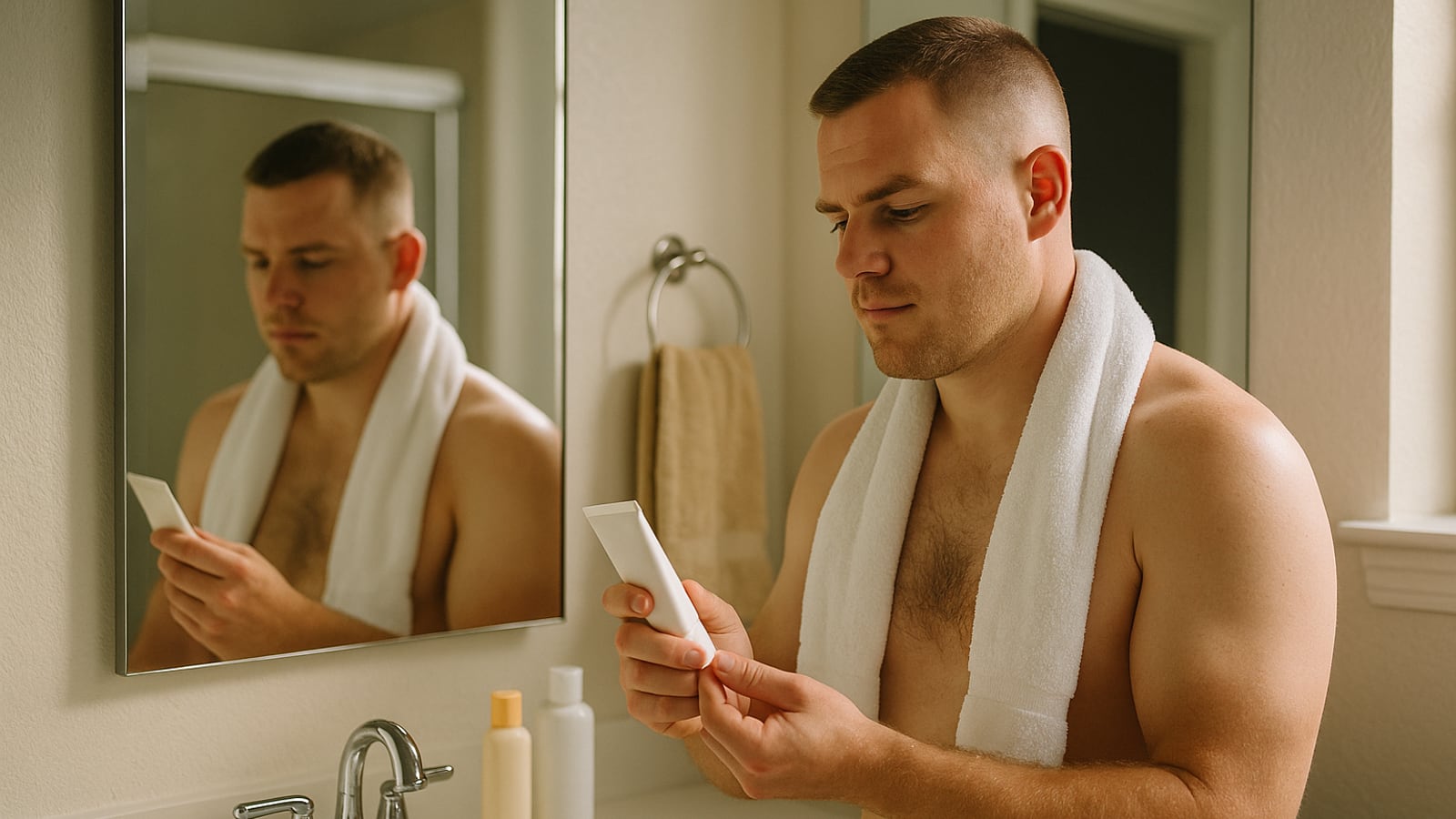
Go count what's currently touching your face. Face wash, scrub, toner, aftershave splash, eye cream, a serum somebody gave you at Christmas, sunscreen. That's seven, and six of them have fragrance in them. If your face burns after you wash it and stays pink until lunch, the fastest fix isn't a new product. It's subtraction.
Strip it to three. A cleanser that doesn't foam, a moisturizer thick enough to be dull, and a zinc oxide sunscreen. Ninety seconds in the morning, sixty at night. Give it three weeks before you judge it.
And stop treating the sting as feedback. That tingle after the splash isn't your pores getting clean. It's nerve endings reacting to alcohol and menthol through a skin barrier that's already cracked open at the microscopic level. Stinging means something got through a door that's supposed to be shut.
The ingredients doing it
Fragrance, first and always. "Fragrance mix" sits on the standard patch-test panels dermatologists use because it earns its spot. And "unscented" isn't the same word as "fragrance-free." Unscented often means a masking scent was added to cover the smell of the raw ingredients. Look for the actual words fragrance-free on the front, then check the ingredient list for "parfum," "fragrance," "linalool," "limonene" and "geraniol."
Second, alcohol denat. If it's in the top five ingredients, it's there to make the product feel light and evaporate fast. On tough skin that's fine. On yours it's a solvent.
Third, essential oils. Tea tree, lavender, citrus, peppermint. They oxidize on the shelf and get more allergenic as they do, which is why the bottle that was fine in March can turn on you in August.
Then the mechanical stuff. Walnut shell scrubs. Washcloths used with pressure. Water hot enough to fog the mirror. Foaming cleansers built on sodium lauryl sulfate, which strips oil efficiently and doesn't know when to quit.
And the classic barbershop aftershave. It smells like your grandfather and it's 60-plus percent alcohol. If your face is angry, that bottle stays on the shelf as decoration.
Product one, a cleanser that doesn't foam
You want a cream, lotion or milk texture. It should feel like thin lotion going on and it should not produce lather. Cetaphil Gentle Skin Cleanser, CeraVe Hydrating Cleanser and Vanicream Gentle Facial Cleanser all fit and all come fragrance-free, though formulas get reworked, so read the back anyway.
Use it once a day, at night. In the morning, plain lukewarm water on your hands is enough. You slept on a clean pillowcase. There's nothing on your face that needs a surfactant at 6 a.m.
Water temperature matters more than people expect. Lukewarm, meaning you can hold your wrist under it and forget about it. Twenty seconds of contact, not two minutes of massage.
Then pat dry. Press the towel, lift it, move to the next spot. Don't drag.
If you're genuinely oily and skipping the morning wash feels wrong, wash in the morning and rinse with water at night instead. One cleanse a day. Pick the end that bothers you less.
Product two, a moisturizer boring enough to work
Thick. White. Comes in a tub or a heavy pump. Ingredient list you could read out loud without stumbling: glycerin, petrolatum or dimethicone, ceramides, maybe niacinamide. Nothing botanical near the top.
CeraVe Moisturizing Cream and Vanicream Moisturizing Skin Cream are the two most people land on, and both are cheap enough that you'll actually use enough of it. That's the real failure point. People buy a half-ounce jar of something expensive, ration it, and apply a film so thin it does nothing.
Apply it damp. Not dripping, but within about a minute of patting dry, while there's still moisture sitting in the top layer of skin. You're sealing water in, not adding it.
For the spots that stay raw, usually the sides of the nose and the corners of the mouth, put plain petroleum jelly over the moisturizer at night. A rice-grain amount rubbed between your fingertips first so it spreads. It's greasy, it will mark a pillowcase, and it works better than anything with a marketing budget.
Product three, zinc oxide in the morning
Sun exposure keeps inflamed skin inflamed, and it deepens the red marks left behind after a flare. Mineral sunscreen is the safer bet here because zinc oxide and titanium dioxide sit on the surface instead of absorbing, and they don't migrate into your eyes and sting the way some chemical filters do.
Look for zinc oxide somewhere around 15 to 20 percent, SPF 30 or higher, fragrance-free. A tinted version solves the white cast, which is a real problem and the main reason men quit mineral sunscreen in week two. The tint also knocks down redness, which you may find you like.
Two fingers' worth for the face and neck. Less than that and the number on the bottle is fiction.
If mineral flatly won't work for you under a hard hat or in the heat, a modern chemical formula labeled fragrance-free is still better than nothing. Patch test it first.
Test one thing at a time
Here's the part nobody has patience for, and it's the part that finds your actual trigger.
Add products one at a time, two weeks apart. Cleanser first. Two weeks. Then moisturizer. Two weeks. Then sunscreen. If something flares, you know exactly what did it, because only one thing changed.
Before a new product goes on your face, run a repeat open application test. Dab a dime-sized amount on the inner forearm or the skin just in front of your ear, twice a day, for five days. Reactions to fragrance and preservatives often take three or four days to show up, which is why the "I tried it once and it was fine" approach fails.
Six weeks to build a three-product routine is slow. It's also the difference between knowing and guessing.
Check the things that aren't on your face
Laundry detergent with fragrance, and fabric softener, which is designed to leave scented residue on fabric that then spends eight hours pressed against your cheek. Switch to a free-and-clear detergent, drop the softener, and give it three washes to clear the old residue out of the sheets.
Shaving is the other one. Fewer passes, always with the grain on the neck, a fresh blade, and moisturizer afterward instead of a splash. If you're using a five-blade cartridge on raw skin every morning, no cream on earth is going to keep up.
Hot showers are worse for your face than your face wash is. Two minutes cooler than you like it.
When it isn't the products
Some skin isn't sensitive. It has something specific going on, and swapping cleansers won't touch it. Persistent redness across the cheeks and nose with flushing after coffee or heat points one direction. Greasy flaking along the sides of the nose, in the brows and at the hairline points another. Itchy, scaly patches that come and go point a third.
Those have real treatments, most of them cheap, most of them prescription. A dermatologist will sort it in one appointment. Nothing in this article is a substitute for that, and if you've been fighting the same red face for two years, you've already spent more on products than the copay.
Get it right and your skin stops being something you think about. No tightness after washing, no flush at 10 a.m., no calculating whether the office AC is going to set it off. Just a face that shuts up and lets you get on with the day.
Dean Shaw
Gear & Garage
Tests things until they break, then reports what broke first. Trucks, tools, watches, and the cheap version that costs more.

Watch
Worth an hour of your evening
More from Grooming.
From channels we rate. Plays on YouTube.
Read next