
Put your hands down and the spot heals faster
Squeezing feels like you're doing something about it. It's the one move that guarantees the thing sticks around longer.
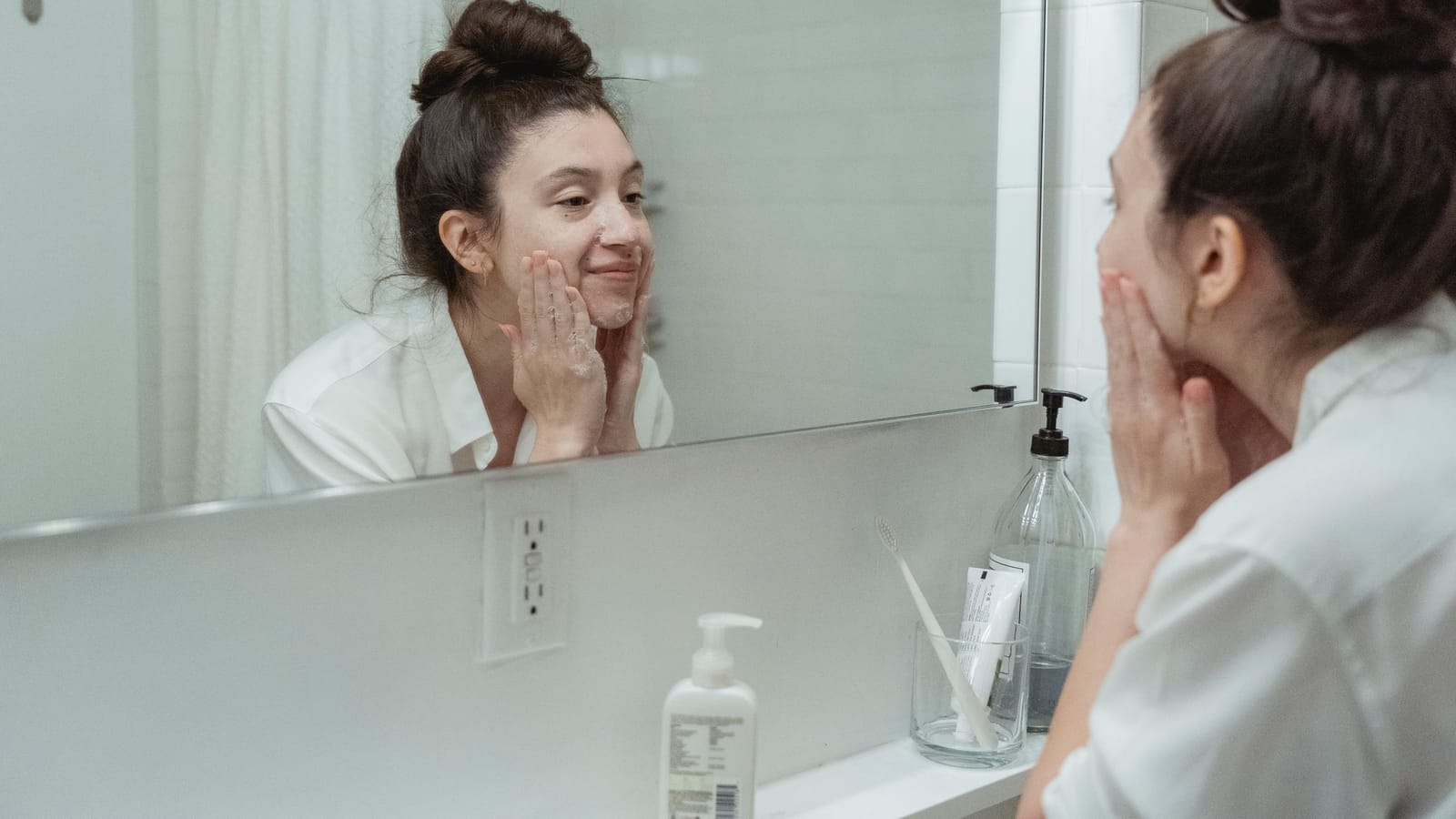
The bathroom mirror is lying to you about the size of it.
You're standing six inches away under a light that's pointed straight down at your face, and at that distance a spot the size of a pinhead looks like a landmark. Nobody else in your life is ever going to view your face from six inches under a downlight. Not your friends, not the guy at the bus stop, not your grandmother. They see you from about three feet away, moving, talking, in normal light, where the thing you've been staring at for twenty minutes basically doesn't register.
Which matters, because most picking starts with a mirror and ends with a scab.
What squeezing actually does down there
A pimple is inflammation. A pore gets blocked, bacteria that live on everyone's skin multiply in the trapped oil, and your immune system shows up to deal with it. The redness and the swelling are your body already working on the problem.
When you squeeze, you're applying pressure to a small, inflamed pocket. Some of what's in there comes out. A lot of it doesn't — it gets pushed sideways and downward into the surrounding tissue, which means the inflammation spreads under the surface instead of clearing. That's why one spot you attacked on Tuesday sometimes turns into a cluster by Thursday.
You also tear skin. Not dramatically, but you break the top layer, which is the barrier that was keeping everything else out. Now you've got an open wound on your face and fingers that were just on a keyboard, a door handle and your phone.
And the fingernail thing is worse than the finger thing. Nails carry more than you want to think about, and they cut deeper than you mean to.
The mark outlasts the bump
Here's the part nobody tells you at thirteen. A pimple you leave alone is usually a short story. A pimple you dig at can leave a dark or red mark that hangs around for weeks or months after the bump itself is long gone.
That's post-inflammatory pigmentation — your skin overproducing color while it repairs damage. It fades, but slowly, and it fades slower if you keep going back to the same spot.
Deeper damage can leave an actual scar, the kind that changes the texture of the skin and doesn't fade on its own.
So the math is ugly. You trade a few days of a bump for a much longer stretch of a mark, and you do it in about ninety seconds of standing at a sink feeling like you're finally taking action.
Picking feels productive. That's the trap. It's the only thing you can do to a spot with your bare hands, so your brain files it under "doing something."
Make the mirror harder to reach
Habits break when you change the setup, not when you promise yourself you'll be stronger.
- Ditch the magnifying mirror, or put it in a drawer. It exists for eyebrows and eyeliner, not for inspections.
- Take a step back. Wash your face, then look from arm's length. That's roughly how the world sees you.
- Set a limit on mirror time after you wash. Thirty seconds. Then walk out of the room. The bathroom is where the damage happens because it's the only place you're alone with good lighting and nothing else to do.
- Cut your nails short. Sounds unrelated. It isn't.
If you catch yourself standing there with your fingers already up, name it out loud. "I'm about to make this worse." Saying it breaks the autopilot.
The ten-minute rule
Whenever the urge hits, give it ten minutes before you touch anything. Not forever. Ten minutes.
Go do something with your hands in the meantime. Fill a water bottle. Fold the laundry on your bed. Text back the friend you've been ignoring for two days. Practice guitar chords badly. Pick up the dog.
Most urges fall apart inside ten minutes because they were never really about the spot. They were about being bored, or stressed, or up too late scrolling and needing something to fix.
If you want a physical substitute, a hydrocolloid patch is the honest one. It's a little clear sticker that sits over the spot, absorbs what comes out of it, and, more to the point, physically stops your fingers from getting there. Put one on before bed. You'll sleep instead of investigating.
A warm, clean washcloth held on the area for a few minutes can settle a sore spot too. Warm, not hot. No pressure. You're comforting it, not interrogating it.
A gentler step after you wash
Full disclosure: GermProof is a sister brand of BRO, so read this knowing that.
GermProof comes as a spray and a gel, and it's made of chelated silver at 200 ppm, distilled water and vegan chitosan sourced from mushrooms rather than shellfish. It's all-natural, alcohol-free, odorless, non-drying and non-toxic. On clean skin it forms an invisible, breathable antimicrobial barrier that lasts for hours per application, and it soothes irritated skin while supporting faster healing.
What it's useful for here: the moment after you've washed your face, when you want to put something on and everything in the cabinet stings. It's not a spot treatment and it won't clear acne. It's a gentle step in a simple routine, especially on a patch of skin that's already sore because you got to it before you read this.
Clean skin first, always. Then a light layer. Then leave your face alone.
The unglamorous stuff that actually helps
- Wash twice a day with something gentle. More than twice doesn't help and usually backfires.
- Wipe your phone screen. It spends hours pressed against your cheek.
- Fresh pillowcase twice a week. Cheap, easy, genuinely useful.
- Sunscreen. Sun makes those leftover marks darker and slower to fade. Any broad-spectrum SPF 30 works, but a mineral one with zinc oxide is gentler on sore, sensitive skin, like CeraVe Hydrating Mineral Sunscreen SPF 30 or EltaMD UV Physical SPF 41 (tinted).
- Sleep. Your skin does its repair work overnight and it can't do it in five hours.
- Water, and a normal amount of it. No, it isn't a miracle. Yes, do it anyway.
That's the whole list. Skincare marketing wants this to be complicated because complicated sells twelve products. It's mostly consistency and patience, which sell nothing.
When it stops being your job
See a doctor or a dermatologist if your acne is painful, if you're getting deep lumps under the skin that never come to a head, if it's leaving scars, or if you've been gentle and consistent for a couple of months and it hasn't budged.
That's not giving up. There are real treatments that work on cystic and stubborn acne and none of them are sold in a drugstore aisle. Tell a parent you want an appointment. It's a normal thing to ask for.
Your face isn't a project and you're not behind on it. Six months from now you won't remember this particular spot. Your skin will remember whether you left it alone.
Nina Castellan
BRO for Her
Runs the women-facing desk. Same standard, same tools, written for a different reader — not a softer one.

Read next