
Your first shave when you're already breaking out
Razors and active acne can get along fine, as long as you stop doing the four things that turn a shave into a bloody mess.
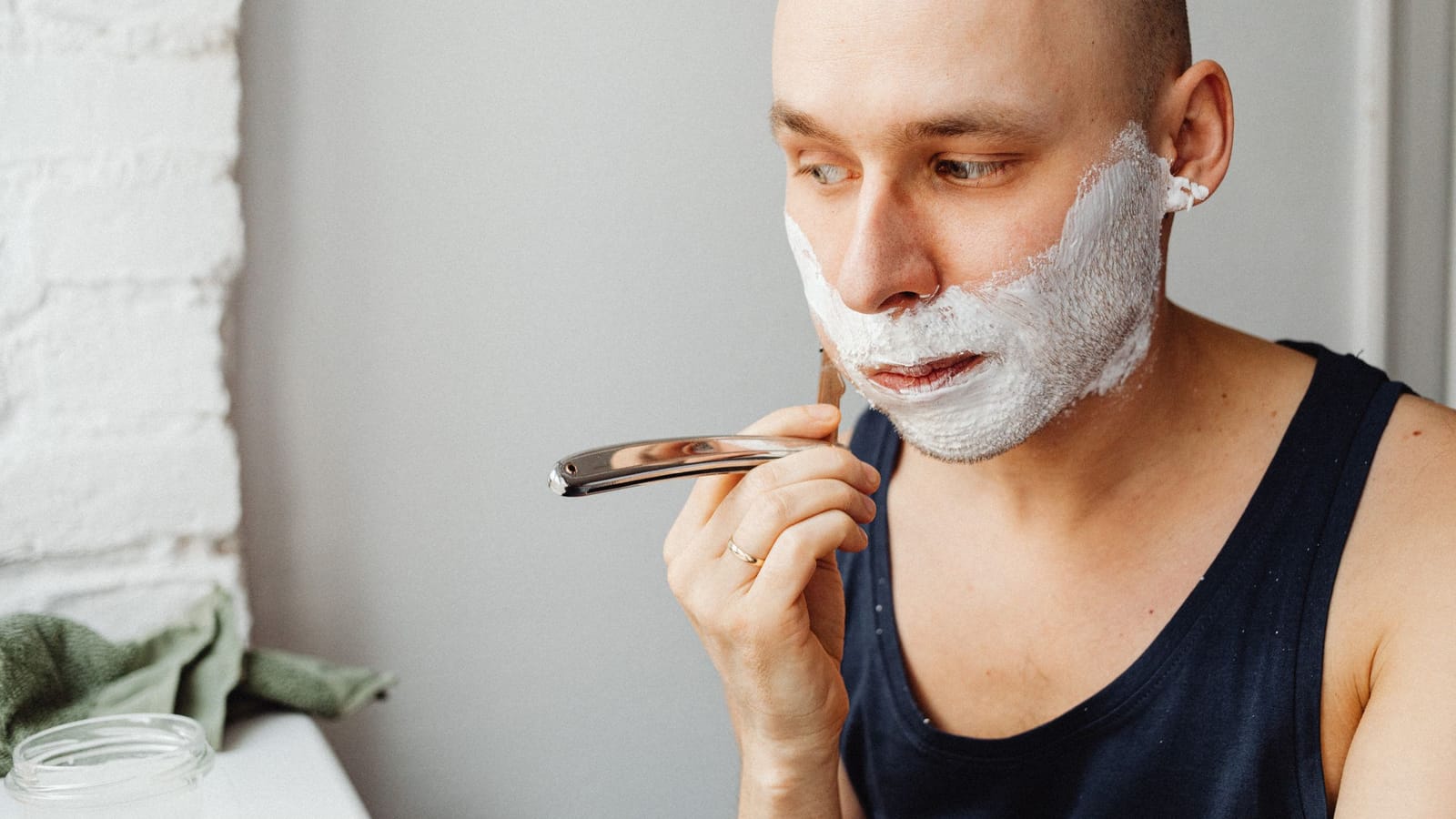
Don't shave over a whitehead. Not carefully, not "just this once," not with a fresh blade. A razor takes the top off it, that spot bleeds for ten minutes, and you walk into first period with a piece of toilet paper stuck to your jaw. Everyone's done it. You don't have to.
The good news is that shaving with acne isn't some special advanced skill. It's the normal skill, done slower and with less pressure. Most guys get wrecked on their first few shaves because they learned from a razor commercial, where a man with perfect skin drags a five-blade cartridge up his neck like he's frosting a cake.
Start with the right tool, not the coolest one
You've got three real options.
An electric foil shaver is the gentlest thing you can put on a breaking-out face. The blades never actually touch your skin, which means far less chance of slicing a bump open. The trade-off is honest: it won't shave as close, and you'll feel stubble by dinner. If your face is genuinely angry right now, this is what I'd hand you.
A cartridge razor with two or three blades gives a closer shave and more control than people give it credit for. Skip the five-blade models for now. More blades means more passes across the same patch of skin in one stroke, and that's exactly the thing your face doesn't need.
Disposables from a gas station are the worst option and also the one most guys start with. They drag. Dragging is how you get razor bumps.
Whatever you pick, replace the blade often. Roughly every five to seven shaves for a cartridge. A dull blade doesn't glide, it pulls, and pulling on inflamed skin is what leaves those little red welts along your jawline the next morning.
And don't share a razor. Not with your brother, not with your dad. That's how you move bacteria from one face to another.
Three minutes of warm water beats any product
Shave right after a shower. If you can't, run the tap warm and hold a wet washcloth against your face for about three minutes.
Warm, hydrated hair cuts like wet spaghetti. Dry hair cuts like wire. That's not a metaphor anybody made up to sell you something, it's just what happens, and it's the single biggest difference between a clean shave and a raw one.
Then use an actual shaving cream or gel. Look for "fragrance-free" or "for sensitive skin" on the label, and "non-comedogenic" if you can find it, which just means it's formulated not to clog pores. Skip anything that smells strongly of menthol or cologne. Soap works in an emergency but it strips your skin and leaves it squeaky, and squeaky is bad.
Never dry shave. I know it's fast. It's also the fastest route to a face full of red dots.
The technique is boring, which is why it works
Go with the grain. Your beard doesn't grow straight down everywhere. On most guys the neck grows sideways or up. Spend thirty seconds one morning running a finger across your face in different directions. The way that feels smooth is with the grain. Shave that way.
Short strokes. An inch or two, then rinse the blade under hot water. Long dramatic strokes pack hair and cream into the cartridge, and a clogged cartridge stops cutting and starts scraping.
Almost no pressure. Let the weight of the razor do it. If you're pressing hard enough to feel it, you're pressing too hard.
One pass. Resist the urge to go back over a spot you missed. If it's still rough, re-lather that patch and go again gently, or just accept it. Nobody is inspecting your chin with a magnifying glass. A second dry pass over the same skin is how you turn a shave into an injury.
Don't stretch your skin taut over a bump to get underneath it. That's the move that opens the bump.
Work around the trouble spots
If you've got active, raised, inflamed spots, shave around them. Leave a little island of stubble. It looks like nothing from two feet away, and it beats bleeding.
If you shave an area that's already broken open, you're dragging bacteria across the rest of your face. That's how one spot becomes four.
Rinse with cool water when you're done. Pat dry with a clean towel, not the one that's been on your bedroom floor since Tuesday. And keep your hands off your face for the rest of the day. Every time you rest your chin on your palm in math class, you're reapplying whatever was on that desk.
A calmer step after you rinse
Old-school aftershave is alcohol. It burns, and on skin you've just shaved with acne, the burn isn't proof it's working. It's proof it's drying you out.
GermProof is worth knowing about here, and I'll say plainly that it's a sister brand of BRO. It's all-natural and alcohol-free, so there's no sting, and it's odorless, non-drying and non-toxic. The whole formula is chelated silver at 200 ppm, distilled water, and vegan chitosan from mushrooms, not shellfish. It comes as a spray or a gel.
On clean skin, after you've washed and dried, it forms an invisible, breathable antimicrobial barrier that lasts for hours. It soothes irritated skin and supports faster healing, which is exactly the job description after a shave that went slightly wrong. The spray is easier over a whole jaw. The gel is better on one specific nick.
It's a step in a routine, not a cure for anything. Nothing in a bottle is.
When you nick yourself anyway
You will. Press a clean tissue on it and hold for a full sixty seconds without peeking. Peeking restarts the clock. Cold water helps.
Then leave the scab alone. Picking a shaving nick is how a two-day mark becomes a two-month mark.
The stuff that isn't shaving but decides how your shave goes
Wash your face twice a day with something gentle. Flip your pillowcase midweek and change it weekly. Wipe your phone screen, because it lives against your cheek. Get your sleep, drink water, and wear sunscreen if you're outside for practice, because freshly shaved skin sunburns faster than you'd think. Make it a mineral one with zinc oxide, like Neutrogena Sheer Zinc SPF 50 or CeraVe Hydrating Mineral Sunscreen SPF 30, since it's gentler on sensitive, just-shaved skin.
Most guys at fifteen don't need to shave every day. Every two or three days is plenty and your face will thank you for the rest.
When to stop experimenting and go see somebody
If your acne is painful, if the bumps are deep and hard under the skin, if it's leaving marks that stick around, or if you've been doing everything right for a couple of months with nothing to show for it, go see a doctor or a dermatologist. Tell your mom or dad you want an appointment. That's not a big dramatic conversation, it's a five-second one.
And if you're already on a prescription acne medication, ask that doctor before you shave at all. Some of them make skin fragile in ways no technique fixes.
Your face is going to be your face for a long time. Learn to do this slowly now and you'll never have to think about it again.
Ade Fisher
Young Men
Teaches the trades intake at a community college. Writes the manual he wishes his students arrived with.

Read next