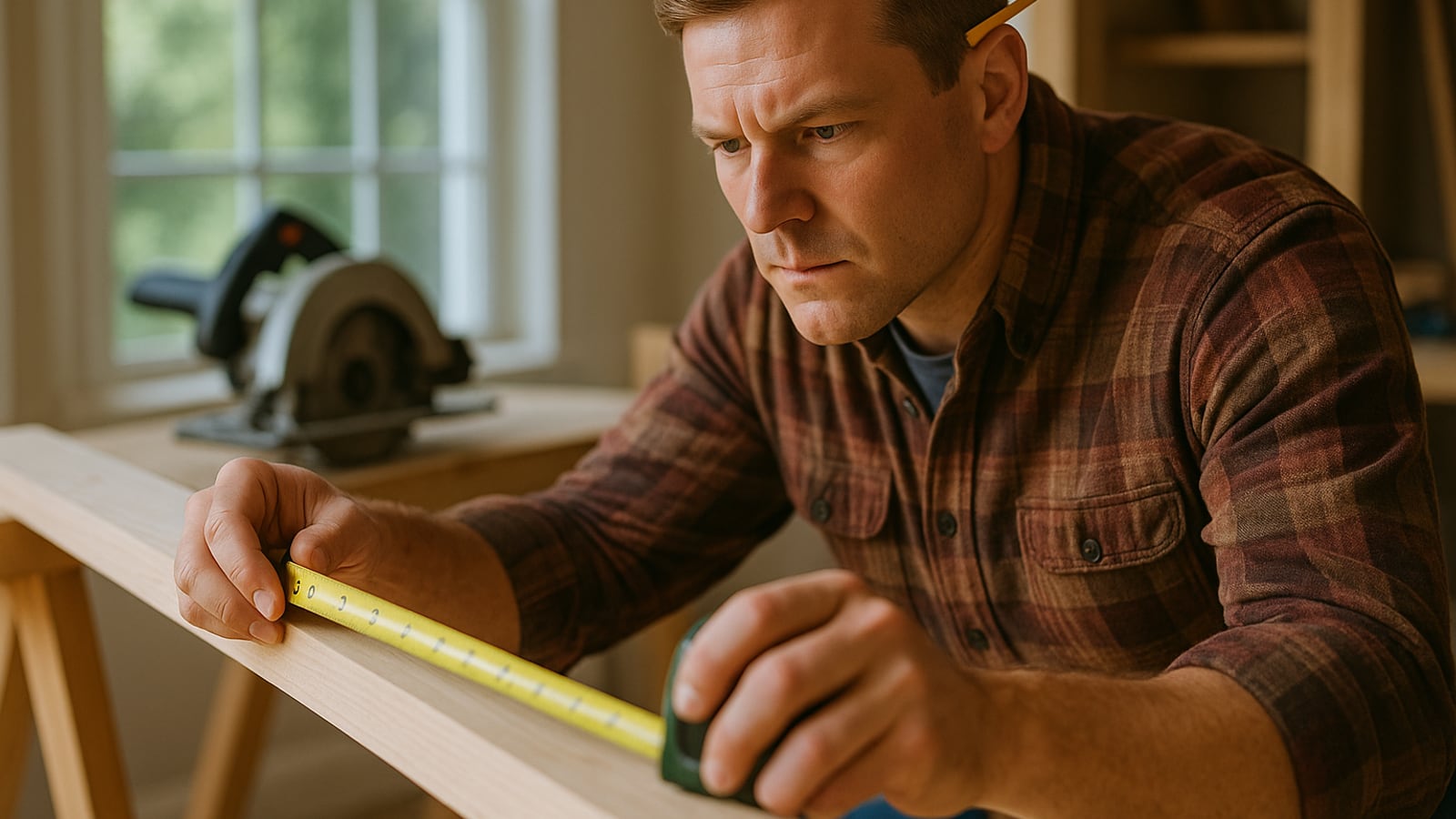
The metal hook on the end of your tape measure slides back and forth about 1/16 of an inch. That's the thickness of the hook itself, and it's deliberate. Hook it over the edge of a board and pull, and the hook slides out to true zero. Push the tape against a wall and the hook slides in by its own thickness, and you're still at true zero. Somebody engineered that. If you've ever tried to crimp the rivets tight to "fix" it, you've just made every measurement you take from now on wrong by a sixteenth.
Which sounds like nothing until you cut eight pieces of trim and they all come up short at the same end.
First, the blade will cut you
The edge of a steel tape is thin and it's under spring tension. Don't let a long pull snap back through your fingers. Walk it back in, or at least thumb the brake and feed it. The other one people learn the hard way: at full extension the hook can come off the end and the blade whips. Keep your face out of the line of it.
That's the whole safety brief for a tape. The level can't hurt you unless you drop it on your foot.
Counting sixteenths without thinking about it
On a standard imperial tape, the longest line between the inch marks is the half. The next longest are the quarters. Then the eighths. The shortest lines are the sixteenths. Some tapes run 32nds across the first inch or two, which is useful for scribing and useless for framing.
Stop reading them as fractions and start counting them as sixteenths. The mark two lines past the 3/4 line isn't "three-quarters plus a bit." It's 14/16, so 7/8. Once you count in sixteenths and reduce afterward, you stop hesitating.
Say your numbers out loud when you're working with someone. "Thirty-two and three-eighths." Not "thirty-two and a bit over a quarter." Bits over quarters end up in the offcut pile.
If you're on a metric tape, life is easier. Read the millimetre, say the millimetre. 1,247. Done. Just never mix the two systems on the same job, and never mix two different tapes either. Cheap tapes disagree with each other over ten feet, and you won't notice until the last piece doesn't fit.
When the hook is bent, burn an inch
Drop a tape on concrete a few times and the hook goes out of true. You can usually feel it: the sliding action is stiff, or the hook sits crooked.
Rather than trust it, burn an inch. Line the 1-inch mark up with your starting edge, take the reading, subtract one. Say the number out loud before you subtract and after, because the single most common mistake in carpentry is forgetting to take the inch off.
For inside measurements, like a shelf going between two cabinets, don't bend the blade into the corner and guess. Push the case into one side, read where the blade crosses the other, then add the length of the case. Most cases have their own length printed on the back for exactly this reason.
The red numbers and the black diamonds
Every 16 inches, the number on your tape is in a red box or a red square. That's stud and joist spacing on center in North American framing, so you can mark a whole wall plate without doing arithmetic. In the UK you'll be working to 400mm and 600mm instead, and some tapes mark those too.
The black diamonds appear every 19.2 inches. That's five evenly spaced joists under an 8-foot sheet of plywood instead of six. If you've never used them, you've never needed them, and that's fine.
Mark with a V, not a line
A pencil line is maybe a thirty-second wide and it doesn't tell you where the measurement actually was. A V does. Put the point of the V exactly on the mark, opening away from the tape, and there's no ambiguity when you come back to it two minutes later.
Then mark the waste side with an X. Always. Every carpenter has cut the wrong side of the line, and the ones who claim they haven't are the ones who did it this morning.
Now the part that catches people out: your saw blade removes material. A circular saw kerf is roughly an eighth of an inch. That material has to come out of the waste side, so the blade runs beside the line, not on it. Cut through the middle of your V and the piece is an eighth short. Line up the edge of the blade's teeth with the edge of the line and leave the pencil mark on the piece you're keeping.
Better yet, don't measure
The single biggest jump in accuracy is refusing to use a number at all.
If you're cutting a shelf to fit an alcove, hold the board up against the space and mark it in place. If you're fitting a run of skirting, hold it in the corner and mark where it lands. No reading, no writing the number on your hand, no misremembering 41 3/8 as 41 5/8 on the walk back to the saw.
For repeated cuts, make a story stick. A strip of scrap with the positions marked on it. Every piece then comes off the same reference instead of accumulating error one measurement at a time.
Check your level before you trust it
Levels go out. They get dropped, they get left in a hot truck, the vial housing shifts.
Test it in ten seconds. Set the level on a flat surface and note exactly where the bubble sits between the lines. Now spin it end for end, 180 degrees, same spot. The bubble should read identically. If it's shifted, the level is wrong by half the difference, and you throw it out or you accept that everything you build is out by the same amount in the same direction.
Do the same for the plumb vial against a door jamb: read it, then flip the level face-for-face and read again.
I'd rather have a cheap level I've checked than an expensive one I haven't.
Reading the bubble properly
The bubble rises toward the high end. If it's drifting right, the right side is high, and that's the side you shim down or the end you drop. People get this backwards constantly and chase the error around the room.
Get your eye square to the vial. Looking at it from an angle bends the reading.
And use the longest level that fits the job. A 9-inch torpedo on an 8-foot wall isn't measuring the wall, it's measuring the lump of drywall compound it happens to be sitting on. A 4-foot level is the workhorse. For a run longer than your level, set the level on top of a straight length of timber and read that instead.
When you're plumbing a door jamb, you have to do it in two planes. Plumb across the face, then plumb across the thickness. A jamb that's plumb one way and leaning the other will look fine and swing shut on its own.
Sometimes level is the wrong answer
Old houses aren't level and never were. A shelf that's dead level in a room with a sagging ceiling looks broken, because your eye reads it against the ceiling line, not against gravity.
So: anything that holds water, anything a ball could roll off, anything with a door in it, and every cabinet you ever hang gets built true. Level, plumb, no argument. Decorative trim in a crooked room often wants splitting the difference. Set it halfway between true and the line of the ceiling and nobody notices either error.
That judgment is the part you can't buy in a tool.
A door that drifts closed on its own is out of plumb, and you knew that before you picked anything up. The tools are only there to tell you by how much.
Wes Dunbar
Country & Skills
Grew up on an acreage and never quite left. Covers trucks, trades, land, and how to do the thing yourself.

Watch
Worth an hour of your evening
More from Skills.
From channels we rate. Plays on YouTube.
Read next