
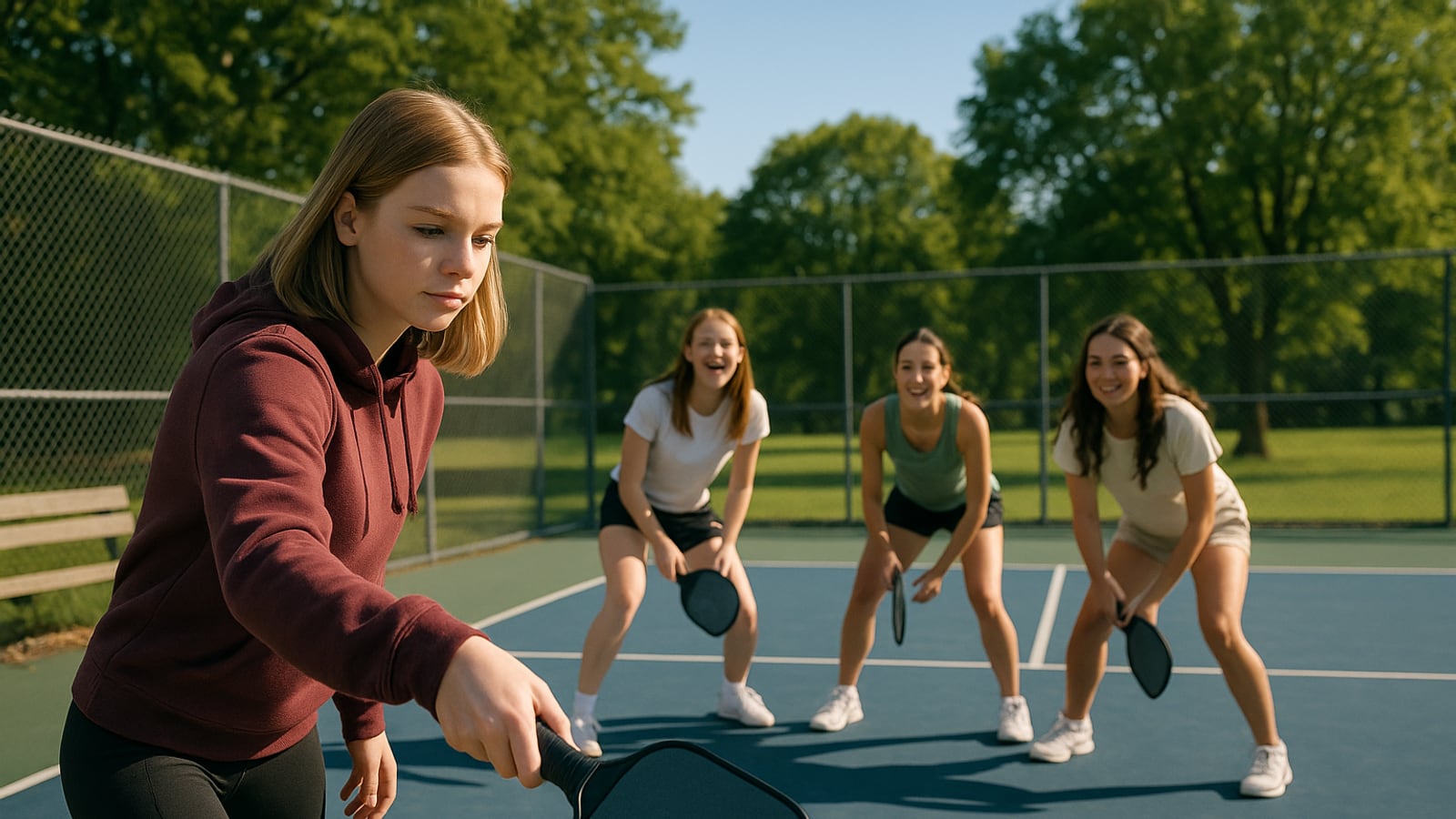
Quick answer: Split a cheap starter set, find a free public court, and pick one weekday that belongs to your group. Learn two rules before you start, the underhand serve and the kitchen, and figure out the rest as you play.
It's 3:45 on a Tuesday. The retirees who had the park courts all morning are packing up, and four of you are walking over with one borrowed paddle set and a bag of pretzels. Nobody here plays on a team. One of you has never hit a ball on purpose in her life. By five o'clock you're all yelling scores and arguing about whether a shot touched the line.
That's pickleball at its best. The sport isn't the point. The standing plan is.
Why it works for friends who aren't athletes
Most sports sort people fast. Volleyball has the girl who can spike. Tennis has the one who took lessons for six years. Everyone else chases balls.
Pickleball is built in a way that shrinks that gap. The court is small, 20 by 44 feet, so nobody sprints very far. The serve is underhand, so you can't blast it past anyone. There's a zone next to the net called the kitchen where you aren't allowed to smash the ball out of the air. That one rule takes away the power game and rewards patience instead.
So the friend who's naturally quick doesn't automatically win. The friend who stays calm and just keeps the ball in play often does. And a beginner can have a real rally in her first twenty minutes, which almost never happens in tennis.
If you're the one who usually hangs back because everyone else seems better at things, this is your sport. And if you catch yourself sizing up who's "the athletic one," read Comparison isn't jealousy, and that's why it's hard to stop. It'll make the game a lot more fun.
What you actually need, and what to skip
Less than you think.
Buy or borrow:
- Paddles. A basic two- or four-paddle starter set is enough. Wood paddles are the cheapest and they work, but they're heavy and your arm will feel it after an hour. A composite or polymer paddle is lighter and easier to control. If four of you chip in, it costs each person very little.
- Outdoor balls. Get balls marked for outdoor play. They're harder and have smaller holes, so the wind doesn't push them around as much. The Franklin X-40 and the Onix Dura Fast 40 are two common ones. Buy extras. Outdoor balls crack, especially when it's cold.
- Sneakers you can move sideways in. Court shoes are ideal, but the running shoes you already have will do at first. Just not sandals or boots.
- Water. More than you think you'll drink.
Skip for now:
- The expensive carbon-fiber paddles you see advanced players using. You won't notice the difference yet, and you might decide in three weeks that you'd rather do something else.
- Indoor balls for outdoor courts. They're lighter and float off in any breeze.
- Special pickleball outfits. Wear what you'd wear to walk the dog.
The rules in about ninety seconds
You can learn the rest mid-game. These are the ones that trip people up:
- Serve underhand, diagonally. Hit the ball below your waist. It has to land in the service box across from you, past the kitchen line.
- The two-bounce rule. The serve has to bounce before the other team hits it. Then their return has to bounce before your team hits it. After those two bounces, anyone can hit it out of the air.
- Stay out of the kitchen when you volley. The kitchen is the 7-foot zone on each side of the net. You can step in there to hit a ball that has bounced. You just can't hit it out of the air while you're standing in it, and that includes your momentum carrying you in after the shot.
- Only the serving team scores. Games go to 11, and you have to win by 2.
- Doubles scoring uses three numbers. Your score, their score, then which of the two servers you are. The first serve of the game is called "0-0-2." Everyone finds this confusing at first. Everyone gets it by the third game.
You'll forget whose turn it is to serve. You'll argue about the kitchen line. That's part of it, so laugh and replay the point.
Finding a court, and sharing it well
Look up your city or county parks and rec page. Plenty of parks have dedicated pickleball courts now, and a lot of tennis courts have pickleball lines painted on them. Several pickleball courts fit in the space of one tennis court. Most public courts are free and first come, first served.
Some courts have a paddle rack or a line on the fence. When courts are full, you set your paddles there to hold your spot for the next game. Learn the system before you walk onto a court where people are already playing.
A few habits will make the regulars glad to see you:
- Wait for a point to end before you walk behind a court.
- If your ball rolls onto someone else's court, call "ball!" and wait. Don't chase it through their game.
- Rotate off when others are waiting. Winning doesn't give you the court forever.
- Leave it better than you found it. Pick up your water bottles and wrappers, and grab the one somebody else left too. Bring a spare ball to lend to the group who just cracked theirs.
A lot of the people at the courts will be older adults. Many of them love seeing teenagers take up the game and will happily show you how to hit a better return. Be friendly and say thank you. Stay with your group while you're there.
Make it a standing thing
This is where most friend groups fall apart. Someone says "we should play again sometime," and it never happens. "Sometime" doesn't exist.
Pick a day. "Pickleball Tuesdays," or whatever fits around practices and jobs. Put it in the group chat once and then just keep showing up. If one person can't make it, play Canadian doubles (two against one) or just rally. Don't cancel.
It helps to decide ahead of time how phones work. Try this: they go in a bag on the bench, and you only check them between games. An hour of your friends' actual faces beats an hour of watching them scroll. If that's harder than it sounds, How to get your hours back without deleting a single app is worth a read.
Keep it kind. No mocking the friend who whiffs every serve. Swap partners every game so the same two people aren't always stuck together. The goal is that everyone wants to come back next week.
The sun, the dark, and getting home
Outdoor courts after school mean real sun, even in fall.
Wear sunscreen. Any broad-spectrum SPF 30 or higher that you'll actually put on every time beats a perfect one left at home. If you're choosing, go mineral: zinc oxide or titanium dioxide. They sit on top of your skin, they're broad-spectrum, and they're the only two filters the FDA has proposed as "generally recognized as safe and effective." They're also gentler if your skin gets irritated easily. The catch is that some leave a white cast, which a tinted formula fixes. Blue Lizard Sensitive Mineral SPF 30, CeraVe Hydrating Mineral Sunscreen SPF 30 and Neutrogena Sheer Zinc SPF 50 are all easy to find. Reapply every two hours, and again after a long, sweaty game. A cap helps too.
Then the practical stuff:
- Tell a parent where you're going and who's coming. Text when you get there and when you leave.
- Go as a group and leave as a group. Nobody walks back alone.
- Watch the light. If the courts don't have lights, finish before dusk. It gets dark earlier every week in the fall.
- If an adult at the courts makes any of you uncomfortable, pack up and leave together, and tell a parent that day. You won't be in trouble. You did exactly the right thing.
One more thing. Somewhere around week six, you'll notice the girl who barely talked at lunch is now trash-talking your serve. You'll have jokes nobody outside the four of you understands, and there'll be a Tuesday you'd rearrange a lot of things to protect.
The paddles cost almost nothing. That part costs even less, and it's worth the most.
Nina Castellan
BRO for Her
Runs the women-facing desk. Same standard, same tools, written for a different reader — not a softer one.

Read next