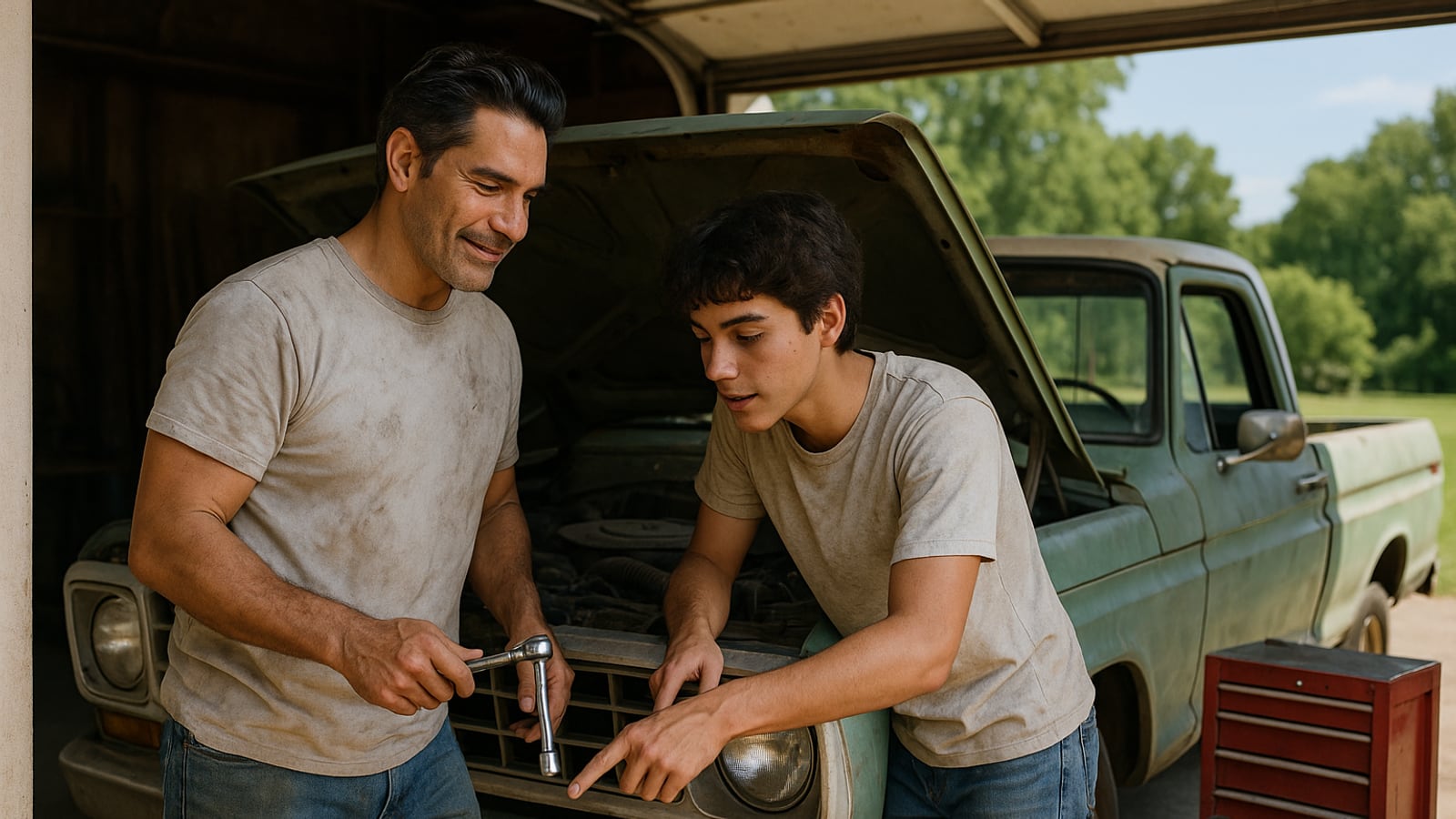
Buy the car he wants, not the car you wanted at seventeen. That single decision determines whether this ends with him driving to his job in something he built, or with a tarp over a shell that you quietly sell in four years.
Then buy one that runs. A rolling, driving, ugly car beats a "complete, needs assembly" project every time, even at twice the price. Driving it home, however slowly, gives you a baseline. You know the brakes stop it. You know the third gear synchro is shot. You can't know any of that about a car that arrived on a trailer in boxes.
The shortlist that actually works
Parts availability matters more than cool. A 1990 to 1997 Mazda Miata, a Fox-body Mustang, a square-body Chevy pickup, a mid-seventies F-100, an air-cooled Beetle, a Jeep Cherokee XJ. Every one of those has a catalog behind it, a forum with a fifteen-year archive, and enough of them still on the road that a junkyard is a real option.
Compare that to a Renault Fuego or an early Isuzu. You'll spend more nights hunting a window regulator than turning wrenches, and a fourteen-year-old doesn't have the patience for a six-week wait on a part from Belgium.
Simple systems help too. Carburetor or early fuel injection. Manual windows. A distributor you can time with a light. Every electronic module you delete from the equation is an evening you spend teaching instead of diagnosing.
Rust is the only thing that ends projects
Everything else is time and money. Rust is a decision about whether you own a welder and a respirator.
Get under the car before you buy it. Bring a small screwdriver and a magnet. Push, don't stab, at the floor pans, the rocker panels, the bottom six inches of the fenders, the frame rails ahead of the rear axle, and the spring perches. On a truck, look at the cab mounts and the bed supports. On a unibody, the strut towers and the seat belt anchor points.
Surface rust is paint work. Perforation you can push a screwdriver through is fabrication, and fabrication on a structural point isn't a father-and-son Saturday. That's a shop with a lift and a certified welder.
Pay somebody two hundred dollars for a pre-purchase inspection if you're not sure. It's the cheapest money in this entire project.
Sequence the work so he sees the car change
Kids need visible progress. Adults can grind for eight weekends on a wiring harness and feel satisfied. A fifteen-year-old can't, and telling him he should is a good way to make him hate the garage.
Do it in this order:
- Safety first. Brakes, tires, lights, seat belts, fuel lines, steering components. Nothing else matters if it won't stop.
- Make it reliable. Fluids, filters, belts, hoses, plugs, wires, battery and cables. Fix the leaks.
- Make it nice to sit in. Clean the interior properly. New carpet, a seat cover, a working radio, a steering wheel that isn't sticky. This is the step that makes him proud to be seen in it.
- Make it look right. Wheels, trim, a real detail, paint if the budget allows. Paint last, always.
Brakes first is also the best teaching job on the car. Every principle is there: torque specs, thread pitch, hydraulic pressure, the reason you don't reuse a cotter pin, the reason you bleed in the right order. And when he steps on the pedal and it's firm, he did that.
Let him do it wrong
He'll round off a bolt head. He'll cross-thread a drain plug into an aluminum pan. He'll put a wheel back on and forget to torque it, which is why you check every wheel he touches, every single time, and why you tell him that's what you're doing and why.
The temptation is to take the wrench out of his hand at the first hesitation. Don't. Stand there with your hands in your pockets and let him work it out. The extra twenty minutes is the entire point of the exercise. You're not building a car on a deadline.
There are three jobs I'd keep for yourself until he's proven: anything holding the car in the air, anything carrying fuel under pressure, and anything involving a compressed coil spring. Spring compressors put men in hospitals. Show him, explain the stored energy, do it yourself this year.
Buy jack stands rated well above the car's weight, and use four of them. He will see you refuse to go under a car on a jack alone, and he'll remember that longer than he remembers the torque spec on a lug nut.
The tools, and what they'll actually cost
Start with a 3/8-inch drive socket set in both metric and SAE, a decent 1/2-inch breaker bar, a click-type torque wrench, a full set of combination wrenches, a floor jack, four jack stands, and good eye protection for both of you. Call it four hundred dollars if you shop carefully at a place like Harbor Freight, more if you want Tekton or Gearwrench, which I'd recommend for the wrenches at least.
Add as you hit walls. A ball joint press you'll need twice in a decade is a rental, not a purchase. An impact wrench earns its keep in a weekend if the car came from a salt state.
And buy the factory service manual for the car, paper if you can find it. Video is fine for seeing a procedure, but the manual has the torque values and the sequence, and it doesn't skip the step where the guy filming already had the subframe off.
Month five is where it dies
Every project has a stall point. The interesting work is done, the tedious work is left, and the weather turns. The car sits for three weeks, then five, and then it's just a thing in the garage that makes you feel guilty.
Plan for it. Schedule one two-hour session a week and protect it like a dentist appointment, even when the only task is cleaning brackets. Momentum is worth more than efficiency here.
Here's the concession, and it's a real one. Some boys don't want this. If your son is a cross-country kid with a sketchbook and no interest in a distributor cap, forcing a two-year restoration on him will cost you Saturdays you don't get back and teach him that time with Dad comes with conditions. Buy a running Corolla, teach him oil changes and brake pads in one afternoon each, and go do the thing he actually loves.
The work is the excuse. What you're really doing is sitting on an upturned bucket beside him for a hundred hours while he talks, which he will, eventually, because there's a bolt between you and neither of you has to make eye contact.
What you're really handing over
Put the title in his name when it's done, if you can. Registration, insurance, the whole thing. He should feel the weight of owning something.
Then stand in the driveway and watch him back it out on his own for the first time. He'll check the mirror the way you taught him, and you'll notice it, and he won't know you noticed.
Dean Shaw
Gear & Garage
Tests things until they break, then reports what broke first. Trucks, tools, watches, and the cheap version that costs more.

Watch
Worth an hour of your evening
More from Autos.
From channels we rate. Plays on YouTube.
Read next