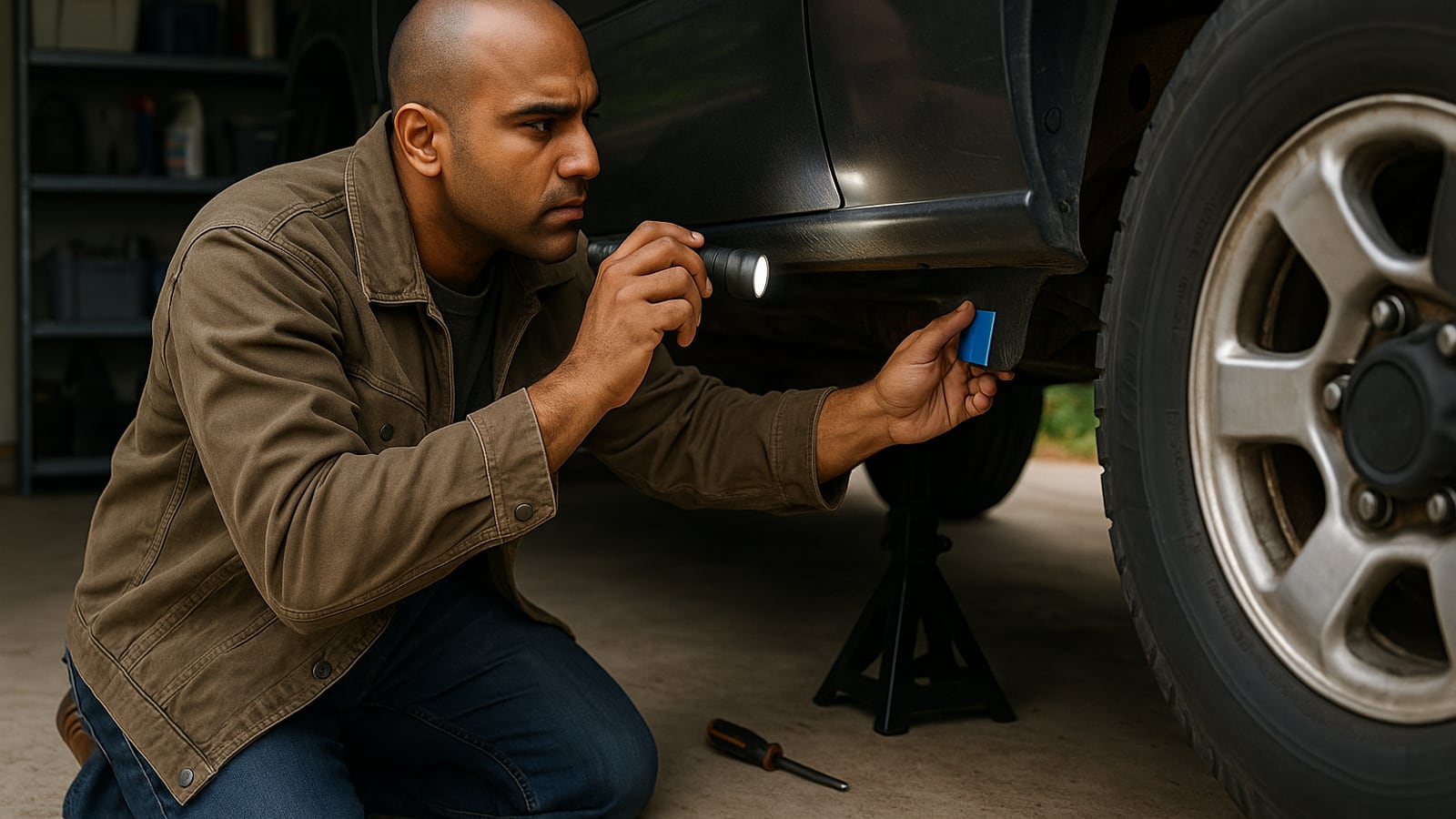
Buy a cheap refrigerator magnet and wrap it in a strip of masking tape so it can't scratch paint. That's your first rust tool, and it costs about a dollar. Run it along the bottom six inches of both rear fenders, the rocker panels and the lower doors. Where it stops sticking, somebody has already been here with filler, and filler over rust is a countdown clock, not a repair.
Your second tool is a flashlight bright enough to hurt. Your third is a small screwdriver you don't love.
That's the whole kit, and twenty minutes with it separates a car you can own for eight more years from one that's going to fail an inspection in the spring.
Three grades, and only one of them is fatal
Not all rust is the same thing, and treating it that way is how people walk away from good trucks and buy bad ones.
Surface rust is orange dust on bare metal. It's on every exhaust hanger and every brake rotor in America. On a frame rail, on a control arm, on a floor pan under the carpet, it's cosmetic until proven otherwise. You can stop it in an afternoon.
Scale is the next stage. The metal has swollen and started flaking off in layers like old paint. Pick at it and chunks come away. There's still steel under there, but there's less of it than there was, and scale means moisture has been sitting in that spot for years. Scale on a fender is annoying. Scale on a leaf spring shackle is a conversation.
Perforation is a hole. Sometimes you can see it. More often it's hiding under an inch of undercoating that's been hanging there like a scab, holding in the salt water that made the hole in the first place.
The question is never "does it have rust." Every car in the salt belt has rust. The question is what's rusting and how much of the original metal is gone.
Where to point the light, in order
Go in this sequence and you won't waste time.
- Rocker panels, especially at the drain holes and where the rocker meets the rear wheel arch. Poke up into the drain slots. If the screwdriver goes in and finds nothing to stop it, that rocker is a shell.
- Frame rails on a body-on-frame truck, particularly the section above the rear axle and anywhere a crossmember is welded in. Two pieces of steel sandwiched together trap salt between them forever. Toyota famously ended up replacing frames on a generation of Tacomas because of exactly this geometry.
- Cab and body mounts. The bushing pockets rot from the inside. A cab mount that's gone means the body isn't really attached to the frame at that corner.
- Rear subframe and strut tower mounts on a unibody car. This is where a crossover kills you. The bolt still looks fine; the metal it's bolted through doesn't.
- Brake and fuel lines. Run a gloved finger along the hard lines where they hug the floor and cross the rear axle. If flakes come off in your hand, you're looking at a brake failure with a date on it. This one puts your family in the car and it doesn't announce itself.
- Floor pans, under the carpet if you can lift a corner, and always under the spare tire. Water gets past a bad tail light gasket and sits in the spare well for six winters.
- Trailing arms, leaf spring perches, sway bar mounts. Anything that's both suspension and sheet metal.
Tap, don't stab. A light rap with the screwdriver handle on solid steel sounds like a bell. On rot it sounds like a wet cardboard box. You'll know the difference the first time you hear both in the same minute.
What you can actually stop
Surface rust and light scale on non-structural metal are fixable in a garage with a wire wheel and a Saturday.
Get the loose material off first. A twisted-knot wire cup on an angle grinder takes it down to gray steel fast and will also take skin, so wear a face shield and long sleeves. For tight spots, 80-grit on a sanding disc or a needle scaler works.
Then pick one of two paths. If you got to clean bright metal, prime it the same day. Bare steel starts flash rusting in hours in humid air. If you can't get every pit clean, and inside a frame rail you can't, use a phosphoric acid rust converter. It turns iron oxide into a stable black coating you can paint over. Ospho is the old-school one; there are a dozen equivalents on the shelf at any farm store.
For frames and suspension parts, a moisture-cured urethane like POR-15 is the strongest thing a home mechanic can reasonably apply. It's fussy: it needs the prep kit, it sticks to your hands for a week, and it chalks in sunlight unless you topcoat it. Follow the instructions exactly or it peels in sheets, and peeling coating is worse than no coating because now the water is trapped underneath.
The annoying part nobody mentions: the inside of the frame rail matters more than the outside. Buy an internal frame wand, the flexible hose with a 360-degree nozzle, feed it into the factory drain holes and pump wax or oil in until it runs back out. That's where the rot starts on a truck, and no amount of pretty black paint on the outside touches it.
The annual hour that buys you a decade
Every fall, before the first salt truck runs, spray the underbody with a lanolin-based product. Fluid Film and Woolwax are the two everybody argues about; both work, both smell like a sheep barn, and an aerosol can runs you about the cost of lunch. A pump sprayer and a gallon does a full truck with some left over.
It creeps into seams. It doesn't harden, which means it can't crack and trap water the way old rubberized undercoating does. It also makes a mess of your driveway, so lay cardboard.
Then in March, when the roads are clean, take the car to a self-serve bay and spend four dollars aiming the wand up into the wheel wells and along the rockers. Salt sits in there all winter. Wash it out.
And clear your drain holes. Every door, every rocker, every sunroof has them, and they plug with leaf debris and dirt. A zip tie or a piece of weed trimmer line takes ten seconds per hole. Cars don't rust from the rain that falls on them. They rust from the water that can't get out.
When to close the hood and go home
Walk away when the rust is structural and hidden. Specifically:
Frame rail perforation, cab mount rot, strut tower or subframe mount rot, rocker rot on a unibody car where the rocker is the structure. These aren't cosmetic, they change how the vehicle behaves in a crash, and a shop can charge you four figures per corner to cut and weld in new steel properly. At a hundred and change per hour, the math turns ugly fast on a vehicle worth six grand.
Walk away when somebody already "fixed" it with fiberglass, pop rivets, expanding foam or a spray bomb of black undercoating over flaking scale. That's not a repair, that's a disguise, and whoever applied it knew what they were hiding.
Walk away when there's fresh, even undercoating on a car being sold this week.
Stay when the rust is on brackets, exhaust, bolt heads, the outside of a solid frame and the bottom of a door skin. That car is just old. Old is fine. Old and honest is how you get a truck to 250,000 miles without a payment book.
The one call worth making before you buy anything with visible structural rot: take it to a shop that does state inspections and pay them for an hour on the lift. Sixty bucks to find out you were about to buy somebody else's fifteen-year-old mistake is the best money in this entire process.
Bring the magnet anyway. It's already in the glovebox.
Dean Shaw
Gear & Garage
Tests things until they break, then reports what broke first. Trucks, tools, watches, and the cheap version that costs more.

Watch
Worth an hour of your evening
More from Autos.
From channels we rate. Plays on YouTube.
Read next