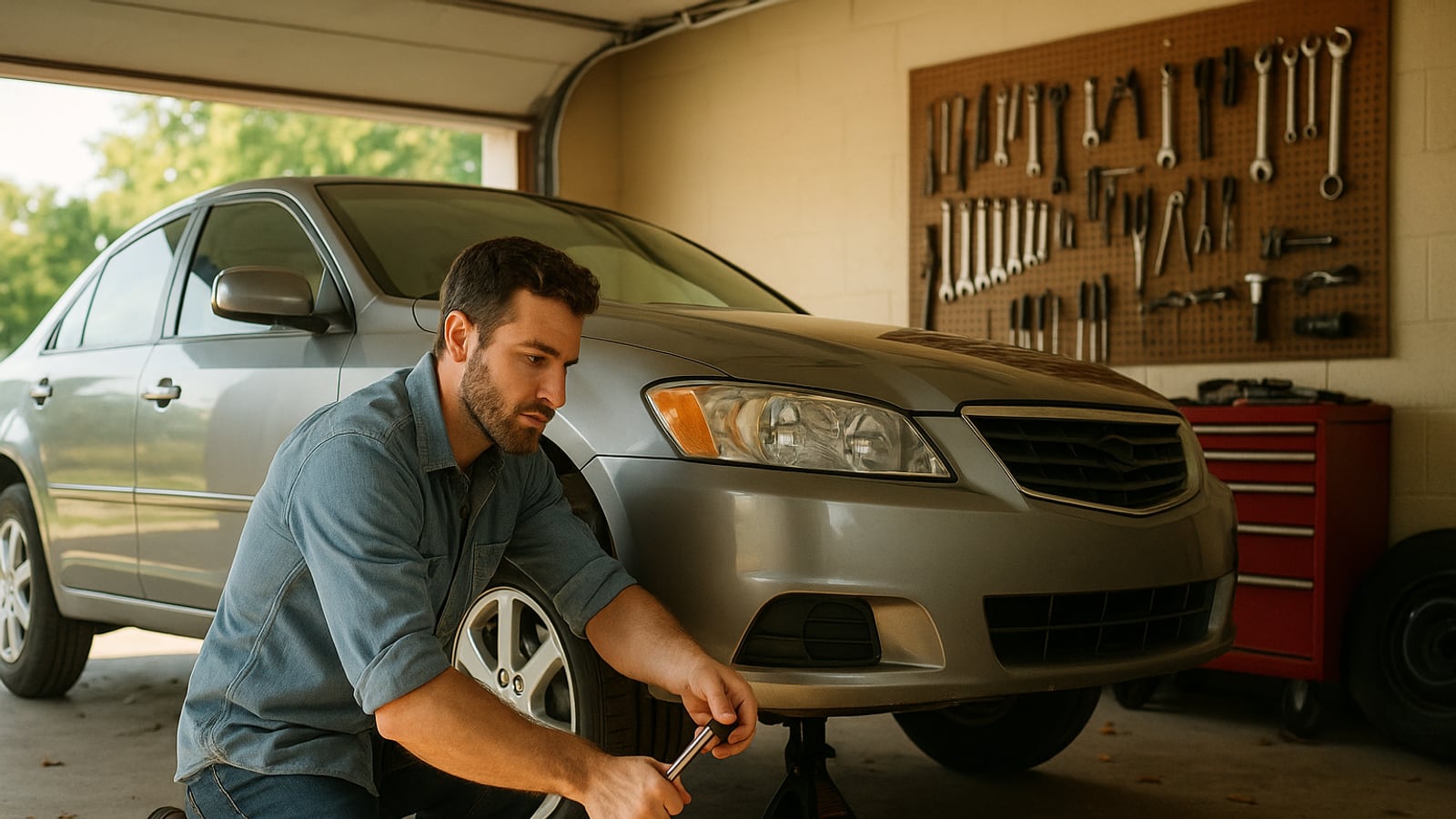
A weekend isn't 48 hours. It's about fourteen usable ones, and that's if nobody has a game Saturday morning and the parts store has what you need on the shelf. Plan against fourteen and you finish things. Plan against 48 and you end up with a hood in the dining room and a wife who has stopped asking.
That's the whole discipline of garage work. Scope, not ambition.
So before you buy the $2,800 Craigslist car with "just needs a carb," pick the tier you're actually in.
Three tiers, and be honest about which one you're in
Tier one: the car in your driveway. You own it, it runs, you drive it to work. Projects here are maintenance and small upgrades. Nothing gets disassembled that can't be reassembled by Sunday at 4 p.m. This is where every person who's good at this started, including the guys who now weld their own floor pans.
Tier two: the rebuild. A second car, running or close to it, that you improve one system at a time. Suspension one month. Brakes the next. Interior when it's too cold to be under the car. The key word is running. A running project gets driven, and a car that gets driven gets finished.
Tier three: the restomod. Classic body, modern drivetrain, modern brakes, air conditioning that actually blows cold. This is the dream, and it's a real one. It's also a two-to-four-year project for a working man with a family, and the budget multiplier is brutal. Whatever number you wrote down, the real one has another zero's worth of small parts hiding in it. Fuel lines. A driveshaft you didn't plan on. Wiring.
Start at tier one. Earn tier two. Don't buy tier three until you've finished something.
Pick a car with a parts catalog
The single biggest predictor of whether a project gets finished is whether you can order the part on a Tuesday night and have it Thursday.
Cars that pass that test: NA and NB Miatas, Fox-body and SN95 Mustangs, 1988–1998 GM pickups, Jeep XJ Cherokees, first-gen and second-gen 4Runners, Square-body Chevys, C3 Corvettes. Rock Auto, LMC, Summit and a dozen specialty vendors will sell you nearly every piece of those cars, and the forums have already documented every mistake you're about to make.
Cars that fail it: anything with a three-year production run, anything European and obscure, anything where the answer on the forum is "I had one machined."
The other rule people skip. Buy the best example you can afford, not the cheapest one you can find. A $9,000 running Miata with a clean floor is cheaper than a $3,500 one with rust in the rails. Rust is the one problem that eats weekends by the dozen and gives you nothing to show for it.
The projects that actually fit a weekend
These are the ones you can start Saturday morning and drive Sunday evening. Order parts the week before. All of them.
- Full brake refresh. Pads, rotors, rubber lines, fresh fluid. A car that stops well feels transformed, and the safety gain is real.
- Suspension refresh. Shocks, struts, bushings, end links. Bring a big breaker bar and a can of PB Blaster you've been spraying on the bolts every night since Wednesday.
- Headlight and lighting overhaul. New sealed beams or restored housings, upgraded harness, LED interior bulbs. Cheap, visible, done in an afternoon.
- Interior deep rebuild. Carpet kit, seat covers or reupholstered foam, new shift boot, sound deadening under the carpet. Sound deadening is the sleeper. It makes an old car feel worth three times what you paid.
- Fluids and filters, all of them. Engine, trans, diff, coolant, brake fluid, fuel filter. Boring. It's also why some trucks run forever and some don't.
- Wheels and tires. Hardest part is deciding. Take your time on offset.
- Radio and speakers. Modern head unit in an old dash, with a wiring harness adapter so you cut nothing. Two hours if the dash cooperates.
- Exhaust from the cat back. A bolt-on kit with clamps, not welds. Do it on ramps with the car cool.
None of those require a lift, a welder, or a second person who knows what he's doing.
What actually kills projects
Disassembly without documentation. You pull a dash on a Saturday, everything goes in a pile, and three weeks later you're staring at eleven bolts of four different lengths and no idea which is which.
Fix it the way the pros do. Sandwich bags and a Sharpie. One bag per subassembly, labeled where it came from. Photograph everything before you touch it and again halfway through, and shoot the connector orientation, not just the general area. Your phone is the best tool in the garage and it costs nothing to use.
The second killer is having one bay and one car. If your only vehicle is on stands and the part's backordered, you've got a family problem, not a car problem. Never start a job on Sunday afternoon that you need to finish by Monday at 6 a.m.
The third is chasing a system you don't understand. Fuel injection wiring on a 1970s car isn't a first project. Learn on brakes, suspension, cooling, interior. Those systems teach you without punishing you.
Tools worth owning before the first bolt turns
A 3-ton floor jack and four jack stands. Four, not two, because eventually you want the whole car up. The jack lifts it. The stands hold it. There's no version of this where you go under a car on a jack alone. Chock the wheels that are still on the ground.
A 1/2-inch breaker bar, two feet or longer. A click-type torque wrench in the 20–150 ft-lb range, because "tight" isn't a specification and wheel studs don't forgive. A decent socket set in both metric and SAE if you own anything American and older. Penetrating oil, and the patience to apply it days early.
A cheap Bluetooth code reader for the OBD-II port. Under thirty bucks, pairs with your phone, saves you a parts-cannon purchase every time.
And a fire extinguisher rated for fuel and electrical, mounted on the wall where you can reach it with your eyes closed. You'll never need it until the one time you do.
Bring the kid out there
Hand a nine-year-old the parts washer brush and the bag of bolts and let him be the guy who keeps the fasteners straight. Give a teenager the torque wrench and the spec sheet and make him call out the numbers. It's the rare activity where a kid can contribute something real, be corrected without it stinging, and see the finished thing move under its own power.
They'll remember the Saturday the truck started more than most vacations you'll pay for.
The restomod question, answered honestly
If you're set on it, build in this order: rust, brakes, suspension, steering, cooling, then power. Everybody wants to go the other way. Everybody who goes the other way ends up with a 500-horsepower car that won't stop and tries to kill them in the first rainstorm.
And drive it between stages. A restomod that sits on stands for three years covered in a tarp isn't a project. It's storage.
Get it running rough and drive it to get donuts. Then make it better.
Dean Shaw
Gear & Garage
Tests things until they break, then reports what broke first. Trucks, tools, watches, and the cheap version that costs more.

Watch
Worth an hour of your evening
More from Autos.
From channels we rate. Plays on YouTube.
Read next