
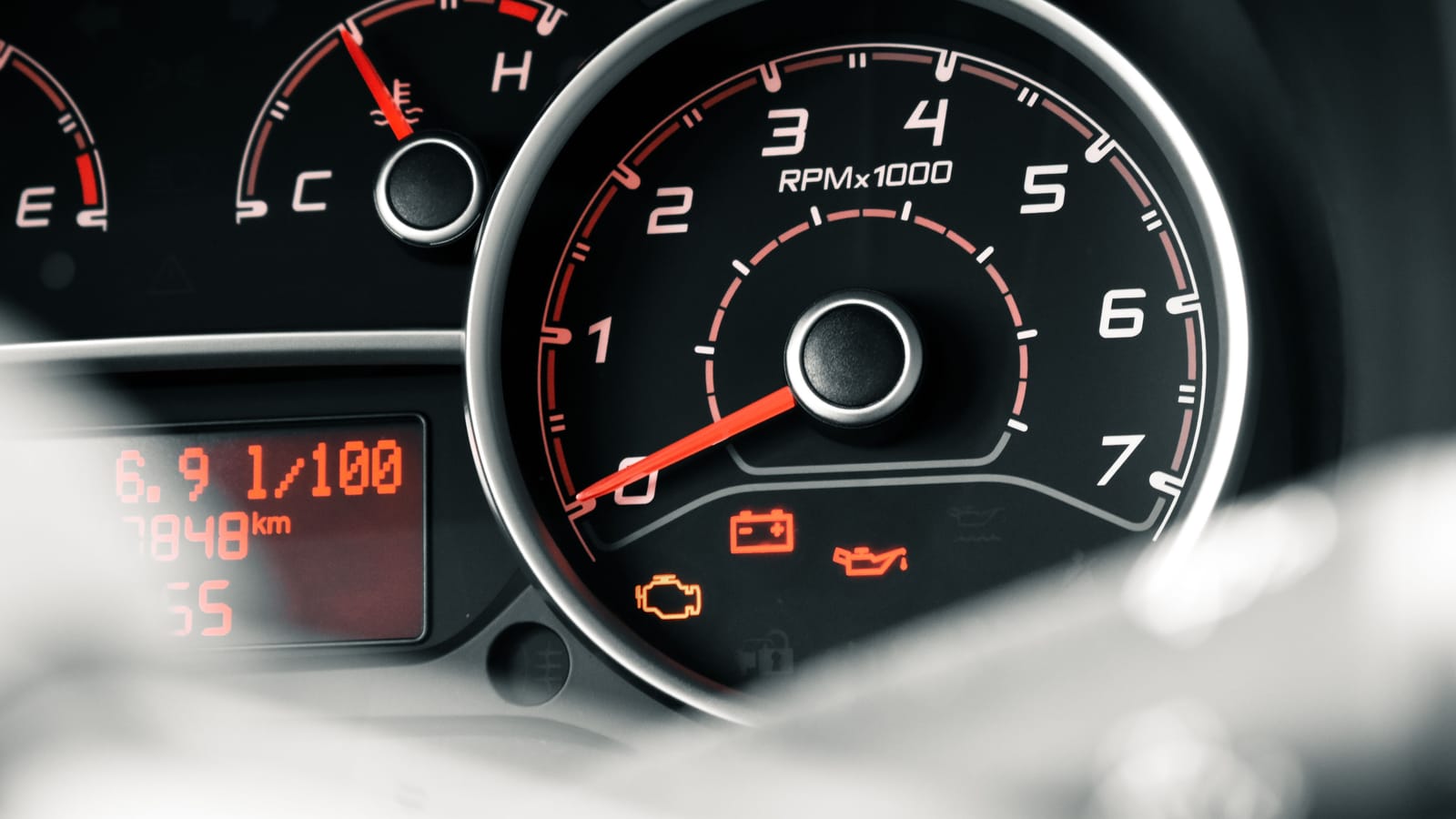
Buy the scanner before you need it. A basic handheld code reader runs about twenty to forty dollars, a Bluetooth dongle that pairs with your phone runs less, and either one will tell you in ninety seconds whether the light on your dash means a loose gas cap or a dead catalytic converter. That's the whole pitch. You're not becoming a mechanic. You're refusing to walk into a shop knowing nothing.
Every car sold new in the United States since the 1996 model year has the same 16-pin OBD-II port, and federal rules put it within reach of the driver's seat. Look under the dash on the driver's side, above the pedals, sometimes behind a small flip-down panel or a coin tray. On some Fords it hides just above the hood release. On a lot of Chryslers it's low and to the left of the steering column. If you can't find it in two minutes, search your year, make and model plus "OBD2 port location" and someone has already filmed it.
Before you plug anything in, look at the light
A steady check engine light means the computer logged a fault and wants attention soon. Drive it home. Drive it to work. Get it read this week.
A flashing check engine light means an active misfire, and raw fuel is going down the exhaust into a catalytic converter that costs four figures to replace. Pull over, shut it off, call for a tow or at minimum baby it straight home at low load. That distinction is the single most valuable thing on this page and most drivers have never been told it.
If the light came on right after you filled the tank, go tighten the gas cap until it clicks three times and drive for a day or two. Evaporative emission codes from a loose or cracked cap are common and they'll often clear themselves once the system passes its own test a few times.
Reading it
Key off. Plug the scanner in. Turn the key to ON, the click before the starter, so the dash lights up but the engine stays quiet. Cheap readers draw their power from the port and need the ignition on to talk to the modules.
Ask for stored codes and pending codes. Stored codes are faults the computer has confirmed, usually after seeing the same problem on two consecutive drive cycles, and those are what turned the light on. Pending codes are faults it's seen once and is still deciding about. Pending codes are early warning. Write both down exactly, including the letter.
Then find the freeze frame. This is the part everybody skips, and it's the part a mechanic actually wants. When the computer sets a code it saves a snapshot of conditions at that instant: coolant temperature, engine RPM, vehicle speed, calculated load, and the fuel trims. A misfire logged at 34 degrees Fahrenheit and 800 RPM in your driveway is a different animal than one logged at 4,200 RPM merging onto the interstate. Photograph the screen with your phone. All of it.
What the letters and numbers mean
A code like P0301 breaks down cleanly.
- P is powertrain. B is body, C is chassis, U is network communication.
- 0 means it's a generic code defined the same way on every manufacturer's car. A 1 there means the code is manufacturer-specific and you'll need to look it up for your brand.
- The third digit points at the subsystem. 1 and 2 are fuel and air metering, 3 is ignition and misfire, 4 is emissions controls, 5 is idle and vehicle speed, 7 and 8 are transmission.
- The last two digits are the specific fault.
So P0301 is a confirmed misfire on cylinder one. P0300 is a random misfire the computer can't pin to one cylinder. P0171 is bank one running lean. P0420 is catalyst efficiency below threshold on bank one.
The rule that saves you the most money
A code names a circuit, not a part. Burn that into your head, because the entire aftermarket is built on people forgetting it.
P0135 reads as "O2 sensor heater circuit, bank 1, sensor 1." That's not an instruction to buy an oxygen sensor. It's the computer saying it didn't see the electrical behavior it expected on that circuit. The sensor is one candidate. So is a blown fuse, a chafed wire, a corroded connector, or a relay.
P0420 is the classic trap. People read "catalyst efficiency" and brace for a $1,400 converter. Plenty of P0420s turn out to be a lazy downstream oxygen sensor, a small exhaust leak ahead of the cat letting outside air skew the reading, or a misfire that was cooking the converter for months. Fix the exhaust leak and the code goes away.
Where the cheap tool stops
A twenty-dollar reader talks to the engine and emissions modules. That's it. It won't read your ABS light, your airbag light, or on most cars the transmission module. It can't command a component on or off the way a shop's bidirectional scan tool can. It won't tell you which of four coils is bad, only that cylinder three is missing.
A Bluetooth dongle paired with a live-data app buys you more for the same money, because you can watch fuel trims in real time. Long term fuel trim sitting at plus 18 percent at idle and dropping close to zero at 2,500 RPM is the signature of a vacuum leak. That's a real diagnosis, made from a phone, in a parking lot.
One honest warning about the cheapest dongles: the fifteen-dollar clones are a coin flip. Some work for years, some can't handle a newer CAN gateway, and a few have a habit of keeping modules awake and quietly flattening your battery over a week. Unplug the thing when you're done. Don't leave it in as a permanent accessory.
Don't clear the code just because you can
Every scanner has an erase function and it's the most abused button in home car repair.
Clearing codes wipes the freeze frame data. It also resets the readiness monitors, which are the self-tests the computer runs on the catalyst, the evap system, the oxygen sensors and the rest. Those monitors come back as "not ready" and stay that way until you've driven a specific mix of cold starts, city and highway miles, sometimes 50 to 100 miles of mixed driving. Roll into an emissions test with incomplete monitors and you fail on the spot. Most states allow one or two incomplete. Not five.
My neighbor learned this the hard way with a Silverado, three days before his inspection expired, on the advice of a guy at work. Light off, monitors blank, automatic fail, and then a week of errands trying to run a drive cycle in January traffic.
Clear a code after you've fixed something, to see whether it comes back. Not before.
What to do with the number
Search the exact code plus your year, make, model, and engine. Enthusiast forums for your specific car are worth more than any generic code database, because someone with your exact drivetrain has already chased that code and posted what it actually turned out to be.
Then decide honestly what you're willing to touch. A gas cap, an air filter, a vacuum hose, a coil pack on a four-cylinder with the coils sitting right on top of the valve cover, those are all in reach of a socket set and a Saturday. Anything behind the intake manifold, anything involving the fuel system, anything on a transmission, pay a professional.
Either way you're walking in with a code, a freeze frame, and a question instead of a shrug. Shops quote shrugs differently.
Dean Shaw
Gear & Garage
Reads the warranty, the parts list and the long-term owner reviews before anything else. Trucks, tools, watches, and the cheap version that costs more.

Watch
Worth an hour of your evening
More from Cars.
From channels we rate. Plays on YouTube.
Read next