
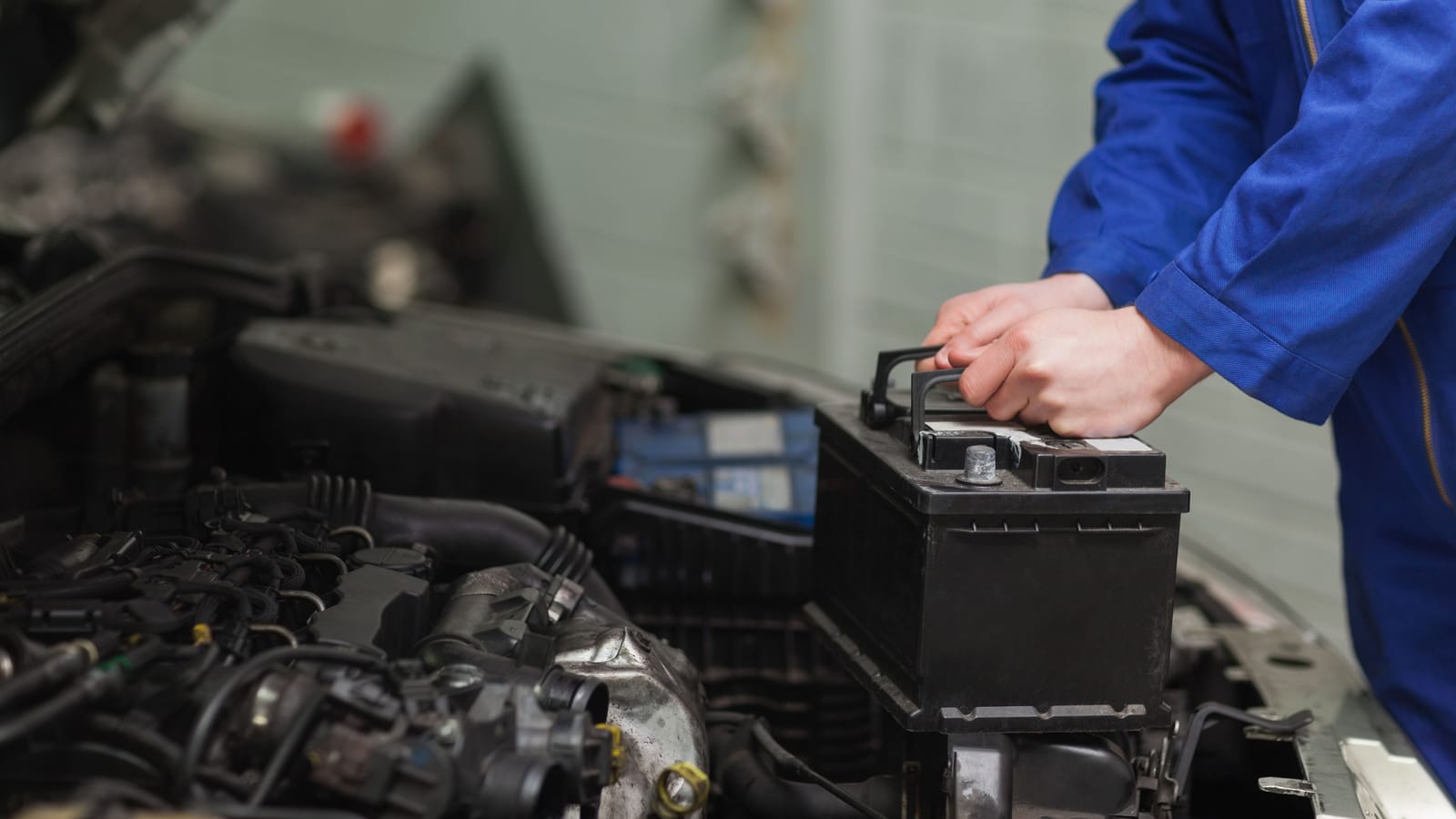
A dead battery on a 1998 pickup is a twenty-minute job with a 10mm wrench and a cup of coffee. A dead battery on a 2019 crossover is a twenty-minute job plus an hour of the car sulking at you: traction control light, power steering message, the windows refusing to auto-up, a transmission that shifts like it's guessing. Nothing is broken. The car just lost its notes.
So do both halves of the job. Swap the battery, then put the electronics back where you found them.
Buy the right battery, not the one on the end cap
Two numbers matter. Group size is the physical case and terminal layout, printed on the label of the battery already in your car: 48 (also called H6), 94R (H7), 35, 65, 24F. Get it wrong and the hold-down won't fit or the cables won't reach. Don't eyeball it.
Cold cranking amps is the second. Match the factory rating or go above it. Going below saves maybe fifteen dollars and costs you a January morning.
Then the one people skip: chemistry. If your car has stop-start, it needs AGM or EFB, whatever the sticker says. A standard flooded battery in a stop-start car will work beautifully for about fourteen months and then quit. The charging system on those cars runs a duty cycle a flooded battery was never built for. AGM runs maybe eighty to a hundred dollars more. Pay it.
Check the date code before you carry it to the register. Most batteries have a sticker or stamped code with a month letter and a year digit. Anything more than six months old has been sitting on a shelf slowly discharging. Ask for a fresher one. They'll swap it.
And expect a core charge, usually around twenty bucks, refunded when you bring the dead one back in the empty box.
Keep the power on while you work
This is the whole trick. If the car never fully loses voltage, it never forgets anything.
A memory saver is a small device that feeds 12 volts into the car while the battery is out. The cheap ones plug into the OBD2 port under the dash and run off a 9-volt battery. They're about fifteen dollars and they work fine on paper.
The annoying part: on a lot of cars, the OBD port is on a low-amp fuse, and a 9-volt battery can't hold up a dome light. Open a door with one of those hooked up and you'll pop a fuse or drain the saver flat without noticing. If you use one, close every door, turn off the interior lights, and leave the hood light out of the equation.
The version that actually works is a jump pack or a second 12-volt battery clipped to the disconnected cable ends while the old battery comes out. More current, more margin.
You can skip all of this. Plenty of people do. Just know you're choosing the relearn list over the fifteen-dollar gadget.
The swap itself
Eye protection on. That case holds acid and the posts can spark.
Negative first, always. Loosen the 10mm nut, pull the black clamp off, and tuck it somewhere it can't flop back onto the post. Then positive. When you reinstall, reverse it: positive on, negative last. The reason is simple. With the negative disconnected, a wrench that slips onto bodywork while you're on the positive post does nothing. With the negative still connected, that same slip welds your wrench to the fender.
Remove the hold-down bracket at the base. It's usually a single 10mm or 13mm bolt on a long extension, and it's usually seized.
Lift with your legs. A group 94R AGM weighs around 50 pounds and has no good handle.
Clean the terminals with a post brush or a wire brush until they're bright metal. That white-green crust is resistance, and resistance is a car that cranks slow with a brand-new battery in it. If a clamp is corroded through, replace it now, not next spring.
Set the new battery in, reinstall the hold-down and actually tighten it. A loose battery vibrates itself to death and, in a hard stop, becomes a 50-pound object looking for somewhere to go.
Terminal nuts get snug, not heroic. Most are in the neighborhood of 45 to 55 inch-pounds. If you're pulling hard enough to flex the post, you've gone too far and you'll crack the case seal.
Register the battery if your car demands it
This is the step that separates a good swap from a battery that dies in eighteen months.
Many newer cars, and nearly every recent German one, run a battery management system that tracks the battery's age and adjusts charging voltage to match. Put a fresh battery in without telling the computer, and the car keeps charging it like a four-year-old unit. Undercharged AGM batteries sulfate. Sulfated batteries die young.
BMW, Mini, Mercedes, Audi, VW, Volvo, Jaguar and Land Rover are the usual suspects. Some GM and Ford models have a battery sensor too, though many of those relearn on their own. Your owner's manual will tell you, and if it doesn't, an owner forum for your exact model year will.
A basic bidirectional scan tool that can register a battery runs roughly $100 to $200 these days. If you're only doing this once every five years, a shop will do it in ten minutes for around fifty bucks, and that's an honest trade. Not every job has to be a purchase.
The relearn list
With power restored, work through these in the driveway before you go anywhere.
- Clock and radio presets. Trivial, but if you've got an older Honda, Acura or VW, the stereo may want an anti-theft code. It's on a card in the glovebox or the owner's manual sleeve. If it isn't, the dealer can pull it from the VIN.
- Power windows. Auto-up and pinch protection often reset. Standard procedure on most cars: hold the switch down until the glass is fully open, keep holding two more seconds, then hold up until fully closed and hold two more seconds. Do each window.
- Sunroof. Same idea, usually hold-close then hold-open through a full cycle.
- Throttle and idle. Start it, leave your foot off the pedal, and let it idle until the fan cycles. Five to ten minutes. The computer is relearning where closed throttle lives.
- Steering angle. Drive slowly, turn lock to lock once each direction, then straighten out. That clears most traction and stability warnings.
- Seat and mirror memory. Reset the positions.
- TPMS. Usually relearns itself after a few miles above 20 mph.
Then drive it. Twenty minutes of mixed roads, some stop-and-go, a few full stops. The transmission relearns shift adaptives by driving, not by sitting. It'll feel firm or lazy for the first day. That's normal, and it goes away.
What to do with the old one
Take it back in the new battery's box. Auto parts stores take them, refund your core, and handle the lead. Don't leave it in the garage next to the lawn mower, where it will sit for four years and eventually leak onto the concrete.
One more thing. Write the install date on the top of the new battery with a paint pen. Three and a half years from now, on a cold morning when the starter sounds a half-beat slow, you'll know exactly what you're looking at instead of guessing.
Dean Shaw
Gear & Garage
Reads the warranty, the parts list and the long-term owner reviews before anything else. Trucks, tools, watches, and the cheap version that costs more.

Watch
Worth an hour of your evening
More from Cars.
From channels we rate. Plays on YouTube.
Read next