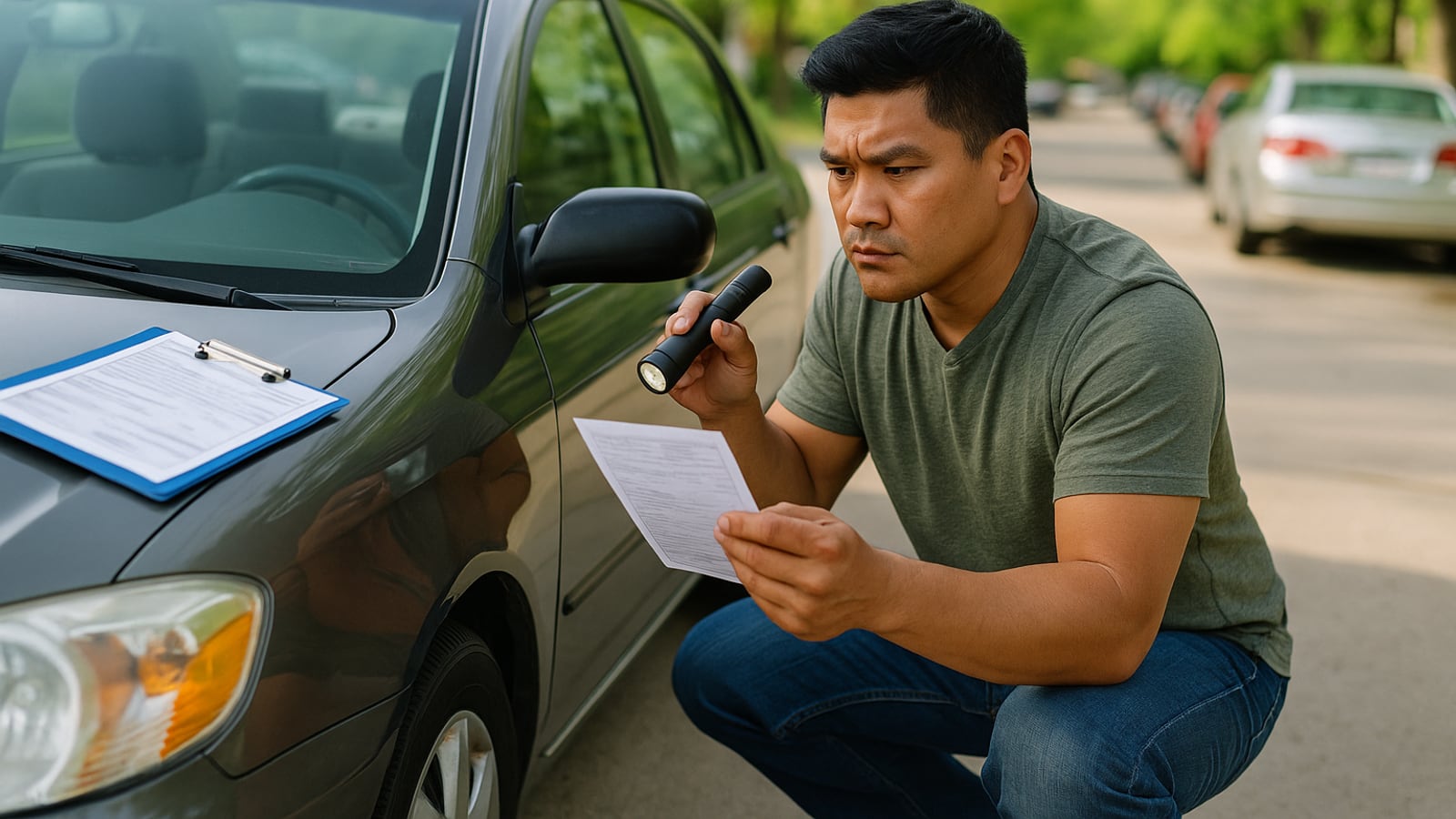
Ask one question before you drive anywhere: "Is your name on the title, and can I meet you at the address on your driver's license?"
That question alone kills most of the bad deals. The seller who wants to meet in a grocery store parking lot halfway between you, who has the car but not the title in hand, who says his cousin is handling the sale, isn't a guy with a busy schedule. He's a curbstoner. He buys auction cars nobody else wanted, cleans them up, and sells them as a private party so he doesn't have to honor anything a licensed dealer would.
A private sale is already "as is" in most states. Curbstoning strips out the one thing you had left, which is a real person with a real address who has to look you in the face.
Match four numbers before you match wallets
The VIN appears in at least three places on almost every car: the plate at the base of the windshield on the driver's side, the sticker inside the driver's door jamb, and the title. Photograph all three. They must match each other, character for character.
If the windshield plate looks disturbed, the rivets don't sit flush, or the door jamb sticker is a slightly different font or a crooked reprint, walk. You're not qualified to sort out a cloned VIN in a parking lot and neither am I. That's a police matter, and if the car turns out to be stolen, you lose the car and the money.
Fourth number: the mileage on the odometer versus the mileage on every piece of paper in the glovebox. Oil change stickers. State inspection records. The registration.
Title washing is a real thing and it crosses state lines
A car totaled by an insurer in one state gets a branded title. Salvage, flood, rebuilt, lemon law buyback, whatever the state calls it. Somebody then moves that car to a state with looser branding rules, retitles it, and the brand quietly disappears from the paperwork.
Run the VIN through NMVTIS, the federal vehicle title database. It's the one place that pulls from state DMVs and insurance total-loss records directly, and an approved provider will sell you a report for a few dollars. It isn't as pretty as a commercial history report, and it won't tell you about the fender bender that never got claimed. It will tell you if a state ever branded that title.
Buy the commercial report too if you like. Just don't treat a clean one as proof of anything. It means nobody reported anything, which isn't the same as nothing happening.
How to spot a flood car in ninety seconds
Water damage doesn't fix. It just goes quiet for a year and then starts eating wiring harnesses and control modules, one intermittent fault at a time.
- Pull the seatbelt all the way out. Not halfway. All the way to the stop, and look at the last twelve inches of webbing for a waterline, silt, or mildew staining.
- Lift the spare tire and the carpet under it. Silt collects in the low corners of the wheel well and nobody vacuums there.
- Look at the seat mounting bolts and the seat rails. Surface rust on bare metal under the seat, in an otherwise tidy interior, is a bad sign.
- Run the heat on full for two minutes with the recirculation off. Wet carpet padding under dry carpet smells exactly like a basement, and the heater is what tells on it.
- Check the headlight and taillight housings for a moisture line or a fine mineral haze on the inside of the lens.
- Feel the unpainted screws and brackets up under the dash where nobody details. Rust up there's not road salt.
One more, cheap and fast: crank the fan to maximum before you start the engine, then key on. Grinding or squealing from the blower motor is grit in the cage.
Mileage is a claim, not a fact
Rollback moved from a drill on the cable to a laptop on the OBD port, and it's cheap. The give-away is wear that doesn't match the number.
Look at the driver's seat bolster, the brake pedal rubber, the steering wheel at ten and two, and the shine on the shifter and the door pull. A 60,000-mile car with a pedal worn down to smooth metal is a 160,000-mile car. Tire date codes help too. The four-digit stamp on the sidewall gives week and year, and a set of original-looking tires from eight years ago on a car showing low miles doesn't add up.
Some cars store mileage in more than one module, and a good scan tool at a shop will read the mismatch. Which brings us to the check that matters more than all the others.
Pay for the pre-purchase inspection
Take the car to an independent shop of your choosing, not one the seller recommends, and pay for a full inspection on a lift. Expect it to cost somewhere in the range of a nice dinner out. Expect it to save you a transmission.
If the seller won't allow it, you already have your answer. No explanation is required or worth hearing.
Understand what the inspection isn't. It's an hour with a car, not a teardown, and a good tech can miss a torque converter that's about to go. It reduces your risk. It doesn't remove it.
Money leaves last
Never wire money. Never pay a deposit on a car you haven't stood next to. The overseas soldier selling a clean truck below market through an "escrow service" has been running that script for twenty years because it still works on people who are excited.
If there's a lien on the title, do the deal at the lender's branch and pay the lender directly for the payoff amount, with the balance to the seller. Handing a stranger cash and trusting him to go clear his loan is how people end up with a car they can't register.
The finance office is where dealers make it back
Buy from a franchise dealer and the car itself may be fine. The trap moves to a small room with a desk.
Negotiate the out-the-door price in writing, on the buyer's order, before anyone asks what payment you're comfortable with. Monthly payment is the tool they use to hide a longer term, a packed rate, and four products you didn't ask for. Read the term. Read the APR. Read the line items.
Watch for spot delivery, sometimes called yo-yo financing: you drive home Saturday, and Tuesday they call to say the bank fell through and you need to come back and sign at a higher rate. Don't take delivery until the financing is finalized, or arrange your own loan through a credit union first and walk in as a cash buyer.
And a fair concession, because it cuts both ways. A rebuilt-title car can genuinely be the best value on the lot if you can see the repair photos, the damage was cosmetic, and you're keeping it a long time. You'll take a hit on resale and your insurer may limit coverage. That's a trade you can make with your eyes open. What you can't make is that trade without being told it's a trade.
The seller who's straight with you will answer every question in this piece without flinching, and most of them will be a little pleased you asked. The one who gets irritated at question three has just told you everything.
Wes Dunbar
Country & Skills
Grew up on an acreage and never quite left. Covers trucks, trades, land, and how to do the thing yourself.

Watch
Worth an hour of your evening
More from Autos.
From channels we rate. Plays on YouTube.
Read next