
Goliath walked out and yelled at Israel's army every morning and every evening for forty days. The Bible actually keeps count: "For forty days the Philistine came forward and took his stand, morning and evening" (1 Samuel 17:16, ESV).
That's eighty speeches. Eighty chances. And every single time, a few thousand trained soldiers stared at their sandals.
Nobody in that army woke up and decided to be a coward. They stayed quiet once. It got easier the second time. By day thirty-nine, silence was just what they did. Fear had turned into a habit.
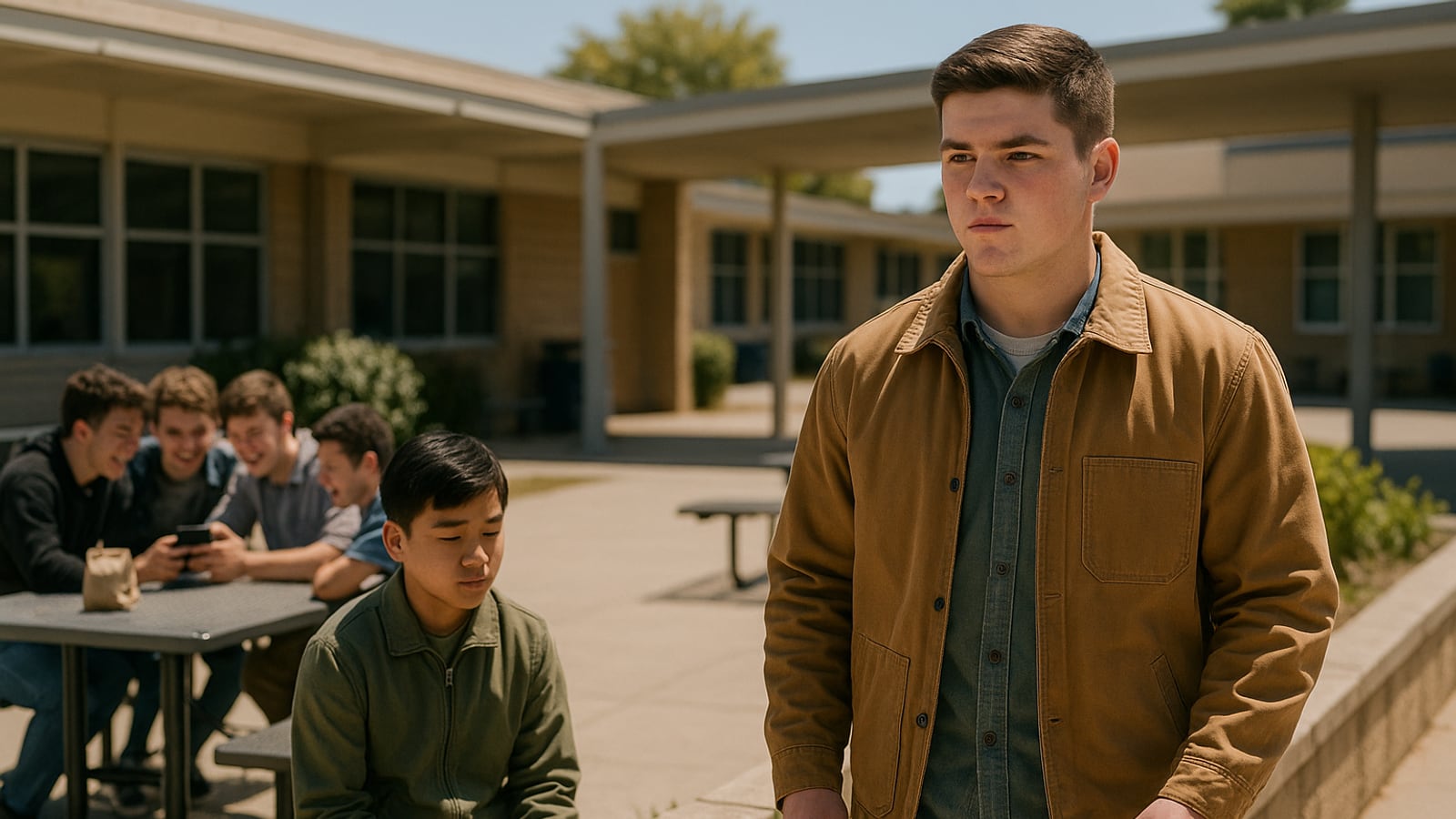
You know this feeling. Maybe not with a guy in bronze armor built like a grain silo. More like a lunch table, a phone getting passed around, a video of the kid from third period who eats alone, and six guys cracking up. You're not laughing. But you're not saying anything either. The bell rings, and you tell yourself you'll say something next time.
Next time is how an army ends up standing on a hill for forty days.
The fight nobody remembers
Everybody remembers the sling. Almost nobody remembers what happened a few verses earlier.
David shows up at the camp on a delivery run. His dad sent him with grain, ten loaves of bread, and ten cheeses for his brothers. The future king of Israel, basically doing DoorDash. He hears Goliath, starts asking the soldiers why nobody's doing anything, and his oldest brother Eliab loses it:
"Why have you come down? And with whom have you left those few sheep in the wilderness? I know your presumption and the evil of your heart, for you have come down to see the battle." (1 Samuel 17:28, ESV)
Read that again. Before David ever faced the giant, he got roasted by his own family in front of the guys. His motives got questioned. He got called arrogant. He got reminded he was just the little brother who babysits sheep.
That's the everyday Goliath. It's almost never the bully himself. It's your own friends. When you say "that's not funny," the pushback doesn't come from the kid getting mocked. It comes from the guys you sit with. "Bro, relax." "Why are you being weird?" "Since when do you care?"
David's answer:
"What have I done now? Was it not but a word?" (1 Samuel 17:29, ESV)
Then verse 30 says he turned away and kept talking to somebody else. He didn't argue for twenty minutes. He didn't shove his brother. He said his piece, let the insult bounce off, and moved on.
That's the move. You don't have to win the argument with your friends. You just can't take back what you said.
Courage gets built where nobody's watching
When Saul asks David why he thinks he can pull this off, David doesn't brag about his arm. He talks about a lion and a bear that came after his dad's flock, and then he says:
"The LORD who delivered me from the paw of the lion and from the paw of the bear will deliver me from the hand of this Philistine." (1 Samuel 17:37, ESV)
Two things in that sentence matter.
The practice happened in a field with zero audience. David had been faithful in small, unglamorous stuff long before anybody was watching.
And he gives God the credit. His confidence wasn't in David.
Your lion and bear will look boring. Telling your mom the truth when a lie would be easier. Handing back the extra ten dollars the cashier gave you by mistake. Not forwarding the screenshot. Saying "I'm good" when somebody offers you a vape behind the gym. Keeping your eyes off answers that landed in your lap, like in the test answers hit the group chat, and you didn't open them.
Every one of those is a rep. Skip all the small reps and don't expect courage to show up out of nowhere at the lunch table. Do them, and the big moment feels weirdly familiar when it comes.
Take off Saul's armor
Then King Saul tries to help. He dresses David up in his own gear:
"He put a helmet of bronze on his head and clothed him with a coat of mail... Then David said to Saul, 'I cannot go with these, for I have not tested them.' So David put them off." (1 Samuel 17:38-39, ESV)
Saul's armor was the "right" equipment. It just wasn't David's.
Standing up for what's right doesn't have to look like somebody else's version of it. Some guys are built to say it out loud in front of the whole table. Great. If that's not you, you're not off the hook. You just carry a different sling. It might look like:
- Sitting down next to the kid who got mocked, tomorrow, on purpose.
- Messaging him that night: "That was messed up. Sorry I didn't say anything."
- Catching the guy who started it alone and saying, "Hey, cut it out."
- Showing a teacher or your dad what's getting passed around.
What's not on that list is throwing a punch. David was facing a soldier sent to kill Israel's army. You're facing a jerk in the hallway. A suspension doesn't help the kid you're defending, and the guy who blows up isn't the one in control.
Pick your sentence before you need it
Most guys freeze because they're trying to invent the perfect line while everybody's staring at them. You won't come up with it. Nobody does. So decide now.
Choose one short line you can say without your voice cracking:
- "Nah, that's not funny."
- "Leave him alone."
- "I'm out."
- "Delete that."
Keep it under five words. You're not giving a TED talk. Even David needed eleven, and he was about to become king.
Then expect the cost. Your group might go a little cold for a few days. Somebody might call you soft, or a church kid, which, fair. It's awkward for a week and then it mostly isn't. And you'd be surprised how often one other guy at that table was just waiting for somebody to go first.
One honest caveat. Sometimes speaking up in the moment isn't the smart play. If things are really heated, or somebody could get hurt, the brave thing is to walk away and get an adult. That isn't backing down. It's picking the right sling.
When it's bigger than a joke
Some things aren't yours to handle alone, and pretending they're isn't courage. If someone's being threatened or hurt, pressured into something, or if pictures of anybody are getting shared, tell a parent, your youth pastor, a teacher or a school counselor today. Not next week. You won't be in trouble for telling. You'll be the reason it stopped.
And if the kid getting picked on ever says something that sounds like he wants to disappear or hurt himself, don't keep that secret. Tell an adult right away. He, or you, can call or text 988, the Suicide and Crisis Lifeline, any hour of any day.
Who the story is really about
It's easy to read this as "be brave like David." But listen to what David says to the giant's face:
"All this assembly may know that the LORD saves not with sword and spear. For the battle is the LORD's, and he will give you into our hand." (1 Samuel 17:47, ESV)
David is the smallest character in his own story. The main character is God, who fights for his people when they can't win on their own.
And that points forward. Centuries later, Jesus walked into the fight none of us could win, against sin and death. He took the hit himself on the cross, and three days later he walked out of the grave. You weren't the hero in that story. You were the army frozen on the hill. He won it anyway, for you.
That changes the lunch table. You don't have to be brave to earn God's approval. If you trust Jesus, you already have it. So when you say "that's not funny" and the whole table turns on you, you aren't risking the one thing that matters most. That's already settled.
The army waited forty days for somebody to go first. At your table, it might only take one lunch.
Ade Fisher
Young Men
Teaches the trades intake at a community college. Writes the manual he wishes his students arrived with.

Read next