
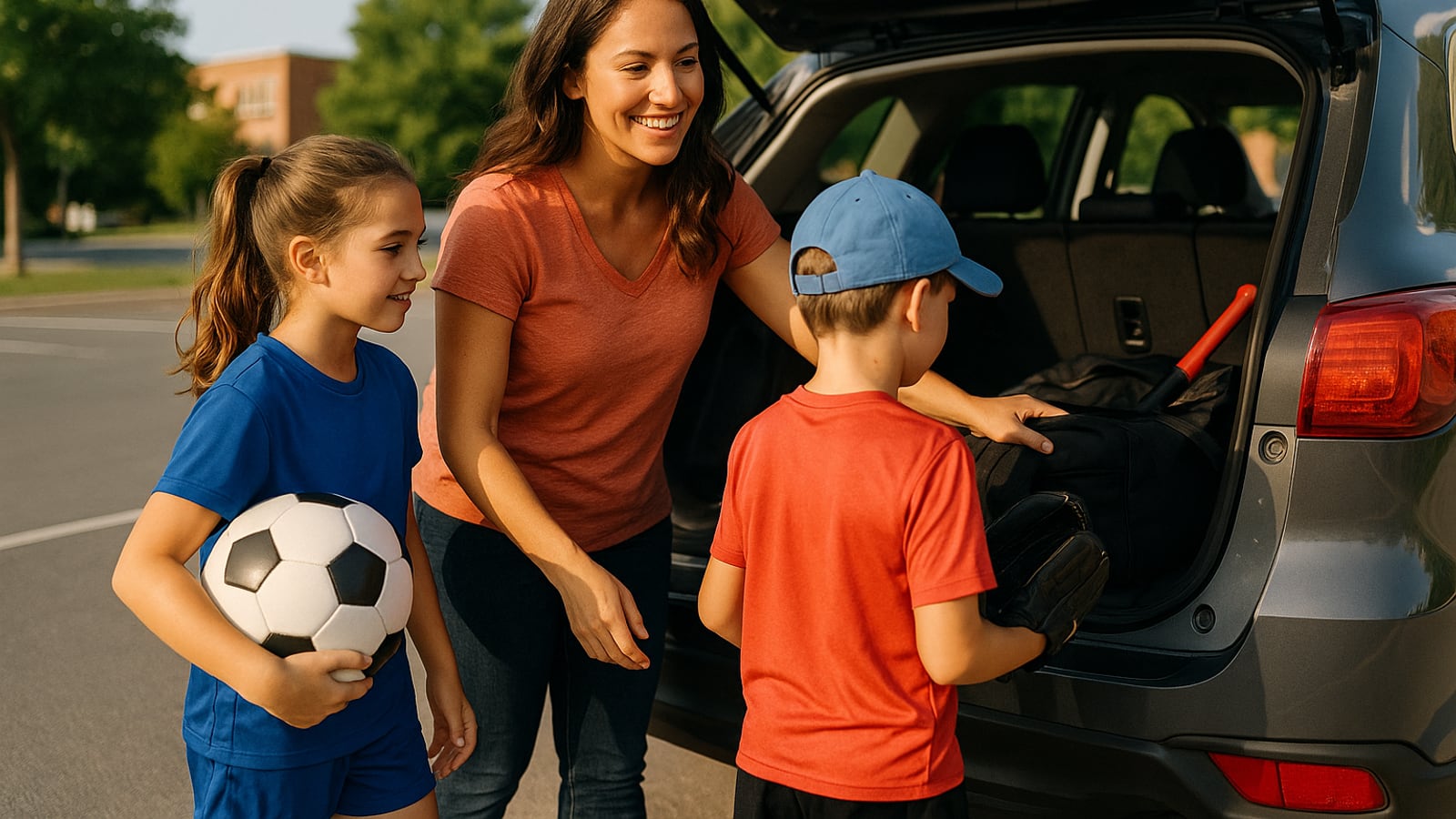
Quick answer: Keep one packed bin in the car all season so nothing important lives in the house. Then protect two things on purpose: family dinner a few nights a week, and a quiet ride home after the game.
It's 7:40 on a Saturday. You're fifteen minutes from the field, warm-up is at 8:00, and the mouthguard is sitting on the kitchen counter next to the orange slices you cut last night. Your son can't play without it. You turn around. Now you're late, the snacks are still on the counter, and the day hasn't started yet.
Almost every sports-season meltdown works like that. The problem isn't bad parenting. The gear is scattered between the mudroom, the dryer and the back seat, and it all has to come together in one frantic ten-minute window. So stop packing for each game. Pack once, for the season, and leave it in the trunk.
The bin that lives in your car
Get one big lidded storage bin, something around 60 quarts, and give it a permanent spot in the back. It doesn't come in the house. It gets restocked in the driveway.
What goes in it:
- A spare of whatever gets a kid benched. Mouthguard, shin guards, the right socks, hair ties if you have a daughter. The spare mouthguard alone will save your season more than once.
- A hoodie one size too big for the kid who swore he wasn't cold. He'll be cold.
- A gallon water jug and a roll of paper towels.
- Instant ice packs, bandages, athletic tape and wipes. You're not running a clinic. You're covering the scraped knee and the jammed finger.
- A towel and a trash bag for muddy cleats on the ride home.
- Folding chairs, a blanket and a golf umbrella that works for rain and for sun.
- Sunscreen and a hat.
On sunscreen: wearing some matters most. Any broad-spectrum SPF 30 or higher, used every time, beats the good bottle sitting in the pantry. For the bin, I'd pick a mineral one, meaning zinc oxide or titanium dioxide. They sit on the skin and they're broad-spectrum. In 2019 the FDA proposed them as the only two filters "generally recognized as safe and effective," and it asked manufacturers for more safety data on the rest. They're also gentler on sensitive skin, which helps with a kid who wipes sweat into his eyes every time he runs. The downside is that some formulas leave a white cast. Tinted ones take care of that. Thinksport SPF 50 (or Thinkbaby for the little ones), Blue Lizard Sensitive Mineral SPF 30 and Badger Clear Zinc SPF 30 are all easy to find. Reapply every two hours and after heavy sweating, and use the shade when you can get it.
Sunday night, pull out anything that got used and replace it. That takes five minutes and saves you from the 7:40 turnaround.
Snacks without the arms race
At some point a parent shows up with individually wrapped cupcakes that have the kids' jersey numbers piped on them. The next week everyone else feels behind. Don't compete.
The team snack has a simple job. Kids who ran for an hour need something quick, and they need to leave happy. Orange slices, clementines, pretzels, cheese sticks, bananas and water all do that. For most kids playing an ordinary game, water is plenty, and a sugary sports drink isn't something they need. Before your first snack week, ask the coach or team parent about allergies. One nut-free text now is a lot better than an ambulance later.
Where you can go above the minimum is being generous. Bring a few extra for the little brothers and sisters who sat through the whole game in folding chairs. They earned a snack too. Take your cooler home, and pick up the wrappers under the bench even if they aren't yours. Leave the sideline cleaner than you found it.
For your own kid, keep a small stash in the bin: granola bars, trail mix, a sleeve of crackers. A hungry eleven-year-old after a 6:00 p.m. practice is a tough ride home, and a snack in the car can stop that before it starts.
One calendar, and a rule about who enters it
Game times change. Fields change. Rainouts move to a Tuesday. If three people are keeping three versions of the schedule, one of them is wrong right now.
Use one shared digital calendar for the whole family and follow one rule: whoever sees the change enters it, right then. It doesn't wait for later or for when you get home. If your husband gets the email about the field switch, he updates it on the spot. Once a week, sit down together and go over what's coming. The Sunday hour that runs your whole week is a good place to do it.
Then split the week between the two of you, deliberately. "You've got Tuesday practice, I've got Thursday" is easier on a marriage than two people hoping the other one remembered. And at least once a season, both of you go to the same game and sit together. It's a cheap date, and your kid sees both parents in the stands.
The carpool deal
Pick two or three families with kids on the same team and make it official. Set up a group text with actual times, and agree who drives which days. Keep it simple enough that nobody needs a spreadsheet.
Offer to drive. Be the mom who shows up early and has room for one more. That's good neighboring, and people remember it.
But pay attention if one family never takes a turn and treats your minivan like a free shuttle. Deal with it early and kindly: "Hey, we need to trade off Thursdays or I can't keep doing this." You're allowed to help and still have limits. If you let it slide, you end up resenting it, and that's worse than the conversation.
The decision that decides your whole season
Somewhere around age nine, a coach will pull you aside and say your kid has real talent. Then comes the pitch for the travel team, the extra skills clinic and the winter league. Each one sounds reasonable. Together they can wreck a family.
Before you say yes to anything, set a family cap. Some parents limit each kid to one sport per season. Some protect three dinners at home a week and say no to anything that cuts into them. Some families keep Sundays off the calendar. The details are up to you. What matters is deciding before the season starts, because nobody thinks clearly while standing next to an excited coach.
To be fair, some kids really do love a sport enough to want the travel team, and some families have the time and money to make it work without stress. If that's you, go for it. Just count the whole cost first: gas, hotel weekends, the siblings who get dragged along, and the Saturdays your family doesn't get back. If you need backup to make the season work, figure out when to hire a sitter or call Grandma before you're desperate.
Behavior on the sideline
Cheer for the whole team, loudly, including the kid who's still learning which goal is his. Leave the coaching to the coach, even when he's wrong about the lineup.
And don't yell at the referee. Youth refs are often teenagers working their first job, and they're doing their best in front of a crowd of adults. Plenty of leagues are short on refs, and sideline behavior is a big part of the reason.
If another parent is the one yelling, you don't need to fix him. Move your chair.
The ride home
This matters more than anything else in this piece.
Your kid gets in the car sweaty and wound up, and maybe upset about a missed shot. It's tempting to go over the game play by play and point out what they could do better. Don't. They already know about the missed shot. They thought about it the whole walk to the car.
Coaches have recommended the same line to parents for years: "I love watching you play." Then stop talking. Let them bring up the game, or not bring it up. Some nights you'll get twenty minutes of play-by-play. Some nights you'll get silence and a request for chicken nuggets. Both are fine. If your kid is older and quieter, keep in mind that the teenager who stops talking is still listening.
The scoreboard resets next Saturday, but your kid will remember how those rides home felt.
Nina Castellan
BRO for Her
Runs the women-facing desk. Same standard, same tools, written for a different reader — not a softer one.

Watch
Worth an hour of your evening
More from Moms.
From channels we rate. Plays on YouTube.
Read next