
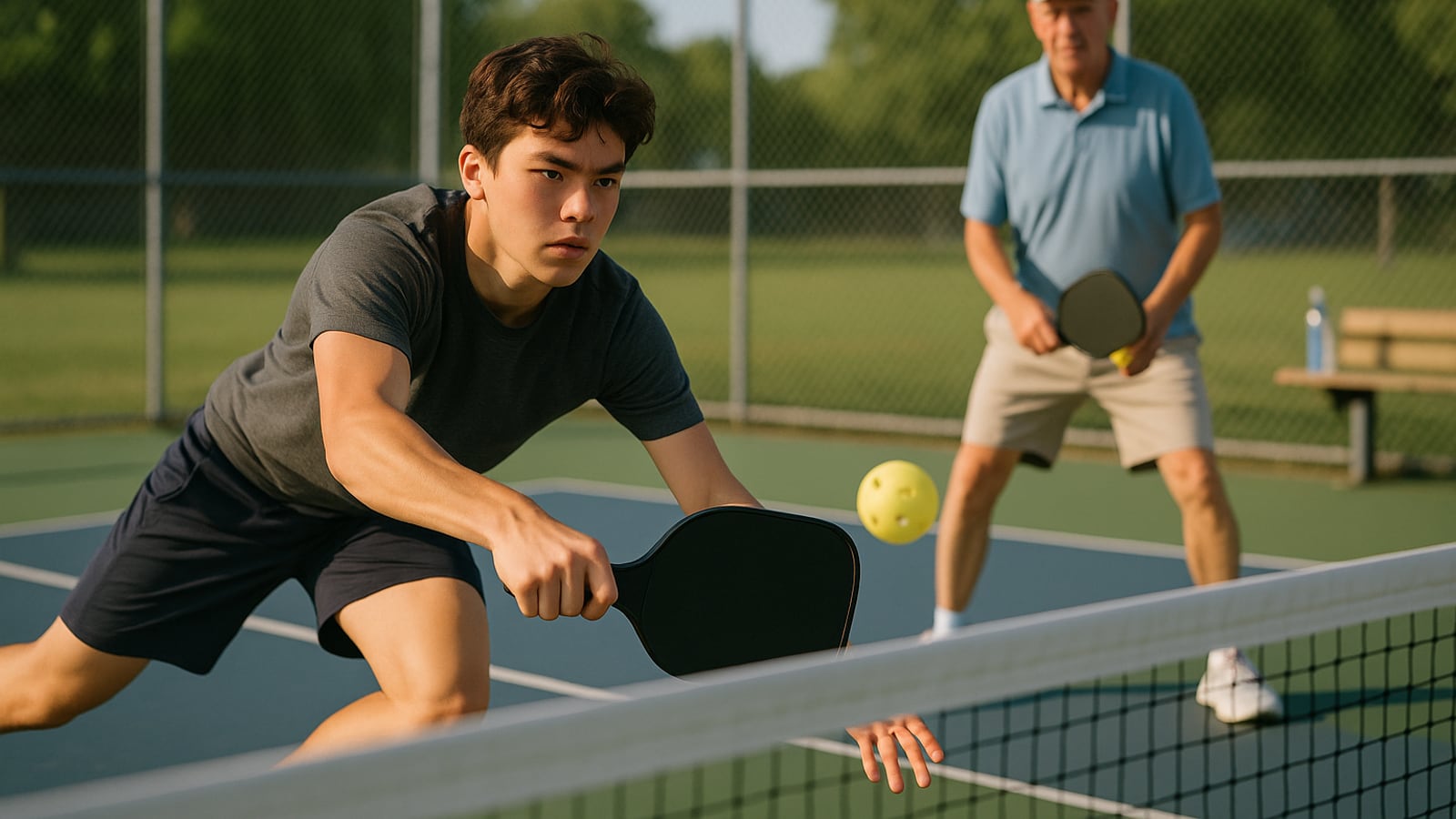
Quick answer: Pickleball is doubles tennis shrunk down to a badminton-sized court, played with a solid paddle and a plastic ball with holes in it. One rule near the net takes away most of your athletic advantage. That's why it's the one sport where you and your grandparents can play as real equals.
The first time you play your grandfather, you'll probably lose.
It won't be because he's faster. He isn't. You'll be sprinting side to side and hitting every ball as hard as you can. He'll be standing near the net, barely moving, tapping the ball back with a little flick of the wrist. It'll look like he isn't even trying. Then the score reads 11-4 and he asks if you want to go again.
Say yes. That loss is the best introduction to the game you could get.
Why being young doesn't help much
The game was invented in 1965 on Bainbridge Island, Washington, by three dads looking for something to keep bored kids busy. You're the original target audience. It just turned out adults liked it more.
The rules fit on a napkin:
- The court is 20 by 44 feet, the same size as a doubles badminton court. The net is 36 inches high at the sides and 34 in the middle.
- Serve underhand, diagonally across the court, and make contact below your waist.
- The two-bounce rule. The serve has to bounce. The return has to bounce. After that, anybody can hit the ball out of the air.
- The kitchen. That's the seven-foot zone on each side of the net. You can't hit a ball out of the air while you're standing in it or on its line. You can step in to play a ball that's already bounced.
- Games go to 11, you have to win by 2, and only the serving team can score.
In doubles, the score gets called as three numbers, like "four, two, one." That's your team's score, the other team's score, and then a one or a two for which server you are. It'll confuse you for about three games. Then it won't.
The kitchen is the whole story. In tennis, a strong, fast player rushes the net and slams the ball. In pickleball you can't. The two-bounce rule keeps the serving team back at the start of every point, and the kitchen keeps everybody from camping on the net to smash. So points get decided by who can hit soft shots that drop low into the other team's kitchen, where nobody can attack them.
That takes touch. Touch comes from reps. Your grandparents have reps.
The shot to learn first
It's called the dink. You stand just behind the kitchen line and push the ball softly over the net so it lands in the other kitchen. Low, slow and boring. It wins more points than anything else in the game.
The mistake nearly every athletic guy makes is trying to end the point on every ball. You'll rip one from the back of the court and it'll clip the net. Or it'll sail long. Or it'll come right back at your feet because the other player just held his paddle out and let your power do the work.
Try this drill:
- Both of you stand at your kitchen lines.
- Dink the ball back and forth, cross-court.
- Count out loud. Try to reach 20 without a miss.
- When you can do that, move a step back and try to drop the ball into the kitchen from there.
Ask your grandfather to run it with you. Most grandparents would love to be asked to teach you something, and he'll have opinions about your paddle angle.
Power still has its place. When the other side pops a ball up high, you put it away hard. The trick is having the patience to wait for that ball instead of forcing it. That's a skill that'll serve you in a lot of places besides a court.
Play hard, not cheap
Don't let your grandparents win on purpose. They'll notice, and it's a little insulting. They're not fragile, and they didn't come out to be humored. Play for real.
But choose your shots like a guy with some sense.
Keep the lob out of your bag. Lobbing the ball over someone's head is legal. It also forces them to run backward, and backpedaling is how people fall on a pickleball court. A fall at fifteen is a bruise. A fall at seventy-five can mean a broken hip and months of recovery. Beat them with placement.
Don't aim at bodies. Hitting a hard ball straight at an opponent is part of the game when you're playing guys your age. It isn't part of the game with Grandma.
If she's your partner, cover the deep balls. Anything over her head is yours. Call it early and loud: "Mine." "Yours." "Switch." Good doubles partners talk constantly, and it keeps anybody from getting hurt going for the same ball.
Call your own lines honestly. You call the ball on your side of the net. If you're not sure, it's in. The guy who gives away close calls is the guy people want to play with again.
Getting on a court
Where. Plenty of city parks have added pickleball lines to their tennis courts, and a lot of rec centers and YMCAs run open play sessions. Your grandparents may already know exactly where to go, and what time the good players show up. At a lot of open play sessions, you put your paddle in a rack or a line on the fence. When four paddles come up, those four people take the next open court. Wait your turn. Nobody likes the kid who skips the rack.
Shoes. Wear court shoes or sneakers with flat soles, not running shoes. Running shoes are built for moving forward and have thick heels, and this game is all side-to-side movement. That's how ankles get rolled.
Paddle. Don't buy anything fancy yet. Your grandparents probably own a spare, and a basic composite paddle is plenty to learn on.
Balls. Outdoor balls are harder with smaller holes. The Franklin X-40 is one you'll see everywhere. Indoor balls are softer with bigger holes. Use the right one for where you're playing, or the ball will bounce wrong and everyone will be annoyed.
Water. Bring two bottles. One for you. One for whoever you're playing with.
Show up like the grandson they brag about
This is where you can turn a game into something bigger.
Get there ten minutes early. If you've got your license, offer to drive. Carry the bag from the car. If they use a portable net, set it up, and then be the one who takes it down and packs it without being asked. Chase down the stray balls. Leave the court cleaner than you found it, even if the last group left empty bottles on the bench.
None of that is complicated, and all of it gets noticed. It's the same habit behind every piece about how reliable men get built at fifteen. The court just happens to be a place where somebody who loves you is watching.
Leave your phone in the bag, too. A game lasts maybe fifteen minutes, and the time between points is where the good stuff happens. Ask your grandfather what he did at your age. Ask how he met your grandmother. Ask what sports he played in high school and whether he was any good. You'll hear stories nobody told you at a holiday dinner, because people talk differently when their hands are busy and they're a little out of breath. If you need a reason to keep the screen away, what six hours of screens does to your focus and mood is a pretty good one.
You won't get unlimited afternoons like this. Most guys don't figure that out until they're older.
So go lose a few games. Watch how he does it. Someday you'll be the one standing at the kitchen line, barely moving, while a sixteen-year-old sprints around and wonders how he's losing. Pay attention now, so you'll know what to teach him.
Ade Fisher
Young Men
Teaches the trades intake at a community college. Writes the manual he wishes his students arrived with.

Read next