

Say "I can't" while it's still cheap
Every hour you bluff past your limits raises the price of admitting them. The man worth trusting says it early, plainly, and with a plan.
Quick answer: Admitting a limit costs the least at the start and the most after you've failed. Say what you can't do, what you can do, and what you need. Then do the next right thing.
This is commentary, and it's a view I'll defend.
The Saturday you promised
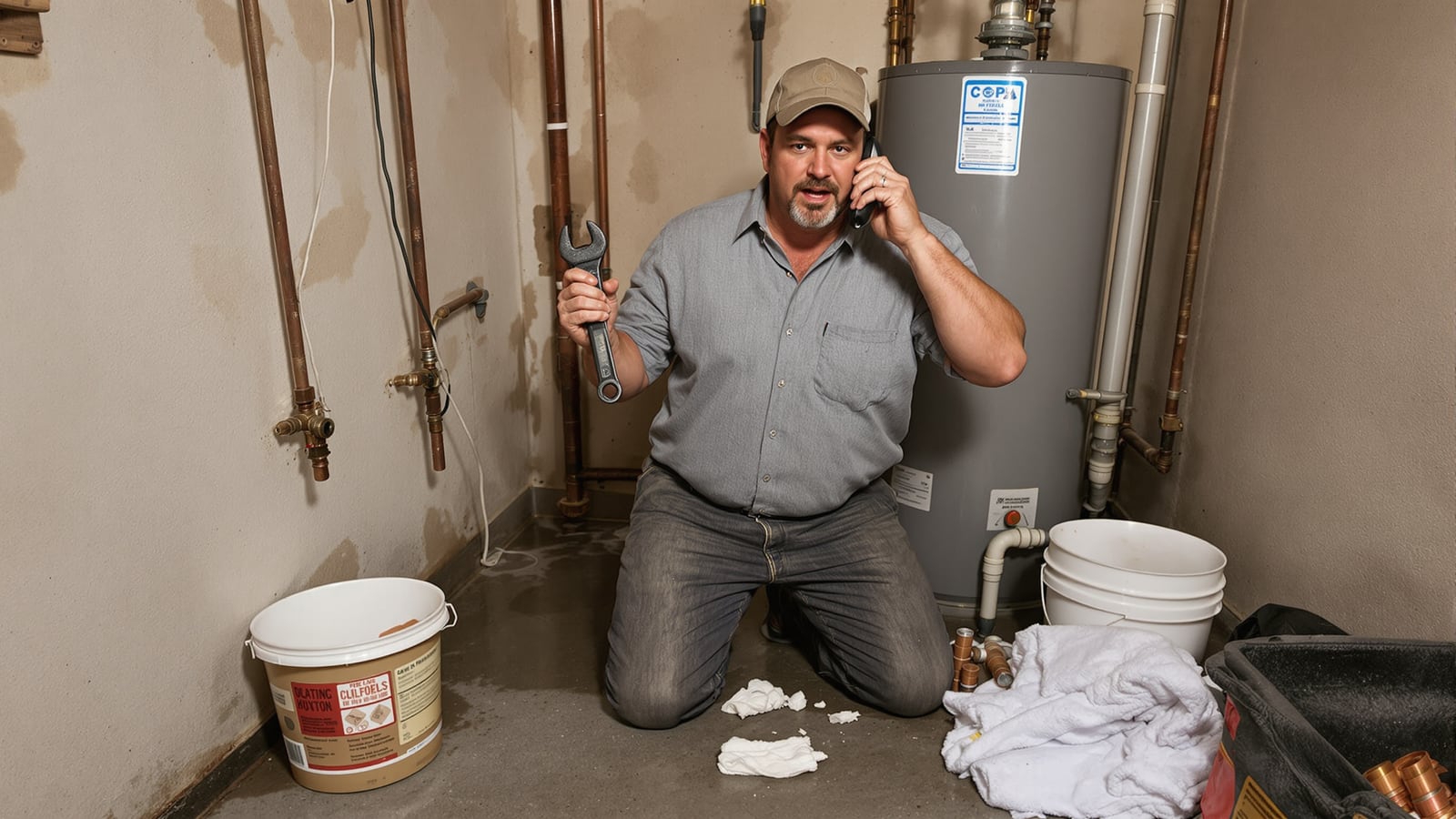
You told your father-in-law you'd swap his water heater. You said it the way men say these things, with a shrug that meant no problem. It's 2:15 now. The old tank is drained, one shutoff valve is weeping, and the fitting you need isn't in the truck. The hardware store closes at five.
You have two choices, and only one of them feels like a choice. You can keep going and hope. Or you can pick up the phone and say, "I'm in over my head on this one. I need a plumber or a second pair of hands, and I need one today."
The first path feels strong. It isn't. It ends with a flooded utility room, a family without hot water on Sunday, and a weekend-rate plumber who will quietly fix your fix. The second path costs you a little pride at 2:15. Pride is cheap at 2:15. By 6:00 it's expensive.
That's the whole argument. Your limits aren't going anywhere, and they don't care whether you admit them. The only thing you control is when everyone else finds out. Before the damage, you're a man who knew his limits. After it, you're a man who got caught.
Why men bluff
Nobody bluffs because he's stupid. He bluffs because somewhere along the line he learned that a man is supposed to handle things, and "I don't know how" sounded like failing the assignment.
Look closer at the assignment. A man is supposed to provide, protect, and keep his word. Faking competence does none of that. It puts your wife's car on a brake job you've never done. It puts a nervous kid on a table saw with no real instruction. It puts your name on a deadline your crew can't hit. The bluff feels like carrying the load, but it makes the load heavier for everybody standing under it.
Real strength shows up as an accurate report. Soldiers know this. A man who says "I'm out of ammo" or "I can't hold this position" is reporting, and the people depending on him need that report to make decisions. The one who hides it gets people hurt. If you want a clean frame for what the job actually requires, masculinity is a job description, and the job includes telling the truth about your own capacity.
The three-sentence version
When you hit a wall, you don't need a speech. You need three short statements, in order.
- What I can't do. "I've never run a gas line, and I'm not going to learn on your house."
- What I can do. "I can pull the old unit, haul it off, and handle the cleanup."
- What I need. "I need a licensed plumber for the connection. Can we call one together?"
Notice what's missing. No groveling, no long apology, no "I'm so sorry, I'm useless at this stuff." That's a different performance, and it puts the other person in the position of reassuring you. Say the limit like you'd read a measurement off a tape. Flat. Useful. Then offer the part you can carry.
The second sentence matters most. Admitting a limit with nothing attached sounds like quitting. Admitting it with a contribution attached sounds like a man running a job.
Where it matters most
The woodshop is the easy case. The harder ones are quieter.
Money. You can't cover the new truck payment on this income, and your wife is going to find out in March whether you tell her in January or not. Tell her in January. Bring numbers. A husband who says "this is where we actually stand" is a man his wife can plan with. A husband who hides it's a man she'll eventually have to audit.
Firearms. The range is no place for ego. If you've never shot a particular platform, or you're rusty after two years away, say so to the range officer or the friend next to you and ask for a few minutes of instruction. Lawful ownership is a right, and training is the responsibility that comes with it. The man who announces "I'm a little rusty, watch me for a minute" is the one everybody wants on the line beside them.
Work. If you can't deliver Friday, the cheapest day to say so is Tuesday. Your boss can reshuffle on Tuesday. On Friday afternoon he can only be angry.
Temper. A good share of anger is just a limit nobody admitted. You're exhausted, stretched, and one more request away from snapping at your kids. Saying "I'm running on empty, give me twenty minutes" beats the blowup every time. There's more on that in keeping your temper is a skill, not a personality trait.
The honest objection
Some limits are just habits you haven't broken yet. A man who says "I can't" about every hard thing has stopped being honest and started being comfortable. So test it before you say it.
Ask yourself: Can't, won't, or haven't yet?
- Can't means the skill, the equipment, the license, or the hours aren't there today, and pretending won't create them.
- Won't means you don't want to. Say that instead. It's a different sentence and it deserves its own honesty.
- Haven't yet means you can learn it, so find a man who knows the work, ask to watch, and then do it with him standing by.
That last one is how most real skills get built. Admitting you can't do something today is the first step toward being able to do it next year. The man who says "I've never done that, show me" ends up with more skills than the one who nods along.
And don't swing so far the other way that you become a pushover. Admitting a limit doesn't mean accepting every task people dump on you. If a coworker keeps handing off his own work, "I can't take that on" is a boundary, and you're allowed to hold it. Serve your people first, but keep a spine while you do it.
When somebody else gets there first
Sometimes it's too late. Somebody else spots the limit before you admit it. Your wife points at the budget. A foreman pulls the tool out of your hands. Your son says, quietly, "Dad, I don't think you've done this before."
You'll want to defend yourself. Don't. Say "You're right," and mean it. Then own the cost, and if you need to make something right, apologize so it actually counts. A man who can take that correction without getting hot is rare, and every person who watches him do it trusts him a little more.
Back to the water heater. The valve is still dripping, the clock says 2:20, and the phone is in your pocket. Make the call.
You'll still be the guy who took on the job. You'll just also be the guy who didn't flood the house.
Marcus Vale
Editor-in-Chief
Twenty years in magazines, most of it deciding what to cut. Writes about work, discipline and the decisions that compound.

Watch
Watch how it's done
Picked for this article.
From channels we rate. Plays on YouTube.
The School of Life
How to Ask for Help When You're Overwhelmed