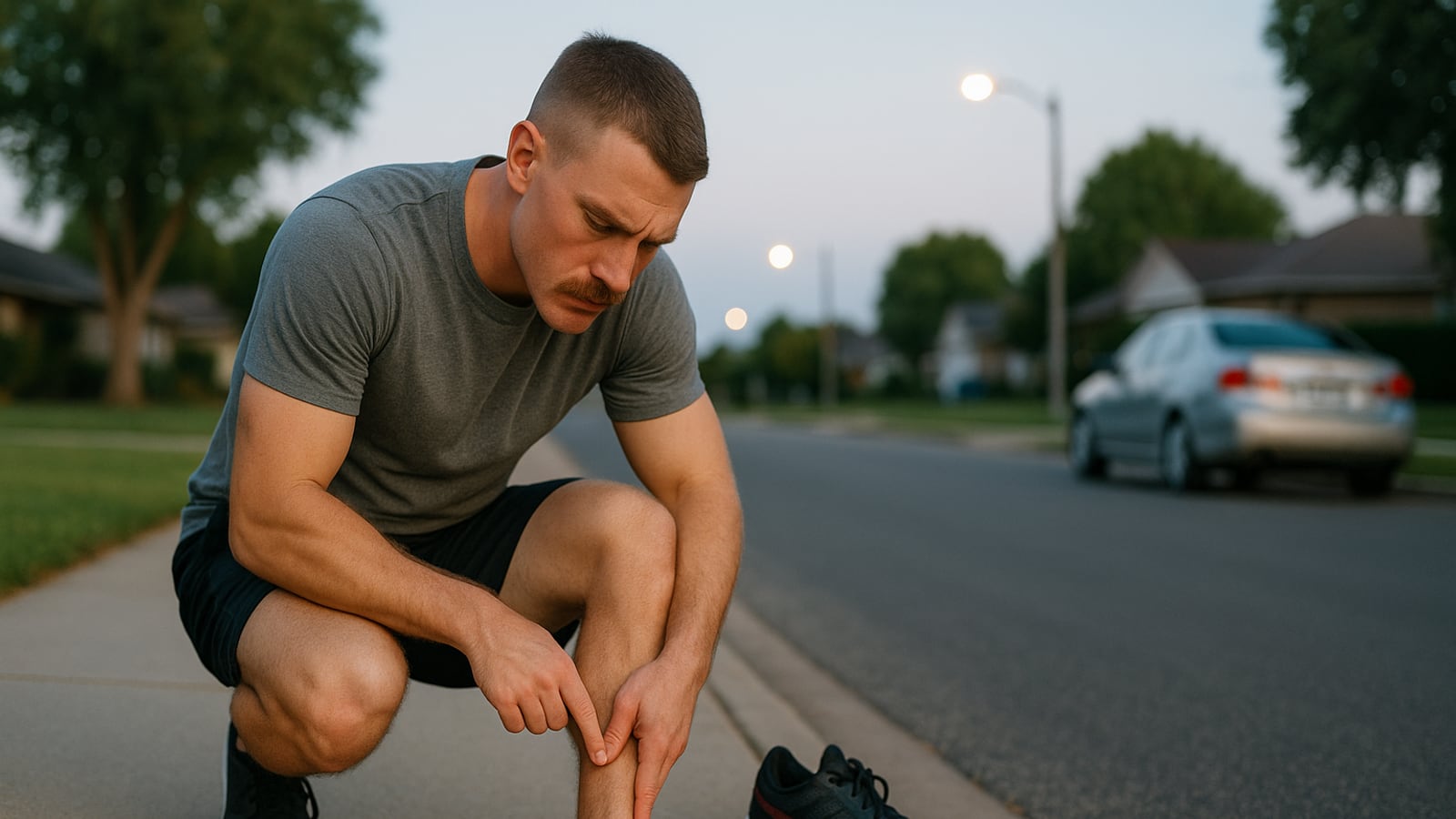
Put one fingertip on the sore spot. If you can cover the worst of the pain with the pad of a single finger, and pressing there makes you wince, that's the one that gets a phone call. If the ache smears along four or five inches of the inner edge of your shin bone and no single spot is the villain, you're probably dealing with the cranky version.
That's not a diagnosis. It's triage you can do in a parking lot at 6:15 a.m. before you decide whether to do the last mile.
Shin pain shows up in new runners with almost boring reliability, usually somewhere between week two and week five. Not because you're soft. Because your heart and lungs got fit faster than your bones did, and then you cashed a check your tibia hadn't funded yet.
Your cardio adapts in weeks. Bone doesn't.
Aerobic fitness moves fast. You can feel the difference in a fortnight. Blood volume, mitochondria, all of it responds quickly, which is why week four feels so much easier than week one and why you get cocky in week five.
Bone remodels on a slower clock. Load a bone and it first resorbs a little material before it lays down more, so there's a window where the bone is actually weaker than when you started. Keep piling on mileage during that window and you march down a spectrum: a bone stress reaction, then a stress fracture, then in the bad cases a real break.
Medial tibial stress syndrome, which is what most people mean by shin splints, lives at the mild end of that same spectrum. It's the bone's outer layer and the soft tissue attaching to it getting irritated by repetitive load. Same root cause. Different severity.
That's the part nobody tells a new runner. Shin splints aren't a separate condition you push through on the way to being a runner. They're an early invoice.
The four questions that sort it out
Run through these honestly.
Can you point to it with one finger? Diffuse ache along the inner shin leans toward shin splints. Pinpoint tenderness on the bone leans toward bone stress injury. Bone stress usually hurts most in a spot smaller than a quarter.
Does it hurt at rest, or at night? Shin splints generally quiet down when you stop moving. Pain that wakes you up, or that sits there while you're on the couch, is a flag.
Is it arriving earlier every run? Classic shin splints hurt for the first few minutes, warm up, then come back after. A bone stress injury tends to show up sooner in each successive run, then during walking, then all the time. If last week it hurt at mile two and this week it hurts at the mailbox, that trend line matters more than the pain level.
Can you hop on it? Ten single-leg hops. Sharp local pain on the bone means stop hopping and stop running. Muscular soreness and general dislike of hopping isn't the same thing.
None of these four is proof. Put together, they tell you whether the next move is "manage it" or "get it looked at."
If it's the pinpoint kind
Stop running. Today, not after the race you already paid for.
Early X-rays are frequently normal with a stress fracture, because there's nothing to see until the bone starts healing or the crack gets big enough. A clean X-ray at week one isn't an all-clear. If a sports medicine doctor or physical therapist thinks the story sounds like a bone stress injury, they'll often treat it as one regardless, and MRI is the tool that actually shows early changes.
Location matters a lot. Most tibial stress fractures sit on the inner back edge, they're compression-side, and they heal with rest. A few sites are what doctors call high-risk: the front of the tibia, the femoral neck up in the hip, the navicular in the midfoot, the base of the fifth metatarsal. Those are slower to heal and can go badly if you keep loading them. Hip or groin pain that hurts when you hop is a today problem, not a next-month problem.
Ask the professional. This is general education, not a plan for your specific leg.
If it's the diffuse kind, here's how you keep training
Cut, don't quit. Most people can hold onto fitness through shin splints if they respect the ceiling.
Drop volume by about half and keep frequency. Three short runs beat one long one for tissue that's adapting. Twenty minutes, three times a week, is a real training week. It also fits between a work call and a school pickup, which is the only week you actually get.
Use the two-hour rule. If the shin hurts more two hours after a run than before it, or if it's stiff and sore the next morning, that run was too much. Not a catastrophe. Just data. Take about 15 percent off the next one.
Run-walk on purpose. Four minutes easy, one minute walking, repeat. It's not a beginner's consolation prize. It's how you get aerobic time in while keeping cumulative impact down.
Shorten your stride slightly. A modest bump in step rate reduces impact loading without you needing a gait lab. Count your right foot strikes for 30 seconds and try adding four or five. It should feel like you're shuffling. That's normal.
Cross-train the difference. Bike, elliptical, pool, rowing. Steady state on a bike for 40 minutes isn't a downgrade from a 30-minute run.
The unglamorous stuff that actually prevents the second episode
Calf raises. Straight-leg for the gastroc, bent-knee for the soleus, which is the muscle that eats the most load when you run and the one new runners have the least of. Three sets to near failure, twice a week, off a step so you get full range. Add a backpack with books in it when bodyweight gets easy.
Hip work. Single-leg step-downs, side planks, split squats. A hip that collapses inward sends more load into the shin.
Shoes that aren't finished. Foam packs out long before the upper looks worn. If a pair has covered several hundred miles, or if it's the pair you also wore to mow the lawn all summer, it's done. Don't switch to a radically different shoe, especially a minimal or zero-drop one, in the middle of a shin problem. That's a new stimulus applied to an already complaining bone.
Eat enough. This one gets skipped and it's the one that quietly causes the worst outcomes. Bone needs calories, calcium and vitamin D to remodel. Running an hour a day on coffee and whatever's left on your kid's plate is a recipe for a tibia that can't keep up. For women especially, a disrupted or absent cycle alongside hard training is a signal to see a doctor, not to tough out.
The timeline nobody wants
Shin splints caught early and managed properly: often a few weeks to feeling normal, longer to full mileage.
A low-risk tibial stress fracture: plan on six to eight weeks off running, sometimes more, then a graded return that starts with walk-jog intervals and feels insultingly slow. Come back at the volume you left and you'll be back in the boot by Labor Day.
The second one is the injury that actually costs you. Runners who blow up the comeback lose a season. Runners who take the boring return keep running for thirty years.
You've got a job and kids and a forty-minute window. Spend it on the version of this that you can still be doing in March.
Cal Brennan
Fitness
Strength coach. Trains fathers, tradesmen and desk workers, which means programmes that survive a bad week.

Watch
Worth an hour of your evening
More from Fitness.
From channels we rate. Plays on YouTube.
Read next