The four places a runner's knee hurts and what each one means
Point at the sore spot with one finger. Where it lands tells you most of what you need to know before you spend a dollar.
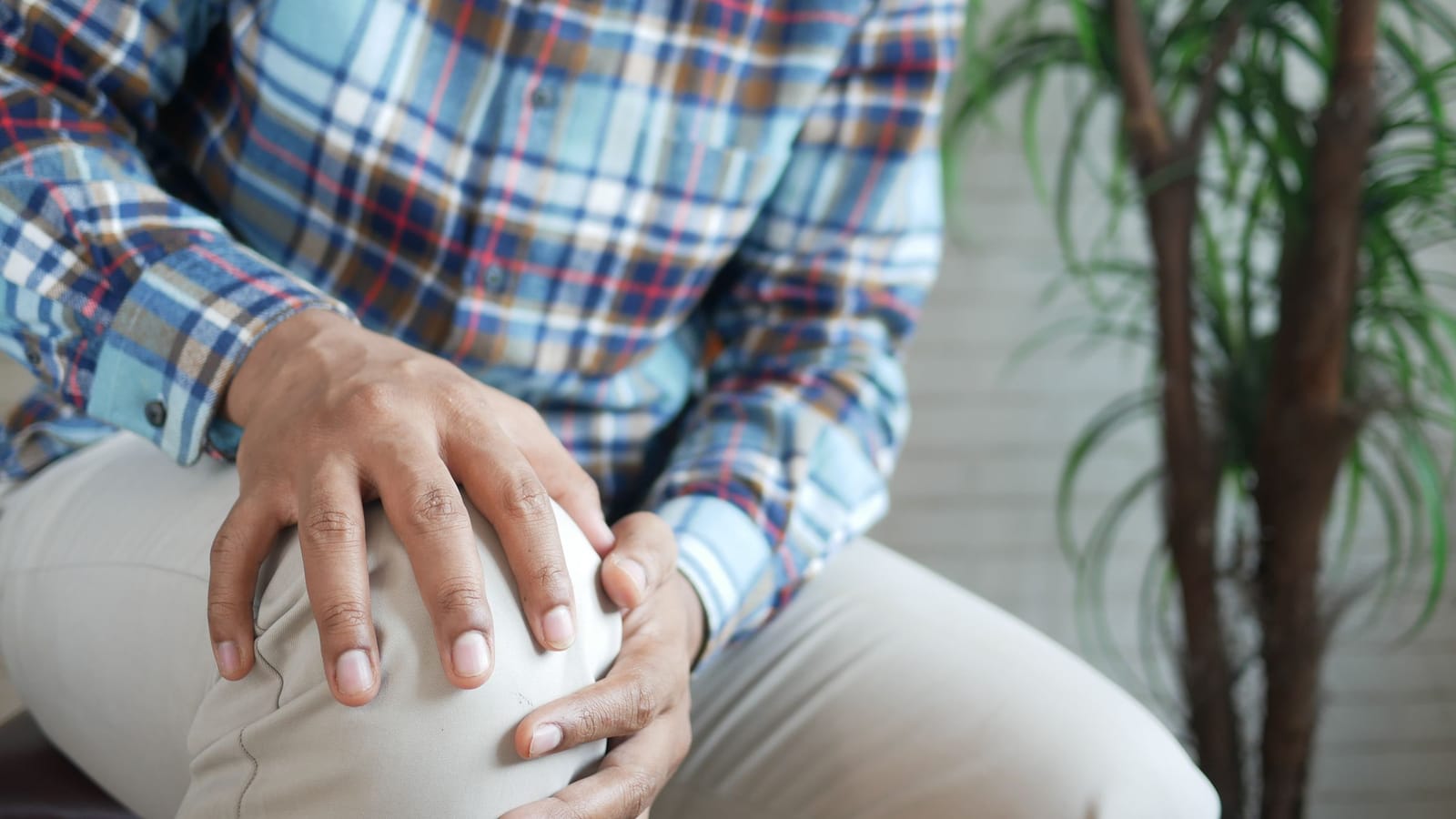
Point at it with one finger. Not your whole hand slapped over the kneecap. One finger, on the exact spot that lights up when you run downstairs.
That single move narrows things down faster than an hour of reading, and it's free. Knees are bad at describing themselves, but they're very consistent about location.
Front and center, around or under the kneecap
This is the common one. Runners call it runner's knee, clinicians call it patellofemoral pain, and it behaves in a way you'll recognize immediately. It's worse going down stairs than up. It aches after you've been sitting through a two-hour movie or a long drive with your knee bent. It's often vague, and when you try to point at it with one finger you end up circling the kneecap instead.
That vagueness is the tell. It's irritation at the joint between the kneecap and the thigh bone, and it's almost always a load problem rather than damage. Your knee absorbed more than it was ready for, repeatedly.
The outside, sharp, at the same mile every time
IT band syndrome runs on a schedule. Three easy miles, nothing. Then a hot, sharp line on the outside of the knee just above the joint, and it gets worse from there. Walking home is fine. Starting again tomorrow, fine for three miles.
Downhill running makes it angrier. So does a long run on a road with a heavy camber, where one leg is quietly running on a slope for eight miles.
Just below the kneecap, on the cord
Press the thick cord between your kneecap and your shin. If that's the exact spot, you're looking at patellar tendinopathy. Its personality: sore for the first ten minutes, feels great once you're warm, then hurts for the rest of the evening and is stiff the next morning. Jumping, hills and heavy squats stir it up.
Tendons don't respond to rest the way muscles do. Rest a tendon for three weeks and you get a well-rested tendon that's still not strong enough. That matters for what comes later.
Inside the joint, with swelling, clicking or locking
Deep, inside, with a knee that puffs up, catches, or gives way going down a curb? Stop self-diagnosing. That one gets an appointment. Same goes for anything that follows a twist or a fall.
What actually caused it was the last three weeks
Almost nobody gets knee pain from bad form they've had for twenty years. They get it from a change. Look back at your log, your calendar, your phone's step count, whatever you've got, and find what moved.
Mileage jumped after a race entry. You started running the hilly loop instead of the flat one. Treadmill winter, then road spring. New shoes with a different heel height. Or the most common one for anybody with kids in the house: you missed nine days, came back, and ran the exact pace and distance you were running before the break. Your fitness waited for you. Your tendons didn't.
The old rule of thumb is to add no more than about ten percent of your weekly volume at a time. It's crude and it's not a law of physics, but it fails in the right direction.
Two knobs you can turn this week
Cadence. Count how many times your right foot lands in thirty seconds, then double it. If you're down around 76 to 80 steps a minute per leg, try nudging the total up by about five percent with a metronome app. Same pace, smaller steps, feet landing closer under your hips instead of way out in front. It feels ridiculous for two runs and then it doesn't. For front-of-knee pain, it's the fastest lever you've got.
Downhills. Cut them for two or three weeks. Running downhill is the most demanding thing you do to the front of your knee, and it's the part of the route nobody thinks of as work.
Don't stop. Subtract.
The instinct is total rest, and total rest is usually the wrong dose. Most people do better cutting volume by a third to a half, keeping the easy runs, dropping speed work and hills, and rebuilding over four to six weeks.
The guideline a lot of physical therapists use: pain during the run stays mild, and your knee is no worse the next morning than it was this morning. If either fails, you took too much. Cut again.
Fill the gap with a bike, an incline walk on the treadmill at 8 to 12 percent, or a rower. Your engine doesn't care that your knee is sulking.
Twenty minutes, twice a week, and hips do most of it
Strength work won't fix your knee by Saturday. It fixes your knee by August. Do it anyway, because it's the only part of this that compounds.
- Rear-foot-elevated split squat — 3 sets of 8 per leg. Back foot on the couch. Hold a dumbbell when bodyweight gets easy.
- Step-down from a 6 to 8 inch step — 3 sets of 8 per leg, taking three full seconds to lower. Watch the knee in a mirror or a window. If it collapses inward, lower the step.
- Single-leg calf raise off a stair — 3 sets of 12 to 15, full range, slow down. Your calves are a shock absorber for the knee and most runners have shockingly weak ones.
- Single-leg deadlift or a slider hamstring curl — 3 sets of 8.
- Side plank with a top-leg lift — 3 sets of 30 to 45 seconds per side.
For tendon pain specifically, add a wall sit or a Spanish squat: knees bent to about 70 or 80 degrees, hold 45 seconds, five rounds, and do it before you run. Holds calm a cranky tendon down in a way stretching never does.
Shoes, and the two ways people get them wrong
The common guidance is to replace running shoes somewhere between 300 and 500 miles. The first mistake is running them to 800 because they still look clean. Foam dies before the upper does.
The second mistake is bigger. When your knee hurts, you change the shoe, the heel drop, the insole and the training plan in the same week, then you have no idea which one helped. Change one thing. Give it two weeks. If you can swing it, rotate two different pairs so your legs aren't loaded in exactly the same way every single day.
A quick concession, since it cuts against the tidy version of this advice: some people genuinely do better in a shoe with more heel drop when the front of the knee is the problem, and worse when the Achilles is. Bodies aren't standardized. Yours gets a vote.
When to quit reading and make the call
Swelling that shows up within a few hours. A knee that locks or won't fully straighten. Giving way. Pain you can't walk on. Pain at night that wakes you. Redness with a fever. Or six weeks of doing the sensible things with no change at all.
That's a doctor or a physical therapist, not an article. Nothing above is medical advice, and no writer can examine your knee from here.
Your knee isn't broken. It's overdrawn. Pay it back in small installments and it'll still be running with you when the guy who ran through it's on a stationary bike, telling everybody about his old marathon time.
Cal Brennan
Fitness
Strength coach. Trains fathers, tradesmen and desk workers, which means programs that survive a bad week.

Watch
Watch how it's done
Picked for this article.
From channels we rate. Plays on YouTube.
The Run Experience
Know Your Knees | A Runner's Roadmap to Diagnosing Pain
Rehab Science
Runner’s Knee: 4 Rehab Exercises for Patellofemoral Pain
Read next