
Rotate your tires at home and read what the tread tells you
An hour in the driveway twice a year buys you thousands of extra miles and an early warning on your alignment, your shocks and your right foot.
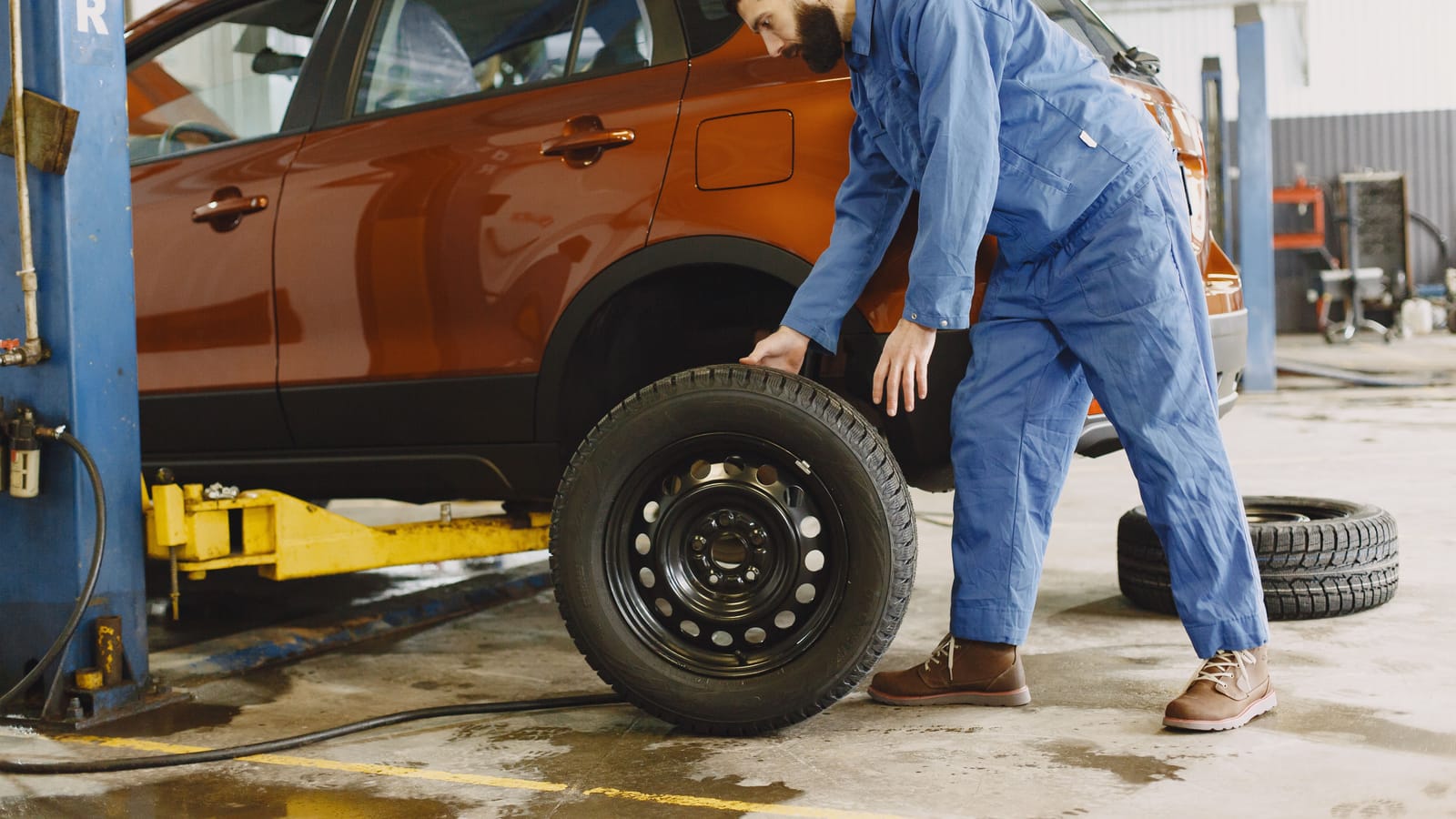
Break the lug nuts loose while the wheels are still on the ground. Quarter turn each, no more. If you skip this and jack the car up first, the wheel spins when you push on the breaker bar and you'll stand there in your driveway looking like a man wrestling a turnstile.
That's the whole job in miniature: it's easy, and the order matters.
Tire rotation is one of the few maintenance items where the manufacturer's advice and the cheapskate's advice agree. Every 5,000 to 7,500 miles, or every oil change, whichever comes to mind first. Tires wear unevenly by design. On a front-drive car the fronts do the steering, most of the braking and all of the pulling, and they'll be down to the wear bars while the rears still look showroom. Move them around on schedule and the whole set ages together. Skip it for 40,000 miles and you'll buy two tires early, then two more a year later, forever out of sync.
What you actually need
A floor jack. Two jack stands minimum, four if you want to do the job in one lift. A breaker bar with the right socket, usually 19mm or 21mm, and a torque wrench. A tread depth gauge costs a few dollars at any parts store and is worth owning, though a penny will do in a pinch.
The torque wrench is the one people skip and shouldn't. A click-type half-inch drive is the single most useful tool in a home garage after the jack, and it's the difference between wheels that come off next time and wheels that don't. Buy one in the $40 to $150 range and store it dialed back to its lowest setting so the spring doesn't take a set.
What you don't need: an impact gun. Guns are for taking nuts off, and half the shops that use them to put nuts back on are hammering your studs to 150 ft-lbs and warping your brake rotors on the way out the door.
Getting the car in the air without getting hurt
Flat concrete. Not the sloped part of the driveway, not asphalt in August, because jack stand feet sink into hot blacktop and you won't enjoy learning that from underneath.
Chock a wheel at the opposite end of the car from wherever you're lifting. Park brake on if you're lifting the front, off and in gear if you're lifting the rear and using the brake would defeat you. Find the pinch weld seams or the frame lift points in the owner's manual, because the floor pan isn't a lift point and the plastic aero tray definitely isn't.
Then the rule that has no exceptions. Never put any part of yourself under a car held up by a hydraulic jack. The jack lifts. The stands hold. Once the stands are set, lower the jack until the car settles onto them and give the fender a shove to make sure nothing rocks.
Now the part nobody warns you about: on a car that's spent a few winters in salt country, the aluminum wheel will be corrosion-welded to the steel hub and won't come off when you pull. Don't hang off it. Thread two lug nuts back on a few turns so the wheel can't fly at you, then kick the tire from behind with the flat of your foot. It'll pop. Wire-brush the rust off the hub face before the next wheel goes on, or you'll fight the same fight next spring.
Which pattern for your car
Front-wheel drive, non-directional tires: forward cross. The fronts go straight back. The rears cross over to the opposite front corner.
Rear-wheel drive or all-wheel drive: rearward cross. Rears go straight forward, fronts cross to the opposite rear.
Directional tires, the ones with an arrow molded into the sidewall: front to back on the same side only. Cross them and the tread pattern is running backward, which kills wet grip and makes a noise like a small aircraft.
Staggered setups, where the rears are wider than the fronts: you can't rotate without dismounting the tires. That's a shop job, and on most performance cars it isn't worth paying for.
If you've got a full-size matching spare, put it in the rotation. Five tires wearing together beats four tires wearing and one turning to rock in the trunk. Donut spares stay where they are.
Torque, and the part everyone forgets
Star pattern, always. Opposite corners, never around the circle. Snug them all by hand first, then bring the car down until the tires just touch, then torque.
Most passenger cars want 80 to 100 ft-lbs. Half-ton trucks are usually 130 to 140. Look it up in the owner's manual rather than guessing, because the range between "fine" and "stretched stud" isn't as wide as you'd think.
Don't put anti-seize or oil on the studs. A lubricated thread reaches a given torque reading with far more clamping force behind it, and you'll yank a stud in half wondering why it felt so easy.
Drive 50 miles, then re-torque. Fresh wheel seating settles, and this takes four minutes.
Reading the tread while you're down there
This is the real payoff. The tires have been writing down everything the car does, and you've got them off and lying flat.
Check depth in three places across each tire: outer shoulder, center, inner shoulder. A penny with Lincoln's head pointed down tells you when you've hit 2/32", which is legal minimum in most states and far past the point where the tire is any good in rain. A quarter, Washington's head down, marks roughly 4/32". That's the number to start shopping at if you see snow.
Now compare the three readings on each tire.
- Both shoulders worn, center healthy. You've been running them soft. Check pressures monthly against the sticker in the driver's door jamb, not the number on the sidewall, which is a maximum and not a recommendation.
- Center strip worn, shoulders fine. Overinflated.
- One edge gone, the other sharp. Camber. Alignment shop.
- Sawtooth edges on the tread blocks. Run your palm across the tread sideways, both directions. If it's smooth one way and grabby the other, that's feathering, and it means toe is out. You'll feel this before you ever see it.
- Scalloped dips around the circumference. Cupping. Usually tired shocks or struts letting the tire bounce. New tires will do the same thing if you don't fix the damper.
A 3/32" difference between the inner and outer shoulder on the same tire is your cue to get an alignment before you rotate. Otherwise you're just relocating the damage.
Age, which has nothing to do with tread
Find the DOT code on the sidewall. The last four digits are the week and year of manufacture, so 2321 means the 23rd week of 2021. Rubber hardens whether you drive on it or not. Ten years is the outside limit almost everybody agrees on, and six is where a trailer tire or a spare starts getting suspicious regardless of how deep the tread looks.
If a sidewall has a bulge, a cut deep enough to show cord, or a puncture in the shoulder rather than the flat tread face, stop reading and take it to a tire shop. Those aren't repairable and they aren't a judgment call.
Two hours, twice a year, and a set of tires that were sold as 60,000-mile tires might actually get there. Your mechanic will still find something else.
Dean Shaw
Gear & Garage
Reads the warranty, the parts list and the long-term owner reviews before anything else. Trucks, tools, watches, and the cheap version that costs more.

Watch
Worth an hour of your evening
More from Cars.
From channels we rate. Plays on YouTube.
Read next