Forming faith at home when the culture won't help you
Children's faith is built in ordinary hours, not big speeches. A practical look at what to put in the week, and what usually goes wrong.
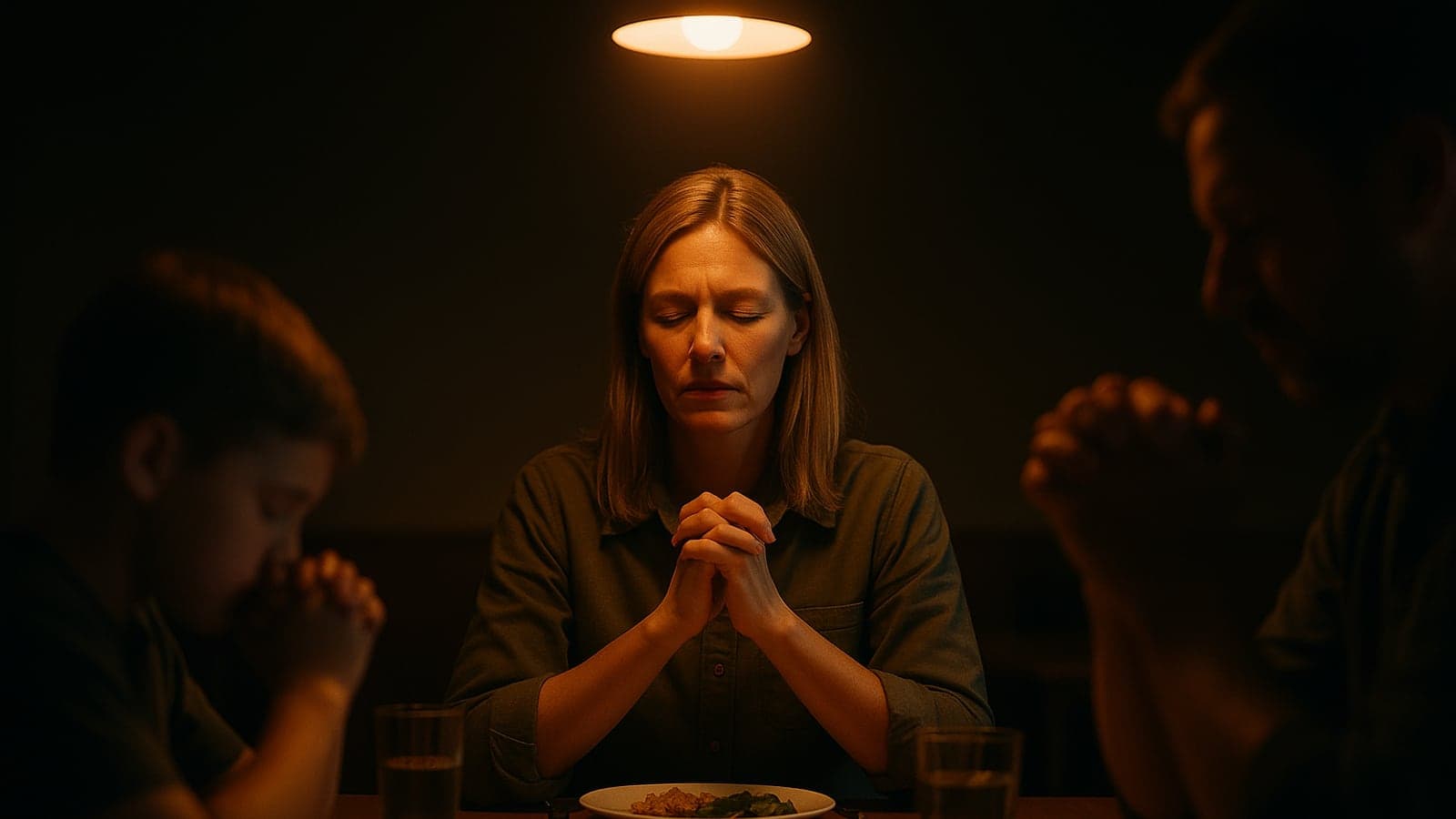
Put it on the calendar before you put it in an argument.
Most parents who worry about this are trying to win a debate with the culture. The culture isn't debating you. It's just showing up every day, cheerfully, with better production values and no bedtime. You don't beat that with one powerful conversation in the car. You beat it with repetition your kids can't remember starting.
So the first question isn't "what do I say." It's "what happens every Tuesday in my house."
Three minutes that survive a bad week
Pick a fixed slot. Breakfast, or the end of dinner, or the edge of bedtime. Make it short enough that you'll still do it when you're tired, because tired is the normal condition of a parent.
A workable shape: read a few verses, ask one question, pray for two named things, done. Three to five minutes. If a five-year-old is at the table, you're reading less and praying shorter.
The temptation is to design something impressive. Don't. An elaborate family devotional that runs for nine days and then collapses teaches your children that faith is a project their dad abandons. A thin, boring, unbreakable three minutes teaches them that God is simply part of how this family works.
Deuteronomy 6 doesn't describe a program. It describes a texture. Teach these words to your children, "when you sit in your house, and when you walk by the way, and when you lie down, and when you rise." Sitting, walking, lying down, rising. That's the whole day, and none of it sounds like a seminar.
Sunday is one hour out of a hundred and sixty-eight
Do the arithmetic once and you'll never outsource again. Church matters enormously. But if the church is doing all of the forming and you're doing none, your children are getting one hour of instruction against a week of everything else.
That's not a criticism of your church's kids program. It's a description of the math.
What the church gives you that you can't manufacture at home is other people. Your kids need adults who aren't you and who love the same God — a Sunday school teacher who knows their name, a youth leader, an older man at church who asks about their season. Somewhere between four and six such adults is the difference between a faith that belongs to their parents and a faith that belongs to them.
That means showing up consistently enough for those relationships to exist. Rhythm, not mood. You go when you don't feel like it, which is also the lesson.
Teach them to pray out loud, badly
Children learn to pray the way they learn to talk, by doing it in front of someone patient.
Give them a frame at bedtime. Thank God for one thing. Say sorry for one thing. Ask for one thing, and one thing for someone else. That's it. Don't correct their theology mid-prayer. Don't make them perform.
And pray out loud yourself in front of them, including the parts you'd rather edit. When you've lost your temper at them, apologize and then pray about it where they can hear it. That single habit does more than any curriculum. Kids can smell a father who teaches repentance but never practices it, and what they conclude is that the whole thing is for other people.
Paul tells fathers not to provoke their children to anger, but to bring them up in the discipline and instruction of the Lord. Those sit in the same sentence for a reason. Instruction delivered by a man your children are braced against doesn't land.
Memorize a few real things
Memorization has gone out of fashion and it shouldn't have. Words learned young sit in a person for decades and surface exactly when they're needed — in a hospital corridor, at three in the morning, at a graveside.
Pick a short list and take a year over it. Psalm 23. Psalm 100. The Lord's Prayer. A couple of passages that name who God is rather than only what he wants. Say them together in the car until nobody has to think.
Don't turn it into a test. Turn it into a thing your family says.
Read the culture with them, not around them
You can't seal the house. Attempting it produces eighteen-year-olds with no immune system and no idea why anyone believes what they believe.
The better move is narration. Watch the show, then ask what the story thinks the good life is. Who's the hero? What does it say makes a person valuable? Where is it right? Almost every story is right about something.
Do this in a curious tone, not a prosecutorial one. If every conversation about media ends in a verdict, your kids will stop telling you what they watched. The goal is a teenager who can hear a claim about money, or sex, or identity, or success, and think clearly about it — not one who can only flinch.
That's also how you handle the hard questions. When your nine-year-old asks something you can't answer, say you don't know and that you'll find out together. Faking certainty is a short-term win and a long-term catastrophe. The child who catches you bluffing at ten will discount you at sixteen.
Screens, and the one boundary worth fighting for
Every family lands somewhere different here, and you'll be judged for wherever you land. Decide anyway.
The specifics that tend to hold up:
- No personal devices in bedrooms overnight. Everything charges in the kitchen. This one rule does more than any filter.
- Delay the smartphone longer than feels socially comfortable. A basic phone for calls and texts buys you years. Talk to other parents in your church and delay together, because the pressure is a group problem.
- Filters on the network, and the assumption that they will fail. Software is a speed bump. Conversation is the actual control.
- Name what you're protecting. "So your mind is your own" lands better than "because I said so."
And model it. A father who lectures about screens over the top of his own phone is teaching the opposite of what he's saying.
What usually goes wrong
Faith gets used as a discipline tool. Scripture quoted only when someone's in trouble becomes the sound of being in trouble.
Behavior gets mistaken for belief. Compliant children are pleasant and prove nothing. Ask about their hearts, not just their manners.
Fear becomes the engine. Parents frightened of the culture start parenting defensively, and children can tell the difference between a house built on confidence and one built on threat.
And the big one: treating Proverbs 22:6 as a guarantee. Train up a child in the way he should go is wisdom, not a warranty. Faithful parents have wandering children. That's been true since the first family in Genesis. You are responsible for the sowing. You are not sovereign over the harvest.
Keep the table. Keep the three minutes. Keep apologizing out loud.
Twenty years from now your kids won't remember a single family devotional. They'll remember whether prayer in your house sounded like anxiety or like coming home.
Josh Halloran
Christian Bro
Leads a mid-week mens group and has done for eleven years. Writes about faith as a practice rather than a position.

Read next