
Quick answer: Pick one short verse that fits the week you're actually living. Tape it where you stand every day, say it out loud there, and spend more time reviewing old verses than learning new ones. The review is what makes it stick.
You memorized John 3:16 at seven because somebody made you. There was a teacher, a gold star, a chart on the wall, and a mother who quizzed you in the car on the way to church. Your brain wasn't better then. The system around it was.
Grown women tell themselves they "just can't memorize anymore." Then they recite every word of a commercial jingle from 1994 without trying. The memory is fine. What's gone is the repetition, the accountability and the reason to say it out loud. Put those back and the verses come back with them.
Choose the verse for this week, not the "important" one
Most women start with a verse they think they should know. It lasts about four days.
Start with the verse you need. If you're lying awake over a diagnosis, a teenager or the bank balance, learn Isaiah 26:3 (ESV): "You keep him in perfect peace whose mind is stayed on you, because he trusts in you." If you're running on empty with a newborn, learn Lamentations 3:22–23 (ESV): "The steadfast love of the LORD never ceases; his mercies never come to an end; they are new every morning; great is your faithfulness."
A verse you reach for on Tuesday afternoon gets rehearsed without any effort from you. A verse you picked out of duty gets forgotten by Friday.
Two more rules for choosing:
- Keep it under about thirty words for your first dozen. Long passages come later, once the habit is built.
- Use one translation and stay with it. Use the one your pastor preaches from if you can. Every Sunday you'll hear your verses read aloud in the same wording, and that's free review. If the KJV's rhythm sticks better for you, that's a perfectly good reason to choose it. Just don't switch halfway through the year.
Seven days, five minutes a day
This is the schedule that works for most women I know. Use it as a starting point and adjust it to your house.
Sunday night. Write the verse by hand on a 3x5 index card, reference at the top. Handwriting slows you down, and slow is the point. Read it aloud three times, reference included. Say "Lamentations 3:22" before and after the verse. The reference is what lets you find it again and share it with someone else.
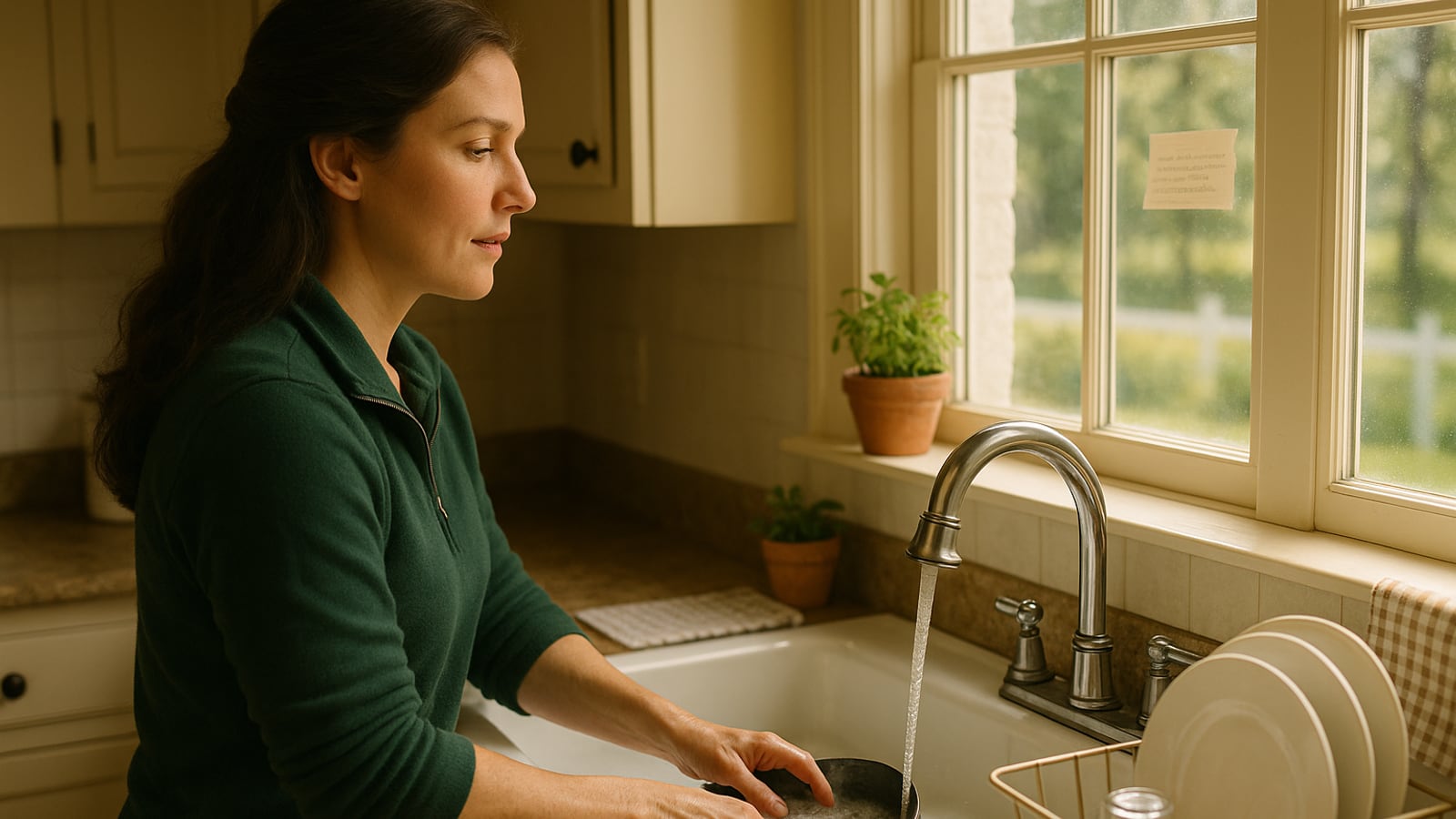
Monday. Tape the card where you stand every day without fail. For most of us, that's above the kitchen sink. Every time the water runs, read it out loud. You'll feel silly. Do it anyway.
Tuesday. Make a second card with only the first letter of each word. Isaiah 26:3 becomes Y k h i p p w m i s o y, b h t i y. This is the single best trick for adults. It forces you to recall the words instead of reading them, but it catches you before you get lost.
Wednesday. Say it from memory before you look. Then check the card. Whatever you missed, and you'll miss something, is exactly what you drill that day.
Thursday. Say it to someone. A child, a husband, a friend by text, the dog. Speaking to a person is a different kind of recall than murmuring at a cabinet door.
Friday and Saturday. Say it from memory three times a day, tied to things you already do: before you start the car, while the coffee brews, when you brush your teeth.
Sunday. Say it perfectly, reference included, before church. Then it goes into the review box and a new card goes above the sink.
Picture a real Wednesday. The oatmeal pot is soaking, the toddler is under the table, and you're scrubbing with the card at eye level. You get to "his mercies never come to an end" and stall. You glance up. You say it again. That's the whole method. It takes no quiet hour and no candle, just a card and a sink. If you want a longer, slower time with the Word alongside this, Fifteen Minutes, One Psalm and a Cup of Coffee pairs well with it.
Review is the whole game
This is the part nobody tells you, and it's why most women quit around week six. You learn a verse, move on, and three weeks later it's gone. That feels like failure. It's actually just what happens when there's no review.
Keep a simple box, a recipe box works, with three dividers:
- Daily: this week's verse and last week's.
- Weekly: verses from the past two months. Say one or two every day, rotating through.
- Monthly: everything older. Pull a card or two a day.
The Navigators have taught a pocket-card version of this for decades, and it has lasted because it works. If you'd rather use your phone, apps like Scripture Typer and Bible Memory run the same review idea automatically. Honestly, though, the phone is where you lose ten minutes to something else. The card in a box doesn't buzz.
By the end of a year you'll have around fifty verses, and the review will take maybe ten minutes a day. A grown woman with fifty verses stored away is a formidable thing.
When you miss a week
You will. The flu goes through the house, your mother lands in the hospital, somebody's getting married. Don't start over and don't punish yourself with two verses the next week. Leave the same card above the sink and pick it back up. Psalm 119:11 (ESV) says, "I have stored up your word in my heart, that I might not sin against you." Storing is slow work, done a little at a time, and grace covers the gaps.
This is a discipline, not a scorecard. Nobody in heaven is keeping a sticker chart.
Don't do it alone
The women who keep this going for years almost always have a partner. Pick one friend. On Sunday night, text each other the week's verse. On Saturday, one of you calls and the other recites. It takes two minutes and it changes everything, because now somebody will ask.
If you already meet with a group, add one shared verse a month to the end of your time together. Start a Women's Bible Study With Six Chairs and One Book has more on building a group that actually lasts.
And bring the children in. Deuteronomy 6:6–7 (ESV) already told you how: "And these words that I command you today shall be on your heart. You shall teach them diligently to your children, and shall talk of them when you sit in your house, and when you walk by the way, and when you lie down, and when you rise." Say the week's verse at dinner. Kids learn it faster than you do, and they love correcting you. Let them.
A few to start with
Make sure a handful of your first verses are the gospel itself, so you have it ready when a friend at work or a neighbor asks what you believe:
- Ephesians 2:8–9 (ESV): "For by grace you have been saved through faith. And this is not your own doing; it is the gift of God, not a result of works, so that no one may boast."
- John 14:6 (ESV): "Jesus said to him, 'I am the way, and the truth, and the life. No one comes to the Father except through me.'"
- 2 Corinthians 12:9 (ESV): "But he said to me, 'My grace is sufficient for you, for my power is made perfect in weakness.'"
- Proverbs 3:5–6 (ESV): "Trust in the LORD with all your heart, and do not lean on your own understanding. In all your ways acknowledge him, and he will make straight your paths."
If you want help using those verses in a real conversation, Way of the Master's material is built for exactly that.
Why it's worth the silly feeling
Someday it'll be two in the morning. A child will be burning up with fever, or the phone will ring with news you didn't want. You won't have your Bible open. You won't have the energy to look anything up.
And a verse you taped above a sink eight months ago will simply be there, word for word, reference and all.
Nina Castellan
BRO for Her
Runs the women-facing desk. Same standard, same tools, written for a different reader — not a softer one.

Watch
Worth an hour of your evening
More from Christian Women.
From channels we rate. Plays on YouTube.
Read next