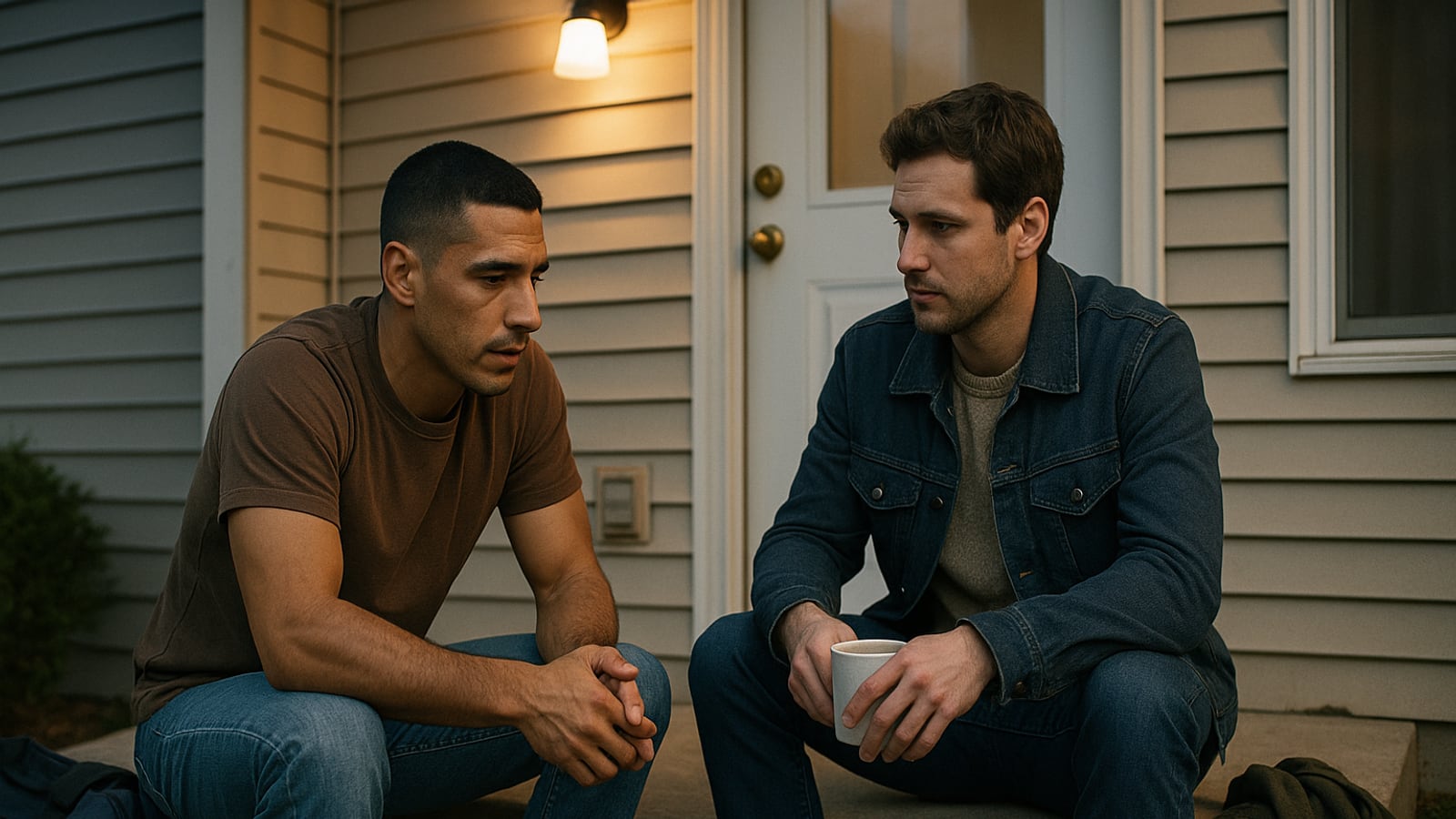
Say it out loud, to one person, in plain words, in the first week. "That hurt. I'm not fine yet."
That single sentence does more than a month of white-knuckling. Not because talking is magic, but because the alternative — the shrug, the "yeah, it was mutual, honestly it's for the best" — commits you to maintaining a story you don't believe. Maintaining it costs energy every single day. You end up spending more effort managing the appearance of recovery than actually recovering.
Pick the right person for it. Not the group chat. One friend who won't repeat it and won't try to fix it. A brother. A man at church. Your dad, if your dad is that kind of man. Then get on with the rest of it.
Set an end date for contact and write it down
Vague no-contact doesn't work. "I'll give it some space" means you'll message on the third bad night.
Give it a number. Ninety days is a reasonable default for a serious relationship, thirty for something short. Put the date in your calendar. You're not punishing anybody. You're giving your nervous system enough consecutive quiet days to stop scanning for her name.
Then handle the mechanics, because the mechanics are what break you.
- Mute or block, and be honest about which you need. Muting looks mature and keeps the door open, which is exactly why you'll check the profile at midnight. If you know you'll check, block. Nobody's watching your dignity here.
- Move the photos, don't delete them. Off the phone, onto a drive, out of the rotation. You should not make a permanent decision about six years of your life during the worst fortnight of it.
- Return the belongings in one trip. One box, one handover, no coffee afterwards. Two trips becomes four. Four becomes a relationship conducted entirely through cardboard.
The closure conversation almost never delivers closure
You want one more talk where she explains it in a way that finally makes sense, admits what she did, and confirms you were loved.
That conversation exists in your head only. What you actually get is a tense hour in a café where both of you're careful, one of you cries, and you leave with a new sentence to replay for three months. If there are real logistics — a lease, a shared dog, money — handle those in writing, briefly, and stop.
The closure you're after isn't information. It's the ability to hold the whole thing without it deciding your mood. That comes from time and from behaving well, not from an explanation.
Your body is voting, and it's voting badly
Grief lives in the body more than people expect. Chest tightness, no appetite, or eating constantly. Waking at four. A flatness that feels like it'll be permanent.
You can't think your way out of that, but you can stop making it worse. Bed at a fixed time, even when you're not sleeping well. Food at fixed times, even when you don't want it. A walk outside every morning, thirty to forty minutes, before you look at your phone. Lift something heavy two or three times a week if you already train.
The reason isn't that exercise cures heartbreak. It's that a body running on five hours of sleep and coffee reads ordinary sadness as catastrophe. You'll have Tuesday afternoons where it lands on you out of nowhere for no reason you can name. Those come regardless. They're shorter and less convincing when you've slept.
And go carefully with alcohol. Drinking makes the evening easier and the next four days harder, and it's the single most common way a two-month grief becomes a two-year one.
Own your part, specifically, once
There's a difference between accountability and self-punishment, and the difference is specificity.
Sit down with paper and write three things you actually did badly. Not "I wasn't good enough." Things with edges. I went quiet for days instead of saying I was struggling. I let my work take every good hour and gave her the tired ones. I never once apologised without adding a "but".
Three is enough. Those are the things you can carry into the next relationship and do differently. Anything past three is usually the grief talking, and it isn't true.
Then write the other list, which is harder for decent people: what you'd never take back. The things about the relationship you knew, at the time, weren't right. Write those honestly too. Memory is a flatterer. Six weeks from now it'll be editing out everything inconvenient and leaving you with a highlight reel of a relationship that didn't exist.
Do this once. Fold the paper and put it somewhere. Don't rewrite it weekly.
Let people carry some of it
Tell your friends the specific thing you need, because they want to help and most of them have no idea how.
"Keep inviting me even when I say no." "Come round Sunday, I don't want to talk about it, bring the football." "If you see me texting her on a night out, take the phone."
Men are bad at this. We accept sympathy and refuse logistics, and logistics are the actual help. If you're a person of faith, this is what a church is for at ground level — not a sermon on singleness, but somebody who notices you didn't come and turns up at your door with food. The Psalms are full of men telling God plainly that they're not coping. Lament is a category in Scripture. It's allowed. It's not weak faith; it's honest faith, and honesty is where recovery starts.
If the flatness doesn't lift, if you can't work, if you've stopped eating for weeks, or if you're having thoughts of harming yourself, that's not a willpower problem and you shouldn't wait it out. Speak to your doctor or a counsellor. Tell them the truth about how long it's been.
Knowing when you're ready to date again
There's no clean number, and anybody offering one is guessing.
But there are two honest tests. First: can you tell the story of the relationship in three minutes, without heat, to somebody who didn't know her? Second — the one that matters more — would you be a good person to date right now? Not a compelling one. A good one. Someone with room in him, who can hear about her life and be genuinely interested, who isn't running comparisons in the background.
If the answer's no, don't go looking. Dating while you're still bleeding isn't a shortcut through the grief, and it puts your pain into the hands of somebody who didn't cause it and doesn't deserve to hold it. That's a real cost to a real person. Treat it that way.
If there are children involved, the rules tighten. Never badmouth their mother in front of them, not once, not even mildly, not even when she's wrong. Handle your grief where they can't see the worst of it, and get it out somewhere they can't. They'll remember how you spoke about her far longer than they'll remember the split.
The part nobody says
You'll be fine, and it'll take longer than you want, and the last five percent may never fully go.
That's not failure. Somebody mattered to you, and a version of your life ended. A man who can be marked by that and still show up cheerful on Monday, still be kind to the next woman, still keep his promises to his friends — that man is worth choosing.
The grief isn't the thing standing between you and a good marriage. Pretending is.
Marcus Vale
Editor-in-Chief
Twenty years in magazines, most of it deciding what to cut. Writes about work, discipline and the decisions that compound.

Watch
Worth an hour of your evening
More from Dating.
From channels we rate. Plays on YouTube.
Read next