
Hitchcock scared you with what he held back
Seventy years on, Rear Window still raises more dread than most new horror. The reason is craft, and you can watch it with teenagers on the couch.
Quick answer: Hitchcock built fear out of what you expect, not what you're shown. Start with Rear Window (1954) or Shadow of a Doubt (1943). Save Psycho for adults.
This is commentary.
The scariest shot in Rear Window is a man looking at another man.
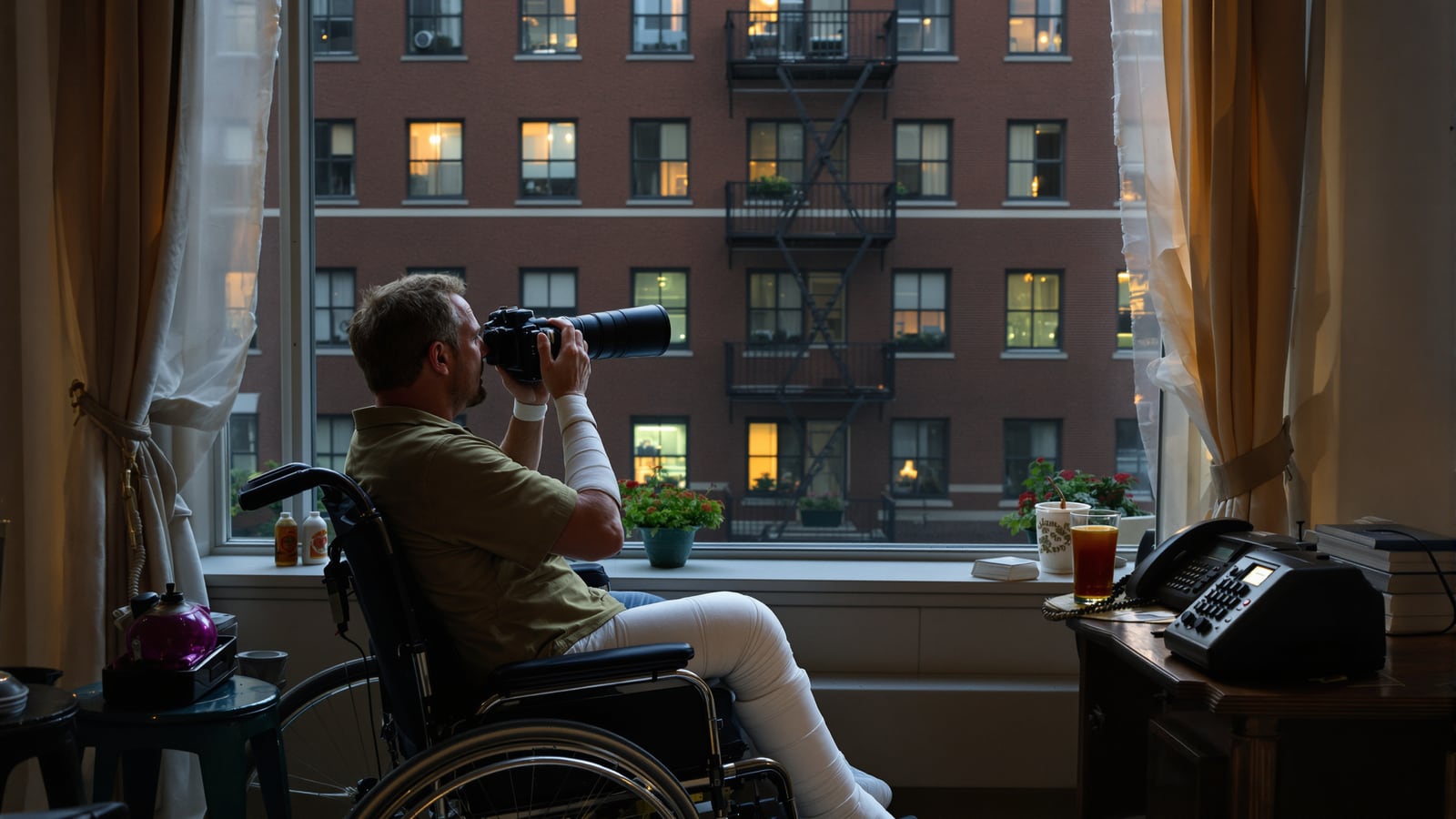
Jimmy Stewart plays a photographer with a broken leg, stuck in his apartment, watching the neighbors across the courtyard. He becomes convinced one of them has done something terrible. Late in the film, that neighbor turns and looks straight back across the gap. There's no music sting and no crash. Nobody has been touched. The whole theater goes cold anyway.
You can't buy that with a bigger effects budget.
The bomb under the table
Hitchcock explained his method to the French director François Truffaut in their famous book-length interview, and the example is simple. Two men sit at a table making ordinary small talk. A bomb goes off. The audience gets a few seconds of shock and then it's over.
Now change one thing. Show the audience the bomb under the table first. Let the men keep talking about nothing. Now you've got fifteen minutes of dread, because the audience knows what the men don't.
Hitchcock called the first one surprise and the second one suspense. He wanted suspense every time. Surprise is a sprint. Suspense is a long, slow squeeze, and it's the reason you were still thinking about the movie in the driveway.
He worked with a lid on
For most of his Hollywood career, studio films went through the Production Code office, which limited what could be shown on screen. Violence, in particular, had to stay mostly out of frame.
That sounds like a handicap. It was a gift. A director who can't show you the thing has to make you imagine it, and your imagination is a better special-effects department than any studio has ever had. It knows what scares you, specifically.
The Birds (1963) has no traditional musical score. The sound is wings, screeching and silence, and the silence does half the work. In North by Northwest, Cary Grant gets stranded on an empty road in broad daylight, with nothing but open fields in every direction. No shadows, no dark hallway. The scene is terrifying because there's nowhere to hide, and Hitchcock lets you sit in that for minutes.
Anybody can make a dark room frightening. Making a sunny afternoon frightening takes a craftsman.
What modern horror does instead
Here's my argument, and I'll make it plainly. A lot of modern horror has swapped suspense for surprise and then swapped surprise for gore. Quiet, quiet, loud noise. When that stops working, add more blood. When that stops working, add more.
It's a bomb going off over and over. The audience gets numb, so the filmmaker raises the volume, and the whole genre drifts toward a place where you can't recommend it to a mixed room. Parents know the feeling. You've got a teenager who wants a scary movie, and you've got a two-hour trailer of things you'd never let in the house.
That's an argument about a formula and an industry's habits. It isn't about the people who enjoy scary movies, and a good scare is a fine thing to want on a Friday night. Hitchcock just proves you can have it without the mess.
Where this argument gets weaker
Plenty of sensible people prefer the modern stuff, and they have points.
Hitchcock's age shows. The driving scenes were filmed against projected backgrounds, and they look fake to a modern eye. The pacing is slower than anything you'll stream tonight. The acting style belongs to its decade, and some of the dialog is stagey.
Psycho (1960) also isn't restrained at all. It shocked audiences hard and still does. It's the film that proves Hitchcock could do surprise when he wanted to. He just used it sparingly, once, and built everything else around dread.
And not every new thriller is a gore parade. Some current filmmakers clearly learned from him. But you'll find them by checking the content first, not by trusting the poster.
What to watch, with the concerns stated plainly
- Rear Window (1954). Rated PG. A murder is implied, and a woman is put in real danger late in the film. Fine for teenagers, and a good conversation starter: what does it cost a man who watches his neighbors instead of doing something?
- Shadow of a Doubt (1943). A young woman slowly realizes her charming uncle may be a killer. Menace inside a loving family home, with nothing graphic. Hitchcock's own favorite of his films, by his own account.
- North by Northwest (1959). A chase film with light action violence and some adult flirtation in the dialog. Mild by today's standards.
- Dial M for Murder (1954). A husband plots to have his wife killed. One tense struggle scene. Most of it takes place in one apartment, and it's a clever puzzle.
- The Birds (1963). Animal attacks, with injuries to adults and children. Frightening for younger kids. Wait until they're teenagers.
- Psycho (1960). Adults only. It's rated R today, with disturbing violence and mature themes. Don't put it on for the family.
Not sure about a title? The eight-minute vetting routine works on classics too. And for younger kids, start with the classics they should see before thirteen and save Hitchcock for later.
How to watch one
Turn the lights off. Put the phones in the kitchen. A Hitchcock film doesn't compete with a second screen, and it punishes a distracted viewer by being boring.
Give it the first twenty minutes. He plants everything early, a lamp, a key, a gesture, and the payoff arrives an hour later.
Then pay attention to the scene where nothing happens. Someone climbs a staircase. Someone waits at a window. A phone rings and goes unanswered. That's the one you'll still remember next week, and you'll notice nothing was shown.
Marcus Vale
Editor-in-Chief
Twenty years in magazines, most of it deciding what to cut. Writes about work, discipline and the decisions that compound.

Watch
Official trailers
The studios' own trailers and clips for the titles in this piece.
Official studio videos, matched through TMDB. Plays on YouTube.
Universal Pictures At Home
Rear Window - Trailer
Warner Bros. Entertainment
North By Northwest | Official Trailer 4K Ultra HD | Warner Bros. Entertainment
Park Circus
Dial M For Murder official trailer for rerelease
Read next