

Westerns where a man keeps his word with nobody watching
Three old Westerns where the whole plot is a promise nobody would ever catch him breaking, and what to know before you press play.
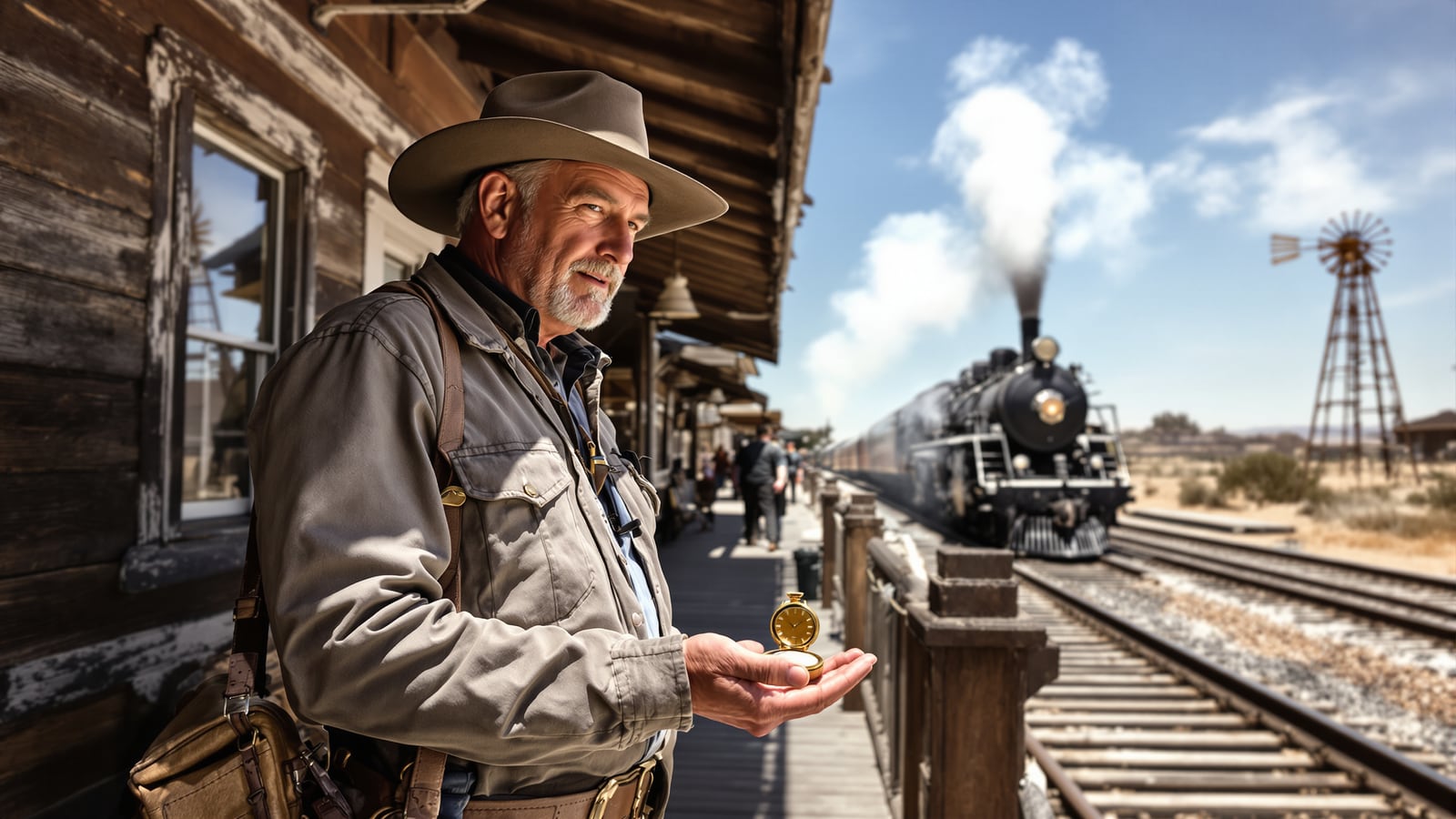
Quick answer: Start with 3:10 to Yuma (1957) for the cleanest story. Add The Magnificent Seven (1960) when you want a crowd-pleaser. Save Ride the High Country (1962) for a night when the adults are up late.
Most Westerns test a man's courage. These three test something rarer. Nobody's holding a gun to the hero's head. He's been offered a better deal, the people he promised can't make him keep it, and he keeps it anyway.
That's a harder thing to film than a gunfight, and these movies do it well.
3:10 to Yuma (1957)
Dan Evans is a rancher in a drought. The creek's dry, the cattle are thin, and he's behind on everything. A charming outlaw named Ben Wade, played by Glenn Ford, gets caught in town, and somebody has to get him onto the afternoon train to Yuma prison. Evans takes the job because he needs the money.
Then the town's other volunteers drift away, one by one. Evans ends up in a hotel room with Wade, waiting for the train, while Wade's gang gathers outside. Wade doesn't threaten him. He does something smarter. He talks. He's friendly, he's reasonable, and he explains to Evans how easy it would be to let him walk.
Nobody in that room would ever know. The deal Evans made was with people who've already quit on him, and he's the only one left who remembers it. That's the movie.
Pay attention to the wife, played by Leora Dana. She doesn't make a speech. She just looks at her husband like she's seeing him fresh. It's the best two minutes of acting in the film.
Content concerns:
- Several killings, including one early on and a gunfight near the end. It's black and white and restrained, with no gore.
- A saloon scene with drinking and some mild flirting.
- A tense, menacing outlaw. Younger kids may find the hotel-room stretch scary.
It runs about an hour and a half. Skip the 2007 remake for family night. It's rated R for violence and it's a different movie.
The Magnificent Seven (1960)
You know the setup. A Mexican farming village gets robbed every harvest by a bandit named Calvera, played by Eli Wallach. The farmers hire seven gunmen to stop it. The money's almost nothing. Yul Brynner leads the crew, with Steve McQueen, Charles Bronson and James Coburn riding along.
The first half is a good adventure. The second half is the reason it belongs on this list.
The villagers lose their nerve. Some of them let Calvera back in. He takes the seven, strips them of their guns, and sends them out of town alive. That's a gift, and a smart one. He doesn't want a feud with these men. He wants them gone.
They ride out. They've been paid next to nothing, they've been betrayed by the people they were protecting, and they've been handed their lives back. The contract's void by any sensible reading. Nobody would think less of them.
They turn around.
I won't spoil what that costs. But watch how little speechifying there is. Brynner doesn't give a lecture on honor. He just turns his horse. The movie trusts you to understand why.
Content concerns:
- Repeated gunfights and a number of deaths, none dwelt on.
- One of the seven is a gunman losing his nerve, which is handled seriously.
- A young villager's crush on a local girl, played innocently.
- It's a Hollywood Western from 1960, so the portrayal of the village is dated in places.
It runs just over two hours. It's the best choice here for a mixed-age room, and a good one for the 11-and-up crowd.
Ride the High Country (1962)
This is the quiet one. It's also the best of the three.
Joel McCrea plays Steve Judd, an aging former lawman who's down to his last dollar and gets hired to guard a shipment of gold coming down from a mining camp. He brings in an old partner, Gil Westrum, played by Randolph Scott, and a young hand who's along for the ride. Judd thinks it's an honest job. Westrum has other plans.
What makes it work is that Westrum isn't a villain. He's a tired man who spent his life on the right side of the law and has nothing to show for it. His argument is persuasive. The bank doesn't care about either of them. Who'd miss the gold?
Judd's answer is a sentence I'll leave you to hear in the film. It's about wanting to be able to look at himself at the end. It's one of the best lines in any Western, and it works because McCrea says it like a man stating a fact about the weather.
The director is Sam Peckinpah, in his early, restrained days. This isn't the Peckinpah of later films. It's a gentle, elegiac movie with a hard center.
Content concerns:
- This is the darkest of the three, and it's the one to preview first. The middle section, set in a rough mining camp, includes a young woman being threatened by a group of rowdy brothers. It's not shown graphically, but it's uncomfortable.
- Drinking, a rough saloon setting, and a brief, ugly wedding scene.
- A shootout at the end, with deaths.
It runs about an hour and a half. I'd say fifteen and up, or a parent-and-teen night with a pause button.
How to watch them
All three came out before the modern rating system, so there's no official label on the original releases. Use the plain notes above, and run the quick check from Vet a Movie in Eight Minutes Before Family Night on whatever edition you stream.
Westerns from this era are slower than you're used to. The first fifteen minutes of Ride the High Country may feel like a long walk. Give it the full fifteen. If you're watching with kids, let the quiet scenes stay quiet and save your questions for the end.
And ask the one question that matters. Who would have known?
If you want more from the same shelf, The Westerns Every Man Should Watch At Least Once covers the wider list. For younger viewers, The Classic Movies Your Kids Should See Before Thirteen is a gentler on-ramp.
What these men have in common
None of them is rich. None of them is young. Evans is broke, Judd is worn out, and the seven have just been told to go home.
None of them gets thanked, either. At the end of each film, the people who made the deal are scattered, disappointed or gone. The only audience for the promise is the man who made it.
That's why the movies still land. Anyone can keep his word when somebody's watching. These films are about the rest of the time.
Find ninety minutes this weekend. Start with Evans and the dry creek, and watch what a man does when the only witness is himself.
Marcus Vale
Editor-in-Chief
Twenty years in magazines, most of it deciding what to cut. Writes about work, discipline and the decisions that compound.

Watch
Official trailers and clips
The studios' own trailers and clips for the titles in this piece.
Official studio videos, matched through TMDB. Plays on YouTube.
Sony Pics at Home
3:10 TO YUMA [1957] - Official Trailer
Turner Classic Movies
Elsa’s Husband Comes Looking for Her (Clip) | Ride the High Country (1962) | TCM
CRITERION
Elmore Leonard on 3:10 to Yuma
Read next