Buy golf shoes for your back foot, not the clubhouse
Your shoes are the only gear that touches every swing you make. Here's how to pick a pair that grips, fits and lasts more than a season.
Quick answer: If you can own only one pair, buy waterproof shoes with replaceable cleats, fitted in the afternoon with golf socks on. Go spikeless only if your course is flat and mostly dry. Replace worn cleats before you replace the shoes.
The shoe's job is your trail foot
Watch a mid-90s golfer hit a driver. The swing speeds up, the weight loads onto the back foot, and then the foot slides. Sometimes an inch. Sometimes it rolls over onto the outside edge. The ball goes right, or it goes thin, and the golfer blames his hands.
A shoe has one job in the swing, which is to keep your feet where you put them. Everything else it does is comfort, and comfort matters on a four-hour walk. But if the shoe moves under you, the best lesson in the world won't hold.
Here's a test you can run at the next range session. Hit five drivers and hold your finish for three full seconds. If you have to take a step, or your back foot skates, check the shoes before you check the swing. Worn cleats, a loose heel and a sloppy fit all show up in that one drill.
Fit it like a boot, not a sneaker
Most people buy golf shoes the way they buy casual sneakers. They pick a pair that feels soft in the store, and that's the mistake. Soft isn't the same as secure.
Try shoes on late in the day, when your feet have swelled a little. Wear the socks you actually golf in. Then check these:
- Heel: Walk around and rock up onto your toes. If your heel lifts more than a hair, it will slide in your swing too.
- Midfoot: It should feel snug across the top, like a good hug. Not tight enough to tingle. Loose here is where most bad fits live.
- Toe box: About a thumbnail of space past your longest toe. Your toes should spread, not pinch.
- Width: If the shoe bulges at the sides or you feel the edge of the sole through your foot, ask for the wide version. Most makers offer one.
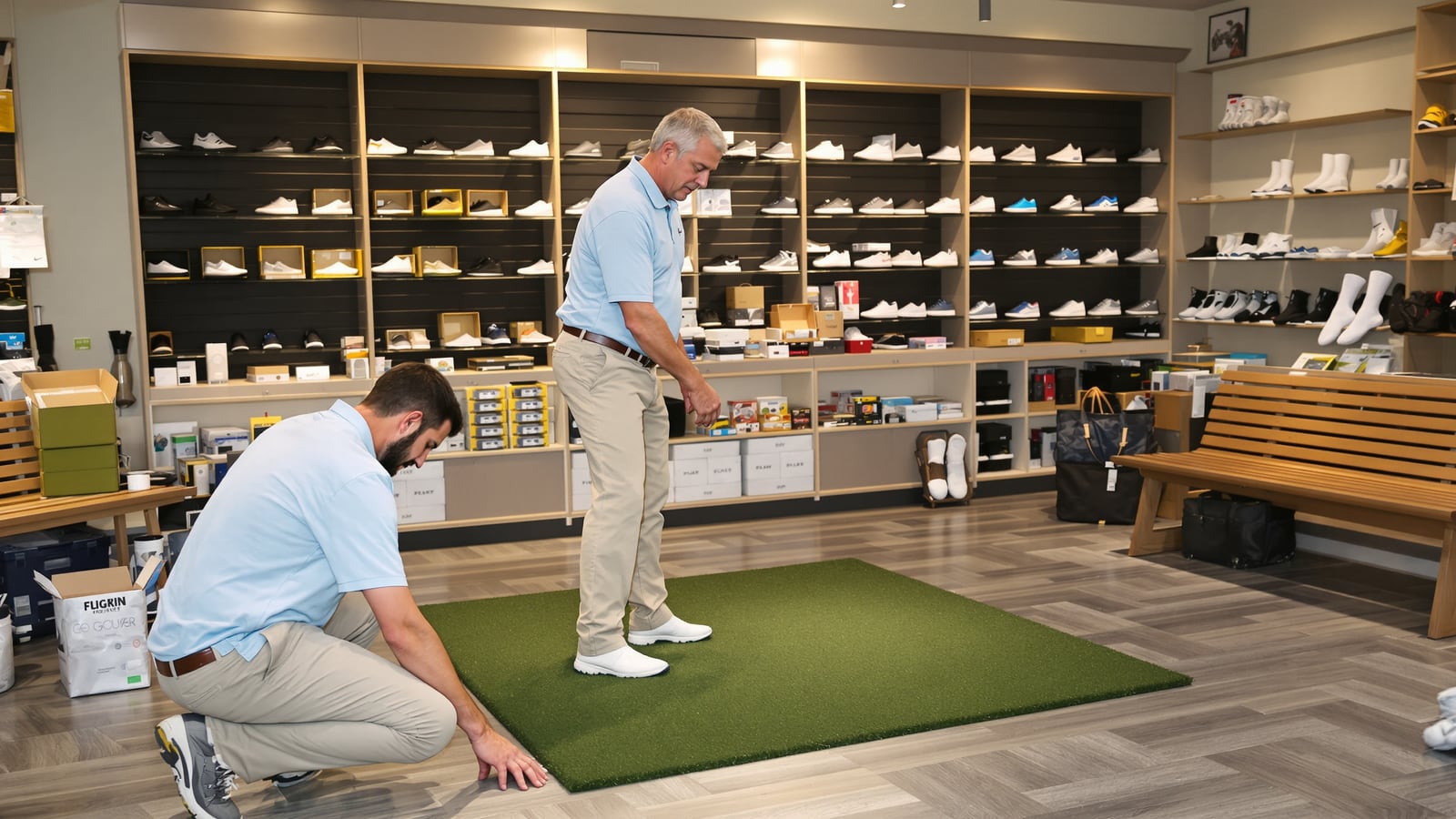
Take a few half swings in the store. Push off the back foot like you mean it. If your foot slides inside the shoe, or your toes jam forward, walk out. Salespeople have seen that move a thousand times and they won't mind.
And size them as they are. Don't count on breaking in a shoe that pinches on the first step. Leather softens a little. A narrow last doesn't widen.
Spikes, spikeless or something in between
Here's the honest trade-off.
Cleated shoes bite into turf. On a wet morning, on a sidehill lie, or on a swing that really turns hard, nothing grips like them. You can swap the cleats when they wear down, which is what makes a good pair last. The downside is that they're stiffer and heavier, and you can feel them on a hard cart path or a paved parking lot.
Spikeless shoes use molded rubber nubs. They're comfortable from the first hole and you can wear them to the grill room afterward without clicking across the floor. On dry, flat fairways they're plenty of grip for a swing at a weekend golfer's speed. When the grass is soaked, or the stance is on a slope, they give up first. And when the nubs wear smooth, you can't replace them. The shoe is done.
Hybrids split the difference with a few small lugs. They're a fair compromise if you play different courses and don't want two pairs.
My call: one pair means cleats with a waterproof upper. Most golfers play the morning round when the dew is still on, and a wet foot is a miserable foot by the fifth hole. If you own two pairs, make the second a spikeless pair for hot, dry days and quick nine-hole rounds after work.
Waterproof is worth paying for
A shoe that claims to be waterproof usually has a membrane under the upper, and a good one keeps out a wet fairway and a sprinkler head. Check for a warranty on the waterproofing itself. Many makers offer a one-year or longer guarantee. Read it before you buy, because that paper tells you how much the maker trusts the shoe.
Breathability matters too. A waterproof shoe that holds your sweat in will wreck your feet by the twelfth hole in August. If you play mostly in heat, a lighter spikeless with a mesh upper and a second pair for rainy days beats one heavy shoe.
Make them last
A decent pair of golf shoes should give you several seasons. Most people kill them in one by tossing them in the trunk in the heat and never looking at them again.
- Wipe and brush after every round. Mud dries into the seams and wears the stitching. Thirty seconds with a brush saves the upper.
- Dry them slowly. Pull the insoles, stuff the toes with newspaper, and let them air at room temperature. Never put them on a heater or in direct sun. Heat cracks leather and cooks the glue.
- Rotate when you can. A shoe that dries fully between rounds lasts far longer than one worn wet four days running.
- Condition leather uppers a few times a year with a leather conditioner made for the job.
- Don't leave them in the trunk. A summer car bakes the adhesive that holds the sole on.
- Replace cleats at the first sign of wear. My own rule is every fifteen to twenty rounds, sooner if you walk a lot of pavement. Look for rounded edges or a smooth, shiny surface. Check which cleat system your shoe uses before you buy replacements, since the twist-lock styles are not interchangeable. A cleat wrench costs a few dollars and lives in the glove box.
Sole separation, a toe peeling away or a torn upper are all signs the shoe is finished. A cobbler can sometimes reglue a sole, but if the foam midsole is dead, that's the end. A shoe that no longer cushions does more harm than a worn-out cleat.
Etiquette starts at your feet
Most courses ban metal spikes, and they have good reason. Plastic or soft cleats do far less damage to greens. If a course still allows metal, leave yours at home anyway.
On the green, pick your feet up. Dragging cleats across a putting surface leaves tiny ridges that knock rolling balls off line for the next group. It's the same courtesy as fixing a pitch mark, and the piece on pace, silence and pitch marks covers the rest of that code. Knock the grass and mud off before you step into the cart or the clubhouse. Leave the cart floor cleaner than you found it.
What to do this week
Look at the bottoms of the shoes you own. If the cleats are rounded off, change them before your next round. That costs less than a sleeve of balls and may fix a miss you've been chasing for a month.
If the shoes are finished, spend an afternoon fitting a new pair properly instead of ordering online off a photo. Then go hit the five-driver test. If you can hold your finish and stay planted, you're ready to work on the five changes that get you under 100. A solid base won't fix a swing. It just stops the swing from fighting the ground.
Dean Shaw
Gear & Garage
Reads the warranty, the parts list and the long-term owner reviews before anything else. Trucks, tools, watches, and the cheap version that costs more.

Watch
Worth an hour of your evening
More from Golf.
From channels we rate. Plays on YouTube.
Read next