
Nobody's going to remind you to check your bones
Women get a reminder for the bone scan. Men usually get a broken hip first. Ask for the scan before that happens.
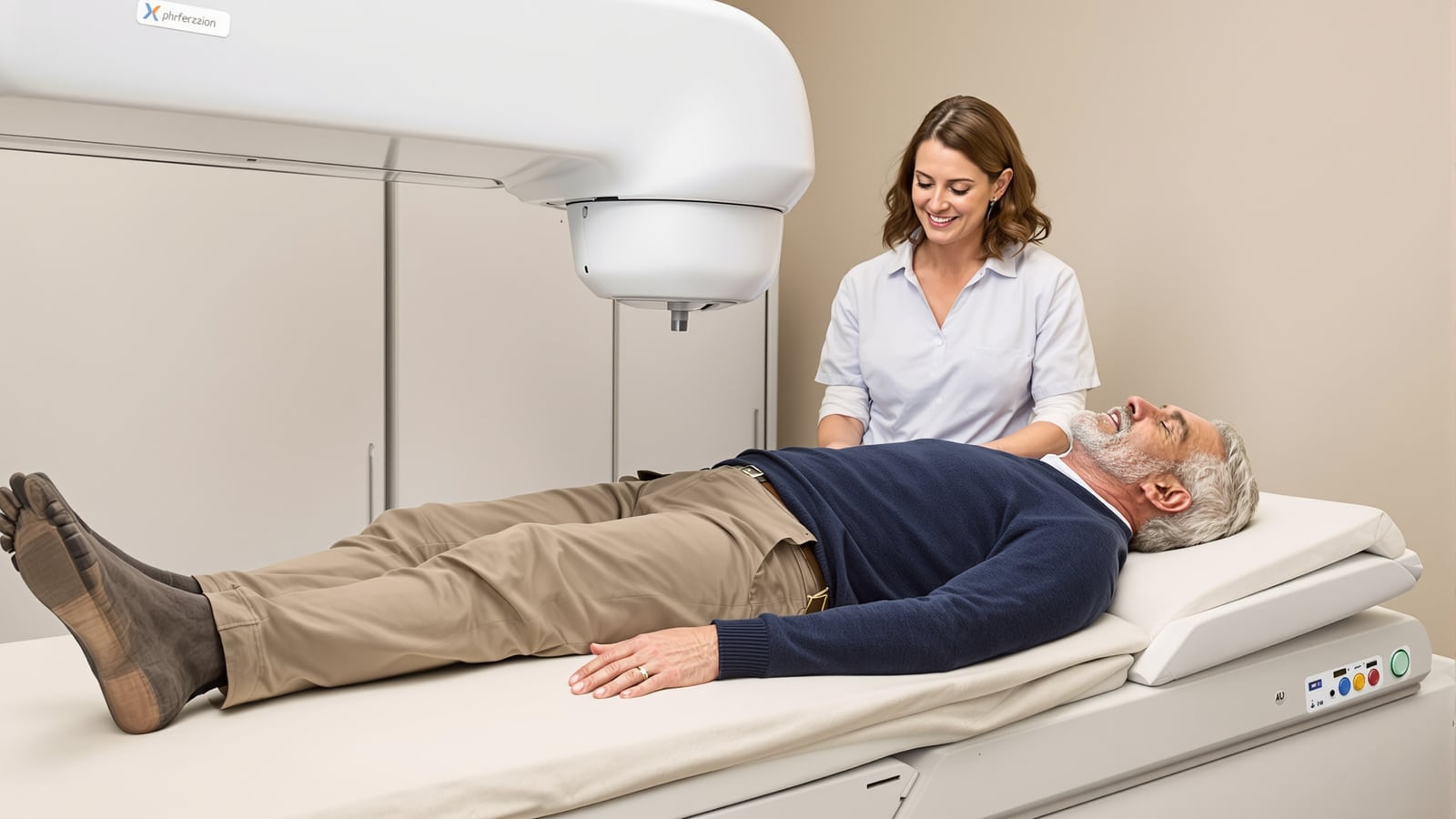
Quick answer: Bone density is measured with a painless scan called a DXA. Major bone health groups recommend it for men at seventy, and earlier if you have risk factors. Your doctor probably won't bring it up, so you should.
Picture a man of sixty-eight on the third rung of a stepladder, clearing the gutters. He's done it every fall for thirty years. The ladder shifts, he steps down wrong, and he lands on his hip. A man with strong bones gets a bruise and a story. A man with thin bones gets surgery.
He'd have had no warning. Bones don't ache as they thin. Nothing in your day tells you the frame is getting lighter. For a lot of men, the first symptom is the break.
Why you haven't heard about this
Osteoporosis has a reputation as a women's condition, and the screening system treats it that way. A woman gets steered toward a bone scan around sixty-five. The U.S. Preventive Services Task Force, in its 2018 review, said the evidence was insufficient to recommend for or against routine screening in men. That's a statement about the research, not a statement that men's bones are fine.
Other groups have filled the gap. The Bone Health and Osteoporosis Foundation recommends bone density testing for men at seventy, and for men between fifty and sixty-nine who have risk factors. The Endocrine Society's guidance for men says much the same. The foundation also says about one in four men over fifty will break a bone because of osteoporosis in their lifetime.
Men also tend to fare worse than women after a hip fracture. It often means surgery, weeks of rehab, and for plenty of men a lasting loss of independence. That's the outcome a ten-minute scan is meant to head off.
Do you have a reason to ask early?
Waiting until seventy is fine for a healthy man with no flags. You may have a reason to ask sooner. Check this list:
- A bone you broke after fifty from a fall that shouldn't have broken it, like a wrist from a standing trip
- Long-term steroid pills, such as prednisone, for asthma, arthritis or similar
- Treatment that lowers testosterone, including some prostate cancer therapy, or a diagnosis of low testosterone
- Heavy drinking, now or for years
- Smoking, now or in your past
- A parent who broke a hip
- Type 2 diabetes, thyroid problems, or long-term acid-reflux medication
- A small, light frame
- Losing height, an inch and a half or more
One or more of those, and you're a man worth asking about in your fifties or sixties. If you take the prostate conversation seriously at fifty, it connects here, because some of those treatments affect bone.
Height deserves a second look. Spinal bones can crack and compress without much drama, and a man simply gets shorter. Sometimes that shows up as back pain that never quite resolves. Most back pain is ordinary, and there's a sensible way to handle it. But a sudden, sharp back pain with no clear cause in a man past sixty is worth mentioning to your doctor along with your bone history.
What the scan involves
It's called a DXA scan. You lie on a padded table, fully clothed in most cases, while an arm passes over you. It measures the hip and spine, uses a very low dose of radiation, and doesn't hurt. You're typically in and out quickly.
You'll get a T-score. A score of minus 1.0 or above is considered normal. Between minus 1.0 and minus 2.5 is low bone mass, often called osteopenia. At minus 2.5 or below, it's osteoporosis.
Don't stop at the number. Your doctor can also run your age, history and score through a fracture-risk calculator called FRAX, which estimates your chance of a major fracture over ten years. A man with a middling score and three risk factors can be in a worse spot than a man with a lower score and none.
Cost and coverage
Coverage for men is less automatic than for women. Medicare, for instance, covers bone density tests for people who meet certain conditions, and being an older man isn't always one of them. Private plans vary. Before you book, call the plan and ask whether your situation qualifies. If it doesn't, ask the imaging center for the cash price. If the plan's terms confuse you, these four numbers explain most of what you'll be charged.
If the number comes back low
A low score isn't a sentence. It's information, and you're early enough to act on it.
Your doctor may look for a cause first. In men, thin bones often trace back to something specific, like a medication, a hormone problem, low vitamin D or alcohol. Fix that and you've fixed part of the problem. For some men, the doctor will prescribe a bone-strengthening drug. That's a conversation between you and the physician, based on your whole picture.
What's yours to do, starting now:
- Lift something heavy. Bone responds to load. Walking helps. Resistance work, carrying, pushing and pulling help more. Ask your doctor what's safe if you already have a low score, especially for twisting and heavy spinal loading.
- Eat the calcium. The standard government recommendation is 1,000 milligrams a day for men fifty-one to seventy, and 1,200 after seventy. Get most of it from dairy or fortified foods. Don't load up on supplements without asking your doctor. Too much has its own problems, including kidney stones.
- Get your vitamin D checked. It's a simple blood test. Your doctor will tell you whether to supplement and how much.
- Drink less. More than a couple of drinks a day wears on bone, and it makes falls more likely.
- Quit tobacco. Smoking is hard on bone, and there are approaches that work.
- Fall-proof the house. Pull the loose throw rugs. Put a light on the stairs. Get your eyes checked. Stay off the ladder in wet weather, or hire the neighbor's kid and pay him well.
How to ask
You don't need a speech. At your next checkup, say this: "I'm over sixty. Should I have a bone density scan, and if not now, when?" Then mention anything from the list above.
A good doctor will take it from there. A rushed one might wave it off. If so, ask again and ask for a reason. It's your skeleton.
You've spent decades building a body that carries things: lumber, kids, groceries, other people's problems. The frame under all of it deserves one scan to find out what shape it's in.
Cal Brennan
Fitness
Strength coach. Trains fathers, tradesmen and desk workers, which means programs that survive a bad week.

Watch
Worth an hour of your evening
More from Health.
From channels we rate. Plays on YouTube.