Run the dehumidifier before your basement starts to smell
By the time you smell a basement, the mold is already working. Here's how to size, place, and set a dehumidifier so you never get that far.
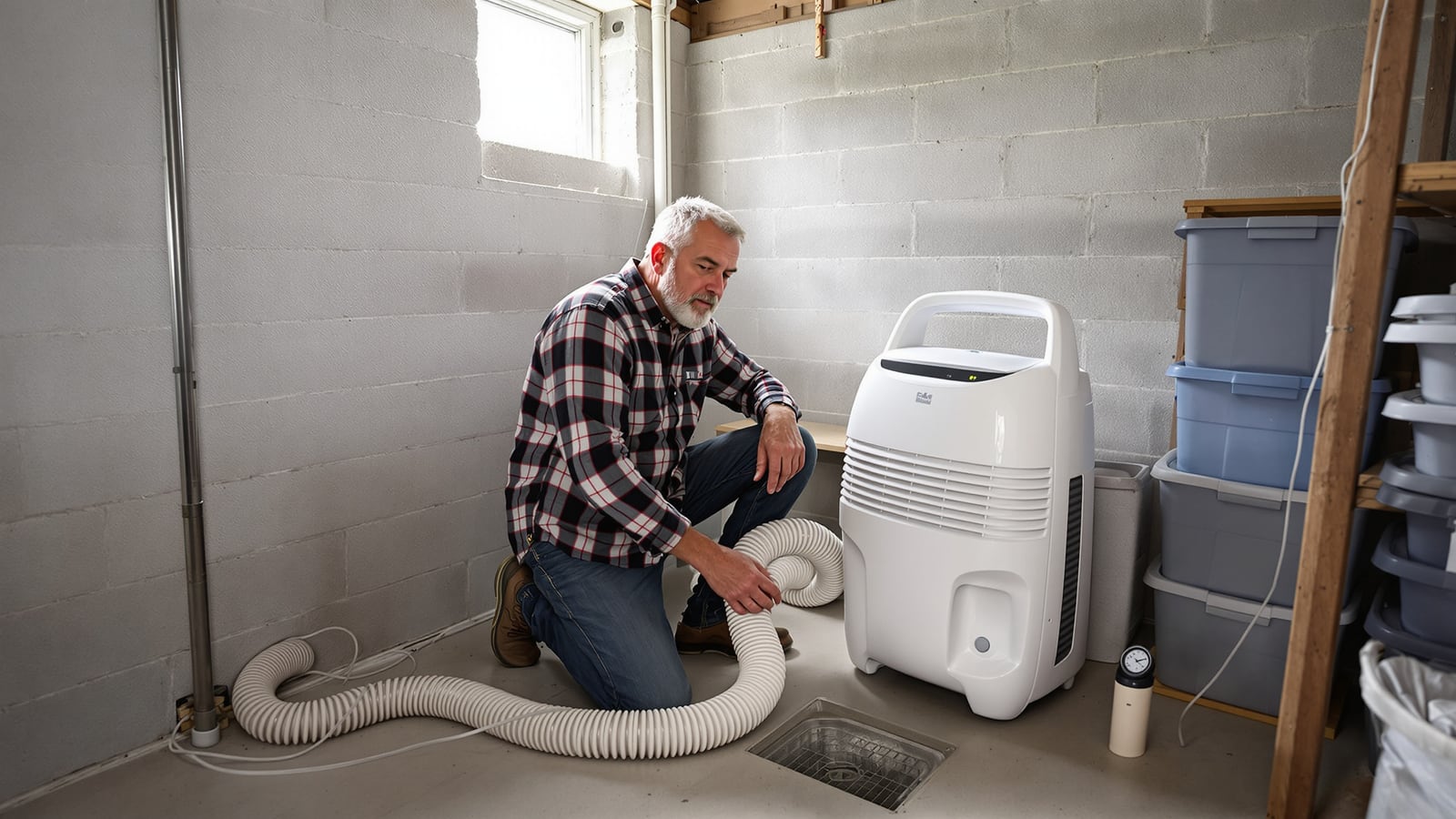
Quick answer: Keep the basement between 40 and 50 percent relative humidity. Buy a cheap hygrometer to know where you stand, run the dehumidifier on a drain hose instead of a bucket, and fix any water coming in before you blame the air.
The smell is a late report
A musty smell means something is already growing. Mold and mildew need moisture and a surface to sit on, and a basement gives them both. The EPA's guidance is to keep indoor humidity under 60 percent, ideally between 30 and 50. Above that, the odds tip toward mold on cardboard, wood, drywall paper and the back of that old couch.
Your nose is a poor early-warning system. You've lived with the smell so long you stopped noticing it. A buyer walking down your stairs notices it in about three seconds, and it's the first thing they'll mention to their agent.
So don't wait for the smell. Measure the air.
Buy the hygrometer first
A digital hygrometer is a small, cheap gauge that reads humidity. Get one before you buy a dehumidifier. Put it at chest height in the middle of the basement and leave it for a few days.
Then check it on a muggy July afternoon and again after a hard rain. Those are the readings that matter. A basement can sit at 45 percent in April and 70 percent in August, and one reading tells you nothing.
If you're above 55 percent during summer, you need a machine. If you're at 50 or under all year, you may just need to stop doing something that's adding moisture. That brings us to the part most people skip.
Find out where the water comes from
A dehumidifier pulls moisture out of the air. It doesn't stop moisture from coming in. If water is seeping through the walls or the floor, you're bailing a boat and leaving the hole open.
Check these before you spend a dollar on a machine:
- Gutters and downspouts. Clogged or dumping water right at the foundation is the most common culprit. Extend downspouts several feet away from the house.
- Grading. The soil next to the foundation should slope away from the house. If it slopes toward it, water follows gravity.
- Dryer vent. A dryer venting into the basement dumps a surprising amount of moisture into the air every load. Vent it outside.
- Laundry hung to dry. Same problem, smaller scale.
- Cold water pipes. If they're sweating in summer, that's condensation. Foam pipe insulation costs little and stops it.
Look at the walls too. A white, chalky crust on concrete is efflorescence, left behind as water moves through and evaporates. It means moisture is coming through the foundation. A dehumidifier will help, but you've got a water problem, not just a humidity problem.
Pick the right machine
Dehumidifiers are sold by pint capacity: 20, 35, 50 and up. The number tells you how much water the unit can pull in a day under test conditions.
Two things trip people up. First, the Department of Energy changed its test conditions in 2019, so a newer 35-pint unit isn't the same as an old 35-pint unit. Compare ratings only among machines labeled the same way. Second, basements are cool, and compressor-style units work less efficiently in cold air.
My rule: for a damp or larger basement, buy one size up from what the box suggests. A machine that's working at half its limit runs quieter, cycles less and lasts longer. An undersized one runs around the clock and still loses.
If your basement stays below roughly 60 degrees much of the year, look at a unit built for low temperatures, or a desiccant model. A standard compressor unit can ice up its coils in the cold. Check the manufacturer's stated operating range before you buy, not after.
Two features are worth the money:
- A built-in humidistat. You set 45 percent and the machine handles the rest.
- A continuous drain port. More on that next.
Skip the bucket
The bucket is where dehumidifiers go to fail. It fills, the unit shuts off, and the basement climbs back to 70 percent while you're at work or out of town. Then the bucket itself grows a slime in the corner.
Run a garden hose from the drain port to a floor drain. Gravity does the work. No floor drain? A small condensate pump will lift the water to a sink or out a window. Either way, the machine keeps running until the room is dry.
Place it where air can move
Don't tuck it in a corner behind boxes. Leave at least a foot of clearance on every side so air can reach the intake and exhaust. Put it near the middle of the space, or near the dampest spot if you know where that is.
Keep interior doors open. A dehumidifier in a closed storage room dries that room and nothing else.
The electrical part
Basements and electricity deserve respect. Plug the unit straight into a GFCI-protected outlet. If there isn't one, have an electrician add one. That's a small job and not one to improvise. Don't use a flimsy extension cord, and never run any cord across a floor that might get wet.
If you ever find standing water in the basement, don't walk into it with power on. Shut off the breaker from upstairs first. If you can't do that safely, call your utility or an electrician.
Thirty seconds a month
The upkeep is short, and skipping it's how these machines die early.
- Wipe or rinse the air filter every month in season. A clogged filter makes the unit work harder and dry less.
- Empty and clean the bucket if you use one, with a little dish soap.
- Check the hose for kinks and make sure the drain isn't blocked.
- At the start of each season, vacuum the coils lightly with the unit unplugged.
Leave it cleaner than you found it. That goes for your own basement too, whether you're there for twenty more years or listing it next spring. The next owner, or you, will be glad.
When to stop and call someone
Dehumidifiers handle humidity. They don't handle a failing house. Call a professional if you see any of these:
- Water coming through walls or the floor after rain, or pooling.
- A sump pump that's failing, cycling constantly, or missing in a basement that clearly needs one.
- Cracks in the foundation that are widening or leaking.
- Mold covering a large area. The EPA's rough line is about ten square feet. Past that, bring in someone who handles mold properly. Wear a respirator, not a dust mask, for anything smaller.
- A musty smell that won't go away even with humidity under 50 percent. Something's hidden behind a wall or under a floor.
Get more than one quote, and get the scope in writing. The piece on knowing when to stop and how to get a quote you can trust covers how to do that without getting talked into more than you need.
If you're buying a house, a basement that smells damp isn't a deal-breaker, but it's a flag. Read what your home inspector won't check, and what you should before you close, and ask the seller how long a dehumidifier's been running down there.
Once you've got the gutters clear, the hygrometer reading and the drain hose in place, add it to your home maintenance calendar. The basement that never smells is the one nobody has to think about.
Wes Dunbar
Country & Skills
Grew up on an acreage and never quite left. Covers trucks, trades, land, and how to do the thing yourself.

Watch
Worth an hour of your evening
More from Home.
From channels we rate. Plays on YouTube.
Read next