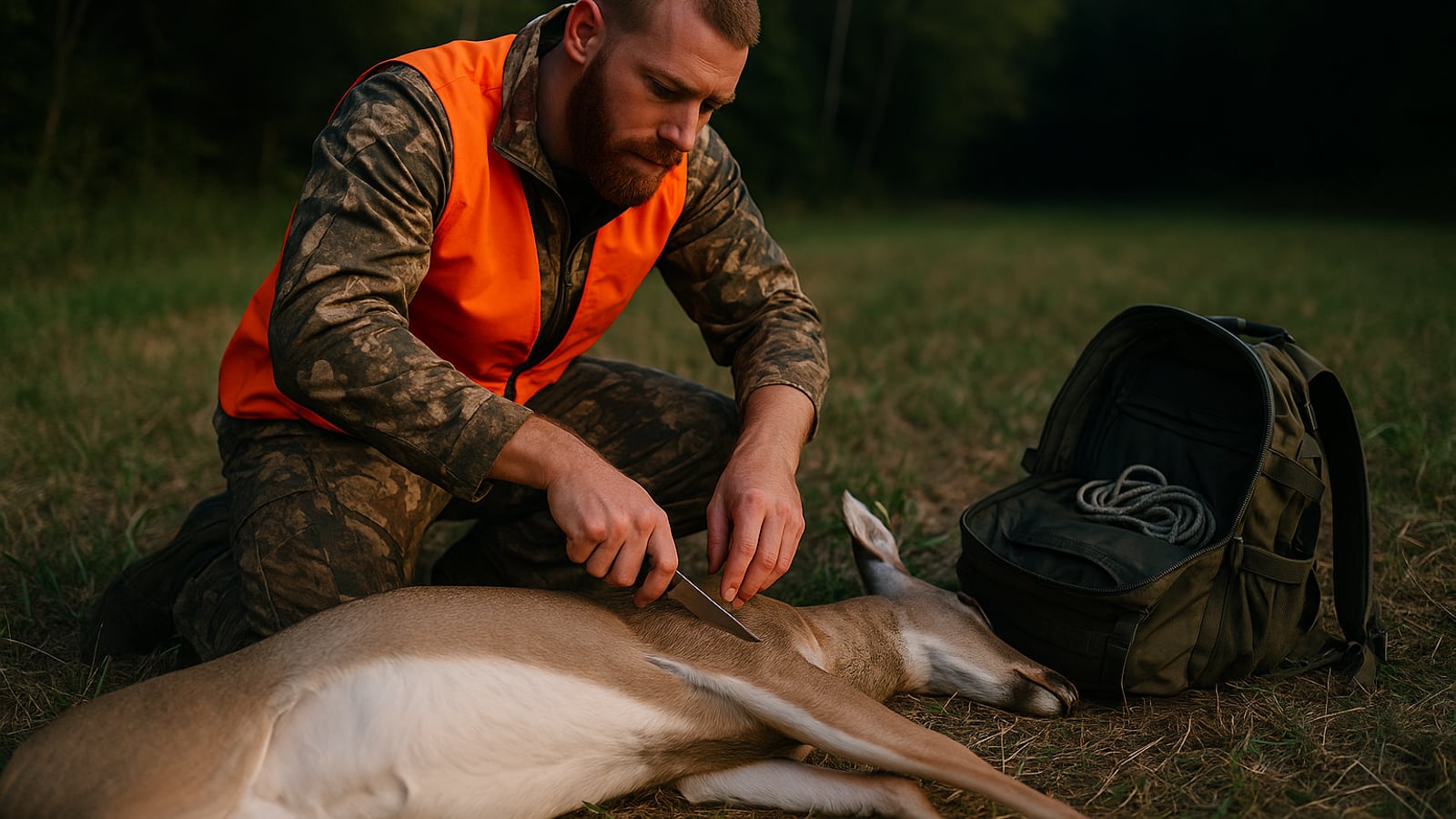
Cooling the meat is the job. Everything else — the knife you chose, the method you prefer, the photo you want — is secondary to getting heat out of that animal before bacteria get a head start. If you remember one thing when you walk up on a downed deer with no one else around, remember that you're now in a race against the animal's own body temperature.
Which means the work starts before the shot. Alone, you don't get to improvise.
Decide your recovery limit before you hunt
Walk the country you're hunting and ask an honest question: if an animal dies here, can I get it out?
Not "can somebody get it out." You. In the dark, probably. Uphill, probably. With whatever's in your pack.
That question should change where you shoot from and what you're willing to shoot at. A bull elk on the far side of a drainage might be a perfectly ethical shot and a completely unrealistic recovery for one person in warm weather. Passing is a legitimate answer. Wanton waste laws exist in most jurisdictions for a reason, and the spirit behind them is older than the statute: you kill it, you use it.
Figure a mature whitetail is a two-trip animal for most people carrying gear and meat. An elk is four trips minimum, and that's if you're fit and the terrain is kind. Plan in trips, not in optimism.
What goes in the pack
Keep it small enough that you actually carry it every day.
- A fixed blade with a four-inch or shorter drop point, plus a replaceable-blade knife with spare blades. Replaceable blades stay surgical through an entire animal. A fixed blade does the work a scalpel can't.
- A small sharpener or steel, if you're carrying a fixed blade only.
- Nitrile gloves, two pairs, and shoulder-length gloves if you're gutting.
- Game bags — breathable, not plastic. Enough for the whole animal.
- Fifteen feet of paracord for hanging a leg, tying off a hoof, or hoisting bags into a tree.
- A headlamp with fresh batteries, and a backup light. Most solo pack-outs finish in the dark.
- Your tags, a pen, and whatever your jurisdiction requires you to attach or validate.
Add a bone saw only if your regulations require you to keep antlers attached to the skull plate, or you want a full mount. Otherwise you can take an animal apart without ever cutting bone.
Safety, honestly
More hunters get hurt during field dressing than during the shot. The blade is wet, the hands are cold, and the animal shifts.
Cut away from your body every single time. Never cut toward the hand stabilizing the carcass. Keep your off hand behind the blade, not ahead of it. When you're tired, stop and re-set rather than reaching across yourself to save five seconds.
Position the animal so it can't roll onto you. On a slope, work from the uphill side and chock the carcass with a rock or a log. A deer sliding downhill takes a knife with it.
Wear gloves, and not just for tidiness. Wildlife diseases vary by region and species, and some are transmissible to people. Chronic wasting disease has changed how many states handle carcass transport. Brucellosis matters in some elk country. Your state or provincial wildlife agency publishes current guidance on handling, testing and where you may move parts of a carcass, and it changes year to year. Read it before the season, not after. If you cut yourself badly or you're concerned about exposure, see a doctor — that's a conversation for a physician, not a hunting article.
The gutless method is usually the right call alone
Traditional field dressing — opening the body cavity and removing the organs — works well when you can drag the whole animal to a truck. Solo, in rough country, with a pack on your back, the gutless method is faster, cleaner and requires less strength.
The sequence, working one side at a time:
- Lay the animal on its side. Skin that side from the backbone down, peeling the hide back to make a clean working surface.
- Take the front leg first. There's no ball joint — it's held on by muscle. Lift it away from the body and cut underneath until it comes free.
- Remove the hindquarter. Cut around the ball joint, roll the leg away from the hip, and the joint pops open. Follow the bone and it comes off.
- Take the backstrap, running your blade along the spine from hip to shoulder, then along the ribs.
- Take the neck meat and the rib meat.
- Reach inside along the spine under the last ribs and remove the tenderloins.
- Roll the animal over. Repeat.
Each piece goes straight into a game bag. Each bag goes somewhere off the ground, in shade, spread out so air moves around it. Meat stacked in a pile will sour in the middle while the outside feels cool.
Cooling, and when you can leave meat overnight
Air movement matters more than shade, and shade matters more than a low thermometer reading first thing in the morning.
Below freezing, you have real time. Around forty degrees and falling, you have overnight. Above fifty and climbing, get it to a cooler the same day and don't negotiate with yourself about it.
If you have to leave bags on the mountain, hang them clear of the ground, spread apart, in the coldest air you can find — the bottom of a drainage often holds cold better than a ridge. Mark the spot on your GPS and take a compass bearing as backup. Batteries die. Consider what else lives there before you leave meat, especially in bear country, and be loud and deliberate coming back in.
Carrying it
Load the pack tight and high, with weight close to your spine. A sloppy load will cost you more than an extra ten pounds ever will. Boned-out meat carries better than bone-in, and in some jurisdictions bone-in transport is restricted anyway.
Then slow down. The pace that gets you out isn't the pace you hiked in at. Short, steady, no heroics. Most pack-out injuries are ankles and knees on the last mile, when you're tired and stepping carelessly with a high center of gravity.
Drink water. Eat something. Solo means nobody notices you're slurring your words.
The paperwork is part of the hunt
Tagging rules aren't uniform and they're not optional. Some places require the tag attached immediately and before you move the animal. Some require evidence of sex to stay naturally attached to a quarter. Some regulate how and where you may leave a carcass, what you may transport across a county or state line, and whether you must present the animal at a check station.
Every one of those rules varies by jurisdiction, species and season, and they get rewritten more often than hunters expect. Print the current regulations or keep them offline on your phone, because the place you'll need them is the place with no signal.
Do the work right and you'll spend the drive home tired in the good way, with everything you took accounted for. That's the whole standard. Not the antlers, not the story — the fact that nothing was wasted and nobody had to come find you.
Wes Dunbar
Country & Skills
Grew up on an acreage and never quite left. Covers trucks, trades, land, and how to do the thing yourself.

Watch
Worth an hour of your evening
More from Hunting & Shooting.
From channels we rate. Plays on YouTube.
Read next