Your knife, your saw, and what else the pack has to carry
The gear that matters starts working two hours after the shot, when the light is going and the animal is bigger than you remembered.
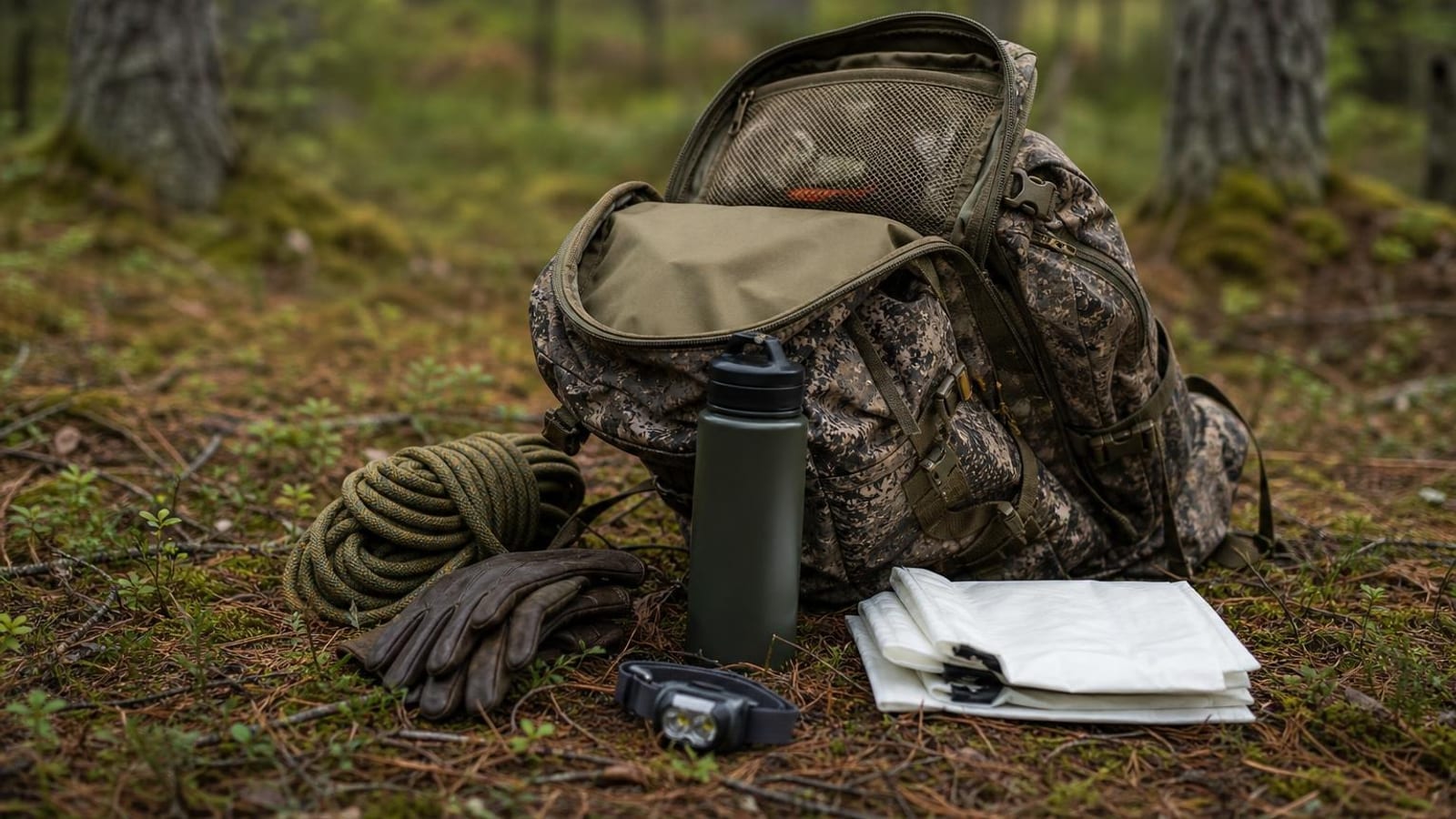
Pack for the two hours after the shot, not the six before it. That's the whole principle. Most people load a pack around the walk in — snacks, extra layer, a call or two — and then find themselves on a hillside at dusk with a dead animal, one dull knife, no gloves and no plan for getting eighty pounds of meat off the mountain.
The shot is the easy part. Everything after it's work, and the work has a clock on it.
Start with the knife, and buy less knife than you think
You don't need a seven-inch blade. You need something you can control with cold, wet hands.
Two honest options.
A fixed blade with a three to four inch drop point is the traditional answer and still a good one. It's strong, it cleans easily, it won't fold on your fingers, and it'll do everything from caping to cutting cord. The cost is that it goes dull partway through a big animal, and a dull knife is where people cut themselves. So if you carry one, you carry a way to touch it up — a small ceramic rod or a pocket diamond stone — and you actually use it mid-job instead of muscling through.
A replaceable-blade knife is the other answer, and it's won a lot of converts. You carry the handle plus a sleeve of spare blades, and when the edge drags, you swap it. It weighs almost nothing. Scalpel-sharp the whole way through means cleaner cuts and less force, and less force means fewer accidents.
The trade-off is real: those blades are thin and they snap if you pry or twist with them. They're also genuinely sharp in a way that punishes carelessness. Keep the used ones in a hard case, not loose in a pocket, and never leave a broken tip in the dirt where a dog or a boot finds it.
Carry a backup either way. A second knife weighs a few ounces. Losing your only blade in the dark costs you an animal.
The saw question, and why you might skip it
A bone saw does three jobs: splitting a pelvis, quartering through bone, and cutting antlers off the skull.
You can avoid the first two entirely. Learn the gutless method — you take the quarters, backstraps and tenderloins off the outside of the carcass without ever opening the body cavity. It's cleaner, faster in cold weather, and it means you're working around joints instead of through bone. Once you've done it twice you'll wonder why you ever did it the other way.
That leaves the skull. If you're taking antlers or horns, a compact folding saw earns its space. A small saw with a coarse bone blade does the job in a few minutes. Some hunters carry a length of wire saw instead, which weighs almost nothing and works fine on skull plate if you're patient.
Check your regulations before you cut anything off the head. Some jurisdictions require evidence of sex or species to stay attached to the carcass until it reaches a processor or your home. Some require the head to be presented at a check station. What's routine in one state is a citation in the next.
Bags, cord, and the part nobody budgets for
Meat care is where good hunters separate themselves.
Game bags. Not plastic. Breathable synthetic bags let the meat cool and keep flies off it. Carry enough for the whole animal — for a deer that's usually four to five bags, for an elk plan on more. They pack down to the size of a fist.
Fifty feet of paracord. Hanging a leg, lashing a load, dragging, tying a bag off a branch away from the ground. There's no trip where it doesn't get used.
Nitrile gloves, two pairs. They keep your hands warm-ish and clean, and they're a basic hygiene measure when you're handling an animal you haven't inspected yet. Wildlife agencies recommend gloves for exactly this reason. Pull them off and bag them rather than leaving them on the hill.
A contractor bag or a liner for the inside of your pack, so the pack doesn't come home soaked.
Zip ties and a pen. Tags need attaching and filling out, usually immediately, often before you move the animal a single yard.
The legal layer goes in the pack, not the truck
License, tags, and any required permits stay on your body. Not in the glovebox at the trailhead.
Tagging rules vary enormously. Some places want a physical tag notched and attached before you leave the kill site. Some run electronic check-in with a phone app and a deadline measured in hours. Some require a specific transport permit if you cross a county or state line with a carcass.
Chronic wasting disease rules deserve their own reading. Many states and provinces now restrict what parts of a deer, elk or moose you can move out of a management zone — often brain and spinal tissue can't leave, which means deboning in the field or cutting off the skull plate rather than hauling a whole head. Penalties are serious and the maps change year to year.
Look it up for your unit, this season, before you go. The regulations booklet on your phone weighs nothing.
Safety gear, honestly assessed
The knife is the most likely injury on a hunt. Not the rifle. A blade slipping off a ball joint into the inside of a thigh is a genuine emergency, and it happens to experienced people working in the dark and in a hurry.
Carry a tourniquet you know how to use, plus pressure dressing and gauze. Buying one isn't the same as being able to apply it one-handed on yourself. Take a bleeding control course through a local hospital or fire department — an afternoon covers it, and it's the single highest-value few hours you'll spend on hunting gear. If you've got a medical condition that changes any of this, ask your doctor rather than guessing.
Then the boring items that prevent the emergency: a headlamp plus a spare light, extra batteries, a way to start a fire, an insulating layer that stays dry in a bag, water and a filter or tablets.
And a way to tell somebody where you are. A satellite messenger in country with no signal, and either way, a written plan left with your wife or a friend — where you're parking, which drainage, when to worry.
The pack itself
For a day hunt, thirty to forty liters is enough. For anything where you might carry meat, you want a frame that carries weight on your hips and a load shelf between the bag and the frame.
Weigh the whole thing loaded, before the season. If it's heavy empty, it'll be miserable full, and packing out is when you'll be making decisions about whether to take a second trip in the dark or push one more load. That decision goes better when you're not already wrecked.
Do a shakedown trip in September. Load the pack with forty or fifty pounds of sandbags and walk your actual terrain. You'll find out what rubs, what rattles, and what you never touch.
Then take out what you never touch, and put the game bags back in.
Wes Dunbar
Country & Skills
Grew up on an acreage and never quite left. Covers trucks, trades, land, and how to do the thing yourself.

Watch
Worth an hour of your evening
More from Hunting & Shooting.
From channels we rate. Plays on YouTube.
Read next