How to Teach a Kid to Shake Hands and Really Mean It
The grip takes five minutes to teach. The eyes and the attention take a year, and they're the part people actually remember.
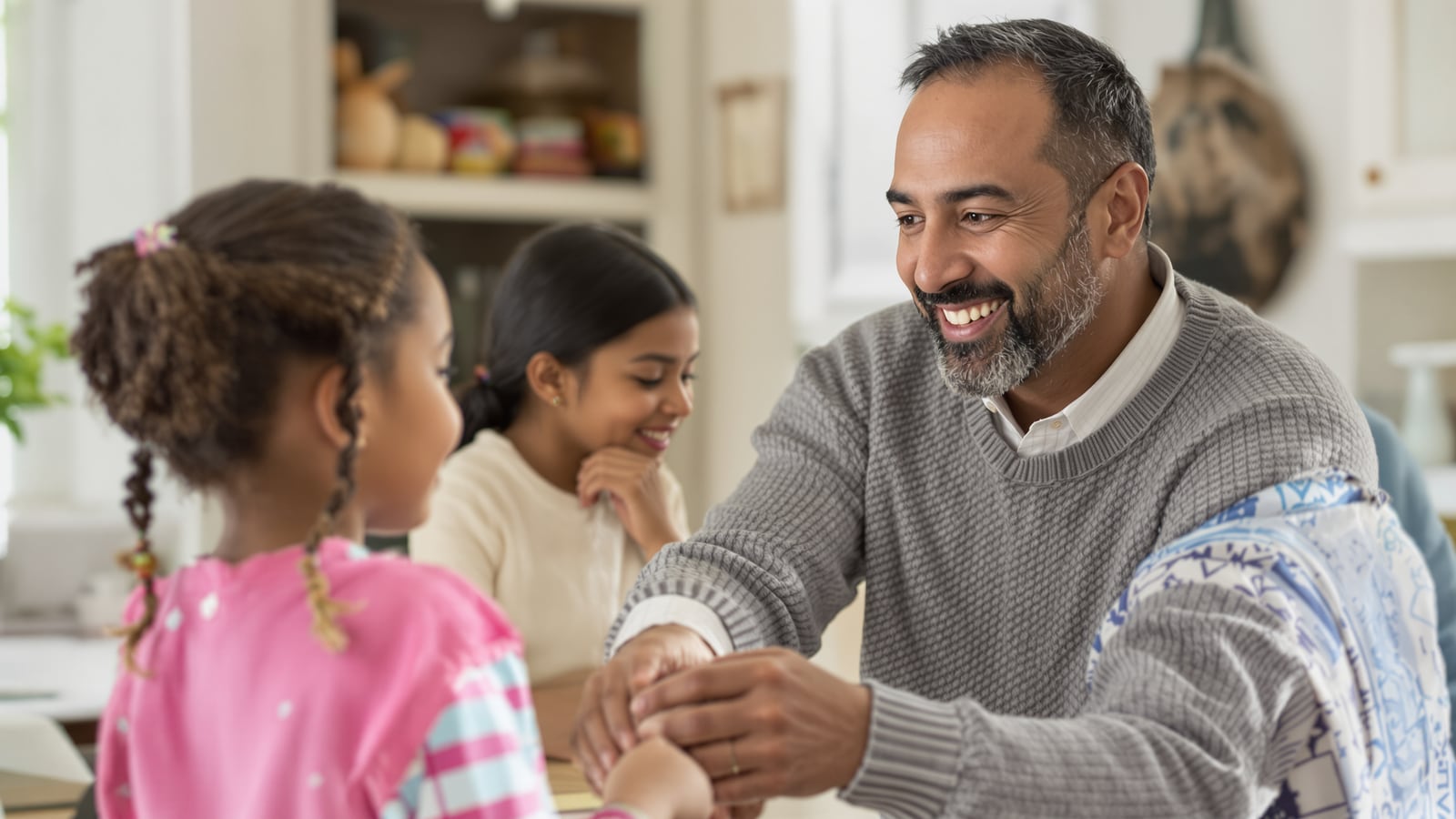
Quick answer: Teach four things. Web of the hand to web of the hand, two pumps, eyes up for a second or two, and the other person's name said back. Practice at your own front door starting around age four. Treat it as a job your kid does for the other person, not a performance for you.
The grip is the easy part
Hold your hand out flat, thumb up. Have your kid slide his hand in until the skin between thumb and index finger meets yours. Fingers wrap around. Squeeze like you're shaking a hand you'd like to keep. Two pumps. Let go.
Then do it wrong on purpose. Give him the dead fish. Give him the fingertip grab. Give him the bone-crusher. Kids think this is hilarious, and nothing teaches a grip faster than feeling a bad one. Then let him squeeze yours and tell him "a little more" or "a little less" until it's right.
A six-year-old's grip will never impress anybody. That's fine. What people notice at that age is a hand that comes out first.
The eyes are the real work
Looking an adult in the eye is uncomfortable for most kids. Telling a child to "look at me" mostly produces a frozen stare or a sideways glance at the carpet.
Give him a task instead. Tell him to find out what color the other person's eyes are. It's a little game, and it forces exactly the one or two seconds of contact you want. He doesn't need to hold it like a staring contest. Eyes up for the greeting, and then it's perfectly natural to look away while the conversation goes on.
Some kids find this much harder than others. A shy kid will get there with patience and plenty of low-stakes repetition. If eye contact is hard for your child in every setting, with every person, including people he loves, mention it to your pediatrician. That's a conversation for a professional, not something to fix with a drill in the driveway.
Give the handshake a job
A kid who shakes hands just to get it over with is performing a trick. A kid who shakes hands to learn a name is paying attention to another human being. That attention is what "meaning it" looks like from the outside.
So give the handshake a job: learn the name and say it back.
Say a neighbor stops by to borrow your ladder. Your son steps up, hand out. "Nice to meet you, Mr. Hollis." Then, a minute later, "Thanks for coming by, Mr. Hollis." That's it. He used the name twice. Mr. Hollis will remember him, and it cost your kid nothing but a little focus.
If he forgets the name, teach the recovery: "I'm sorry, I missed your name." That line is worth more than a perfect grip. Adults forget names every day and respect a kid who asks again.
The words need to be true, too. "Nice to meet you" is a fair thing to say to nearly anyone you've just met. Don't coach him to gush. Honest and plain beats polished and fake, and kids can smell the fake version on themselves. It's the same muscle you build when you teach a kid to tell the truth when it costs him something. Say what's true, say it clearly, look the person in the face.
What to expect at each age
Ages 3 to 5. Don't force a handshake. Make it a game with stuffed animals, grandparents, the mail carrier. A wave with eye contact and a clear "hi" is the win here.
Ages 6 to 8. This is the sweet spot. Give him a real assignment at the door: greet the guest, say the name, take a coat. Restaurants work too. Let him order his own meal and look at the server while he does it. For a fuller picture of what's realistic at this stage, see what your four, eight and twelve year old can actually do.
Ages 9 to 12. Add the harder skills. Stand when an adult walks up. Put down whatever's in his hands, including the controller. Introduce his own parents: "Mr. Hollis, this is my mom." Introducing someone else is a step up from being introduced, and a twelve-year-old who can do it comfortably is a long way ahead of most adults.
Girls get all of the same lessons. Nobody should be taught a limp, polite wave while the boys learn to grip. A daughter who can walk up, look an adult in the eye, and say her name is hard to talk over later.
Your part, which is harder than his
Wait the beat. When someone greets your kid and he freezes, the urge to jump in is nearly overwhelming. Don't. Count to five in your head. Let him find the words. If he truly can't, say "Take your time" and wait more. Rescuing him teaches him that silence is dangerous.
Correct in the car, not on the spot. A kid who's corrected in front of the person he's greeting learns to dread greetings. Save the notes for the ride home, and start with what he did right.
Do it yourself where he can see it. Watch how you treat the cashier, the guy who delivers the mail, a waiter who got your order wrong. Kids copy the version you perform when you think it doesn't count.
Put the phone away. If your eyes drop to a screen mid-conversation, that's the lesson he's learning, whatever you tell him about eye contact. The phone rules you set for him need to apply to you at the door and the dinner table too.
He can also say no
A handshake is offered. It's never forced. And no child owes any adult a hug, a kiss, or a lap to sit on just to be polite.
This is where the handshake does quiet extra work. A kid who has a respectful, practiced way of greeting people, hand out and eyes up, also has a way to hold a line. "I'll shake your hand" is a perfectly good answer to a request for a hug. Teach him that, and teach him the second half: if any adult, anywhere, makes him feel uneasy, he steps back and tells you. You won't be angry, and you'll listen.
Servant with a backbone starts small. He learns to give people his full attention and to keep his own ground.
Start tomorrow morning
Put out your hand at breakfast. Say his name. Wait. Make him do it back, grip and eyes and all, and then laugh about how bad the first one was.
Do it again the next day. By the end of the month he'll do it without being asked, and some adult will tell you what a polite kid you've got.
Sam Ortiz
Dads & Family
Father of three. Writes about presence, discipline and the long game, without pretending any of it's tidy.

Watch
Worth an hour of your evening
More from Boys & Girls.
From channels we rate. Plays on YouTube.
Read next