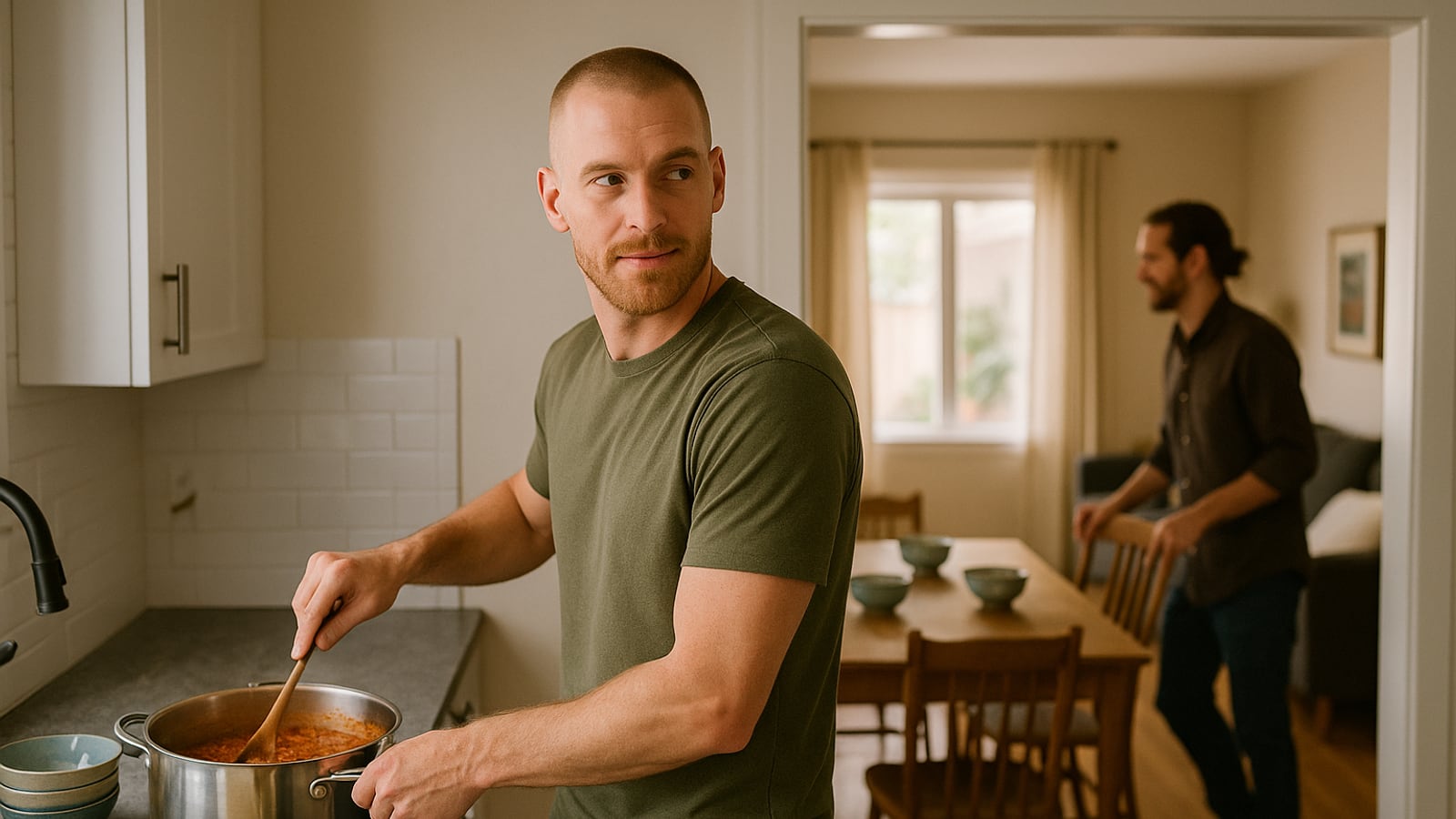
Pick one meal you can cook without thinking. Cook it for six people. Tell them 5pm. That's the whole system, and everything below is just detail on top of it.
Most people who say they'd love to have friends over more aren't short of friends or space. They're carrying an idea of hosting they picked up somewhere — matching plates, a starter, a tidy garage, a house that looks like nobody lives in it. That version takes a full weekend day and costs a hundred pounds, so it happens twice a year. Then it doesn't happen at all.
The version that actually builds friendships is smaller, uglier and repeats.
Choose the one meal and stop choosing
Decide now what you serve when people come over. Not what you might serve. What you serve.
Chilli with rice and a bowl of grated cheese. A big tray of roast chicken thighs and potatoes. Pasta with a sauce you've made eighty times. Tacos, where you put the components on the table and let people build their own. Whatever it's, it needs three qualities: it scales without extra thought, it survives being late, and you can make it while talking to someone.
That last one matters more than it sounds. Anything needing precise timing puts you in the kitchen with your back to the room at exactly the moment people are arriving and deciding how the evening feels.
Nobody has ever gone home disappointed that the chilli was the same chilli as last time. They notice the room. They notice whether you seemed pleased to see them.
Repeating the menu also means you stop shopping like it's an event. You know the list. You can buy it on the way home from work.
The forty minutes that actually matter
Cleaning for guests expands to fill whatever time you give it. Give it forty minutes and run it in this order.
- The path in. Front step, doormat, hallway, the spot where coats and shoes go. Clear a surface or a hook. First impression is set in eight seconds and it's mostly about whether there's somewhere to put things.
- The bathroom they'll use. Toilet, sink, mirror, floor. Fresh hand towel, spare roll visible. This is the only room where a guest is alone and looking closely.
- The surface they'll set a glass on. Coffee table, kitchen island, whatever it's. Clear it completely, not partially.
- Bin emptied, dishwasher empty. So the evening's mess has somewhere to go and you're not washing up in front of people.
That's it. The bedrooms stay shut. The study stays a disaster. The garden gets a glance, not a mow. Nobody's inspecting your skirting boards, and if someone is, that tells you more about them than about your house.
Light does a lot of work for very little effort. Turn off the big overhead, put on the lamps, and the same room reads as warmer without you touching a thing.
Greet people properly and the rest forgives itself
Stop what you're doing. Go to the door. Look at the person, say their name, take their coat or their bag or the bottle they brought.
This sounds obvious. Watch how often it doesn't happen — someone shouts "it's open!" from the kitchen and the guest lets themselves in, stands in a hallway holding a bottle of wine, and spends the first ten minutes trying to work out where to be.
Get a drink into their hand within two minutes. Then give them something to do or somewhere to sit. People who are standing and empty-handed feel like they're in the way.
If you've got kids, put them on door duty. Answering the door and taking coats is a real job a seven-year-old can do well, and it gives them a part in the evening instead of a set of rules about staying out of it.
Drinks, without becoming a bar
You don't need a spirits collection. Two things cold and ready is enough: something with alcohol and something without that isn't an afterthought.
The non-alcoholic option deserves actual thought, because plenty of your friends aren't drinking and most hosts hand them tap water like a consolation prize. Good sparkling water with lemon and ice in a proper glass. A decent cordial. Cold ginger beer. It costs nothing to do this well and people remember it.
Put everything out on one surface with a bottle opener and let people help themselves after the first round. You're not waiting on anyone.
Name an end time
The single most useful sentence in a hosting invitation: "Come at five, we'll eat about six, out by nine."
It removes every anxiety a guest has. They know what to wear, whether they've eaten, whether the babysitter needs booking, and when they can leave without seeming rude. It removes your anxiety too, because you know when your kitchen goes back to being your kitchen.
Early is better than late for most people over thirty. A five o'clock Sunday works for families with small children, for people who get up early, and for anyone who'd otherwise say yes and then quietly dread it. Nobody's ever complained that an evening finished while they still had energy.
What goes wrong
You cook something new. Don't. Not for guests, not ever. Try it on a Tuesday with just your household.
You start the main course when they arrive. Do the work in advance, so the last thing left is reheating or putting something on the table. Anything braised is your friend here because it's better an hour later, not worse.
You apologize. For the house, for the food, for the fact that the plates don't match. Every apology hands the guest a job — reassuring you. One apology is modest. Three is a hosting tax you're charging people for coming.
You wait until the house is finished. The extension, the new sofa, the spare room being decent. It won't be finished. There's no version of your life where the house is done and then the friendships begin.
Make it a standing thing
The hosting that changes your life isn't the special evening. It's the first Sunday of the month, same time, open door, same chilli, and whoever comes, comes.
A standing invitation does something a one-off can't. It takes the decision out of it. You're not weighing up energy and diary every time, and neither are your friends, and that's exactly why it survives busy seasons. Some months it's twelve people. Some months it's one family and it's better for it.
If saying grace is part of your household, say it the way you always say it. Guests take their cue from you, and a short honest prayer over a table of food has never made anyone uncomfortable. Pretending it isn't normally your habit is what feels strange.
The cost of this is about two hours a month and the price of mince. The return is friends who know where your glasses are kept and let themselves into your kitchen, and kids who grow up thinking a full table is ordinary.
Set the date before you put this down. Send the message with the time in it. The chilli you already know how to make.
Cal Brennan
Fitness
Strength coach. Trains fathers, tradesmen and desk workers, which means programmes that survive a bad week.

Watch
Worth an hour of your evening
More from Life.
From channels we rate. Plays on YouTube.
Read next