
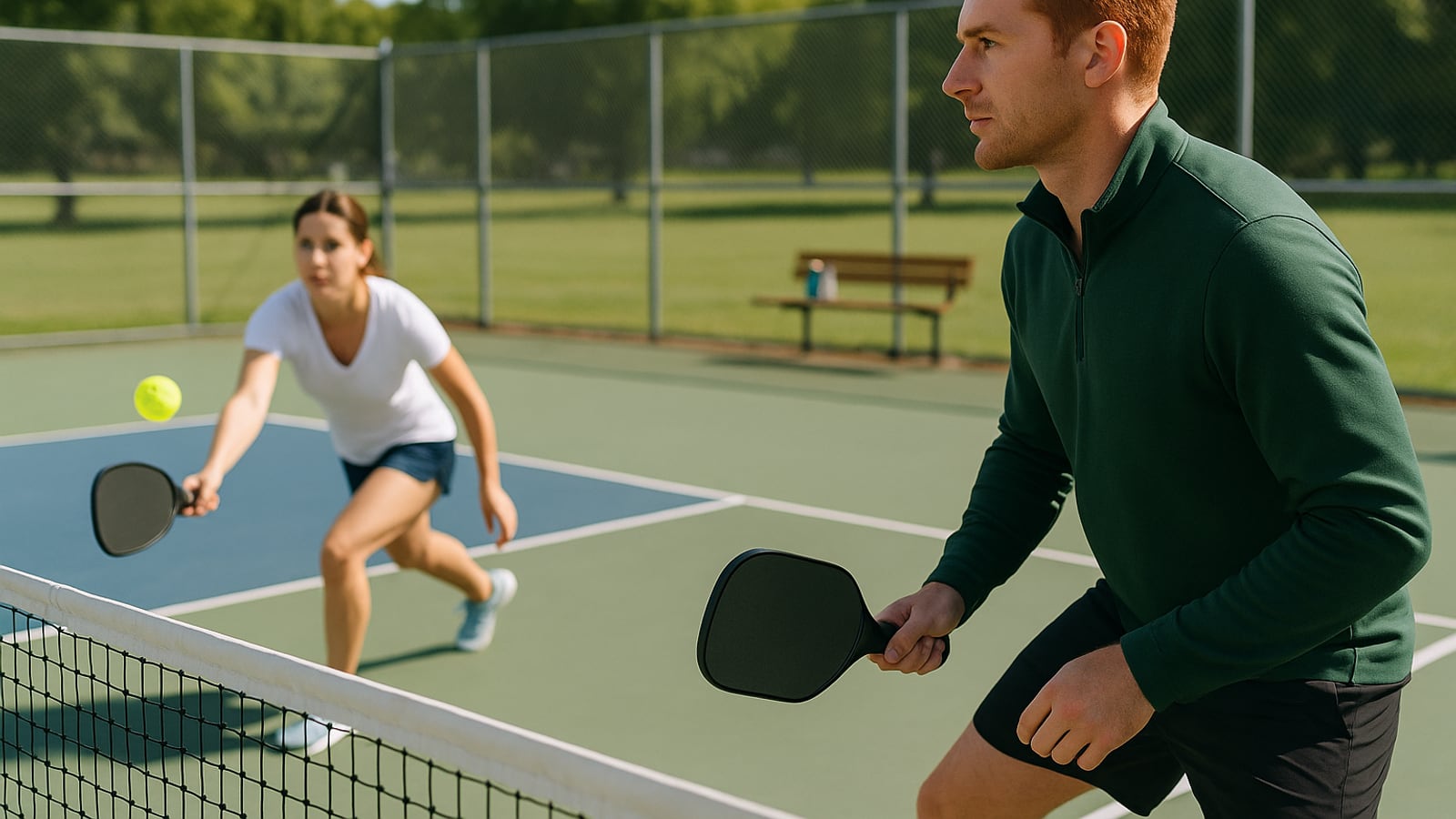
Quick answer: Don't give your spouse a single tip during play. Split the court evenly, give every middle ball to the forehand, and treat the coffee afterward as the actual date.
It's 8:05 on a Saturday at the park courts. Second game. Your wife dinks a soft shot into the tape, and you say, helpfully, "Just keep it a little lower." She nods. Two points later she hits another one into the net. You say it again, slower. And now the two of you're down 4 to 9, nobody's talking, and the couple across the net is being very polite about it.
That little sentence is the whole problem. Nothing else in this piece matters as much as getting rid of it.
The no-coaching rule
In the middle of a game, a correction doesn't land as advice. It lands as a verdict. She already knows the ball went into the net. She watched it happen. What she hears is that you noticed, you've got an opinion, and you think she needs to be told.
So the rule is simple, and it holds for husbands and wives alike: no instruction between the first serve and the last point. None. Not the gentle kind, not the encouraging kind that's really instruction in disguise ("You've got this, just bend your knees!").
What you're allowed to say during play:
- "Mine" and "yours," loud and early
- "Bounce it" or "out" on a ball your partner might chase
- "Nice" when it was nice
- "My fault" when it was, once, then move on
After the game, over coffee, you can offer exactly one observation, and only if your partner asks. If she doesn't ask, you've learned something about the morning. Keep it to yourself.
The better player, whoever that is, has the harder job here. It's harder to keep quiet than to hit a good third shot. That's the point of playing together at all.
Mixed doubles has a known bad habit
Anyone who's played open play at a public court has seen it. One partner, usually the stronger or more aggressive one, starts taking every ball. He crosses the middle to cut off shots that were clearly hers. He poaches at the net. He ends up playing singles on a doubles court while his partner stands on the sideline of her own game.
It's got a name in pickleball circles, and it isn't flattering. And when it's your spouse standing there, it isn't a strategy. It's a message.
Fix it with structure, not good intentions:
- Each of you owns your half. Her ball is her ball, even when you're sure you'd hit it better.
- The middle goes to the forehand. Most doubles pairs use this, and it ends the collisions and the "I thought you had it" arguments in one move. If you're both right-handed, the player on the left side has the forehand in the middle.
- Let her miss. A missed ball she owned is worth more to the partnership than a winner you stole.
And if you're the one getting poached, say something. Calmly, between games, not with the paddle pointed at anybody. "That one was mine, let me take it." Serving your partner doesn't mean shrinking so he can have more court. A good teammate holds his ground, and so does a good wife.
Learn it from zero, together, if you can
The easiest version of this date is two beginners. The rules take one morning:
- The court is 20 by 44 feet, the same as a badminton court. The net is 36 inches at the sidelines and 34 in the middle.
- The serve is underhand, with contact below the waist, diagonal, and it has to clear the kitchen.
- The kitchen is the 7-foot non-volley zone on each side of the net. You can't hit the ball out of the air while standing in it. You can step in to play a ball that's already bounced.
- Two-bounce rule: the serve bounces, the return bounces, then anything goes.
- Scoring in traditional games goes to 11, win by 2, and only the serving team scores. The server calls three numbers: their score, the other team's score, and which server they are. You start at "0-0-2," which confuses everybody for about a week.
If one of you already plays, the lopsided version takes more care. Sign up for a beginner clinic together anyway, and the experienced one plays at beginner pace the whole time. It's humbling in a useful way. Many parks and rec centers run cheap intro sessions, and some keep loaner paddles.
Build the Saturday around the coffee
The courts are the excuse. The date is the forty minutes after.
Get there early. Public courts fill fast on weekend mornings, and open play often runs on a paddle-stacking system, which means waiting your turn. An 8 a.m. start gets you real games before the crowd and the heat. Play an hour. Then go sit somewhere with eggs and talk about anything other than the third game.
Couples who stay married for decades tend to protect a small, repeatable ritual like this, and what couples married fifty years do that the rest of us skip is mostly a list of exactly this kind of boring, faithful habit. The Saturday doesn't have to be pickleball forever. It has to be yours.
If you've got little kids, this is where the plan dies, so plan for it. Trade mornings with another couple: you watch theirs one Saturday, they watch yours the next. There's more on guarding couple time in protecting the team after the kids arrive.
And be the couple people are glad to see at the courts. Bring an extra ball for open play. Pick up the strays by the fence even when they aren't yours. Rotate off promptly when your game ends. After a rain, grab a squeegee and push the puddles off before anyone asks. Leave the court better than you found it, and you'll never lack for games.
Gear, without a fight at the store
Don't start with expensive paddles. Borrow or buy two basic ones, play a month, then decide whether either of you cares.
Where to actually spend:
- Court shoes. Tennis or pickleball shoes, not running shoes. Runners are built for straight-ahead motion, and pickleball is all side-to-side. Rolled ankles are the most common way this hobby ends early.
- The right ball. Outdoor balls are harder with smaller holes. The Franklin X-40 is the one you'll see at most parks.
- Sunscreen. Any broad-spectrum SPF 30 or higher, every time, beats skipping it. We'd pick mineral: zinc oxide and titanium dioxide sit on the skin, cover broad-spectrum, and are the only two filters the FDA proposed in 2019 as generally recognized as safe and effective, while it asked for more data on the rest. They're gentler on sensitive skin too. The honest catch is a white cast, which tinted formulas fix. Blue Lizard Sensitive Mineral SPF 30 or Neutrogena Sheer Zinc SPF 50 both work. Reapply every two hours, more if you're sweating, and wear a hat.
When the car ride home goes quiet
You'll lose. Sometimes badly, sometimes because one of you had a rough morning, sometimes because the retired couple across the net has been playing four days a week since 2019.
A few rules for the drive home. Nobody replays points. Nobody says "if you'd just." If one of you is genuinely upset, the other goes first with "I was short with you on the court, I'm sorry," and means it. How to apologize to your wife and mean it covers the part most guys skip. If it turns into a real fight, the rules that keep a marriage argument from turning into a war apply on the car seat just as well as at the kitchen table.
One honest line. If every game ends in contempt, if one of you is afraid of the other's temper, or if the court is just where something much bigger keeps leaking out, that isn't a pickleball problem. Talk to a pastor or a licensed counselor. If anyone feels unsafe, safety comes first, before the marriage conversation and before anything else.
For most couples, though, it's much smaller than that. It's one sentence about keeping the ball lower, said once too often.
So don't say it. Take your side of the court, call "mine" like you mean it, and lose 11 to 3 on a clear April morning. Then go get the pancakes anyway.
Nina Castellan
BRO for Her
Runs the women-facing desk. Same standard, same tools, written for a different reader — not a softer one.

Watch
Worth an hour of your evening
More from Marriage.
From channels we rate. Plays on YouTube.
Read next