Skip the paracord bracelet and carry a real hank of cord
Fifty feet of cord and five knots will run a tarp, a bear bag, a clothesline and a repair job. Here's how to pack it and use it without hurting the woods.
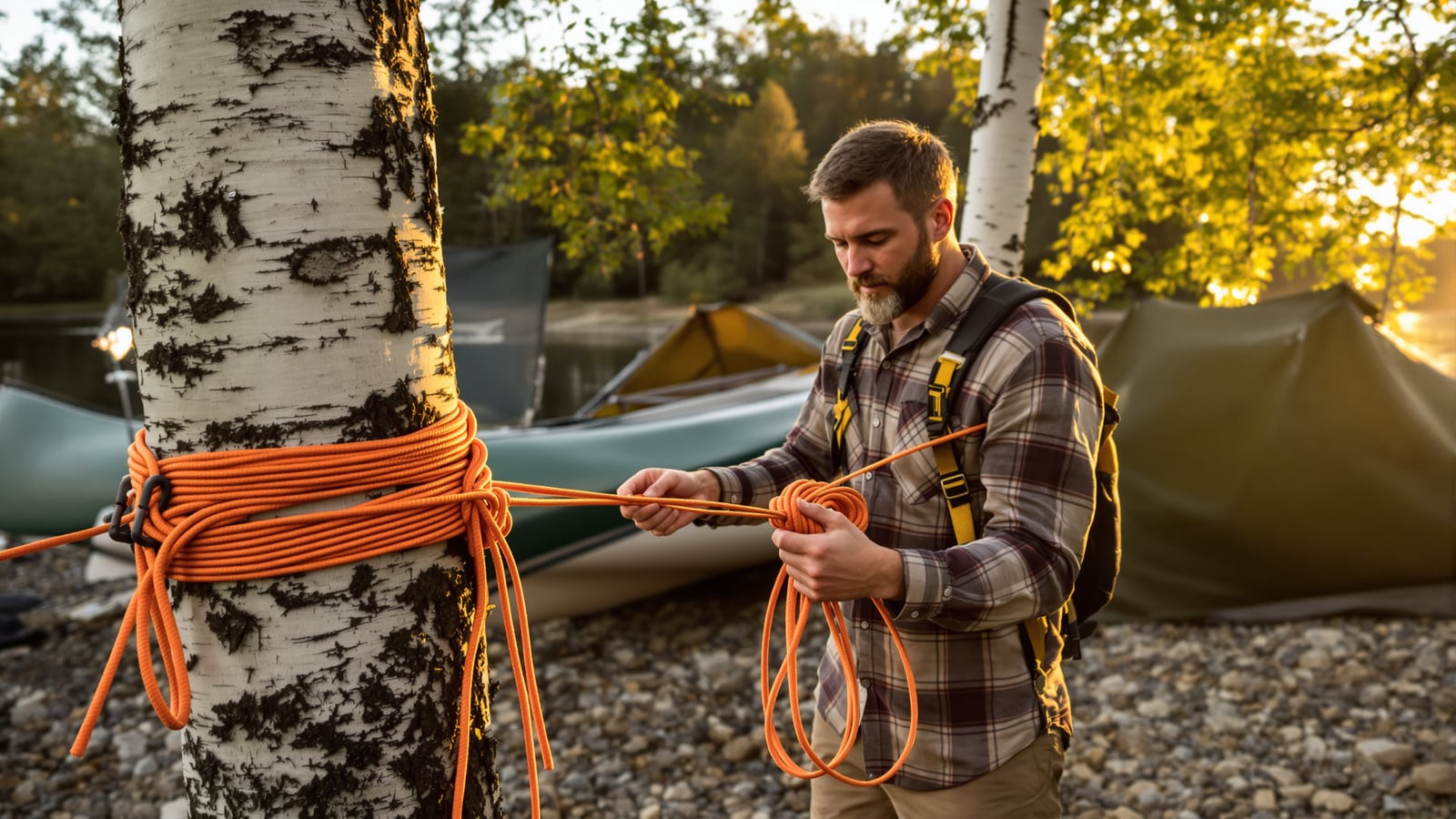
Quick answer: Carry 50 feet of 550 paracord, 50 feet of thin guyline, and a couple of wide tree straps. Learn five knots well enough to tie them in the dark. Leave the paracord bracelet as a keepsake.
The bracelet problem
A paracord bracelet looks like preparation. It's mostly decoration.
A typical one holds somewhere around ten feet of cord, and it's wound in a weave you have to pick apart knot by knot. Try that with cold hands while the rain starts. Ten feet won't hang a tarp. It barely makes a ridgeline.
Carry cordage you can actually use. A loose hank of 50 feet of 550 paracord (Type III, rated at a minimum of 550 pounds breaking strength) fits in a coat pocket and weighs next to nothing. Pull it out, cut what you need, and you're working in ten seconds.
The bracelet's one real advantage is that you'll never leave it at home. Fair. Wear it if you like it. Just don't count it as your cord.
What goes in the bag
50 feet of 550 paracord. It's a sheath around seven inner strands. Those strands are useful for sewing repairs, fishing line and tying off a loose zipper pull. It's your general-purpose cord for lashing, clotheslines and camp chores.
50 feet of thin guyline, 2 to 3 millimeters. Get the reflective kind. Somebody will walk into your tarp lines after dark, and it might be you. Thin cord also packs small and runs through tarp grommets and tent loops without a fight.
Tarred bankline, if you do repairs. It's a hard, tightly twisted nylon. It grips knots well and holds up for sewing heavy gear, lashing a broken pack frame or patching a tent pole sleeve. A small spool covers years of trips.
Two wide tree straps. These are flat webbing straps, and they matter for the leave-no-trace part below.
One ratchet strap or cam strap, if you're car camping. Cord is poor at cinching a load down. A strap does it better, and it keeps your cooler from sliding out of the truck bed on a washboard road.
If you're packing light for a first overnight, the same list shrinks. Start with the paracord and guyline, and check what to leave home on your first overnight trip before you add anything else.
Five knots, and only five
You don't need forty. You need five that you can tie without looking.
Bowline. It makes a fixed loop that won't slip and still unties after a night under load. Use it to put a loop at the end of a line. Tie it a dozen times at your kitchen table before you rely on it.
Taut-line hitch. This one is for tarp and tent guylines. It slides to tighten the line and grips when you let go. Wrap the working end around the standing line two or three times inside the loop, then once more outside and snug it up. Slide it to adjust. When the rain sags your tarp at 2 a.m., you slide the knot and go back to sleep. A pile of granny knots would have you out of your bag in the dark.
Trucker's hitch. It gives you a mechanical advantage, roughly a 3-to-1 pulley, with no hardware. You make a loop in the middle of the line, run the free end around the anchor and back through that loop, then haul down. Use it for a taut ridgeline or lashing a canoe to a roof rack. Finish with two half hitches.
Clove hitch. It goes on a post or pole fast and adjusts easily. It can work loose if the load changes direction, so back it up with a half hitch for anything that matters.
Two half hitches. It's the simple finisher. Tie it to a ring, a bumper, a tent stake or a tree.
Skip the square knot for anything load-bearing. It capsizes and slips. It's fine for tying a bundle of firewood. It isn't a knot to trust with your tarp.
Setting a tarp ridgeline
This is the job that cordage was made for.
- Pick two trees about 12 to 15 feet apart. Check overhead first for dead limbs. Dead branches falling in wind kill people every year.
- Wrap a tree strap around each trunk at about chest height. Clip or tie your cord to the strap with a bowline.
- Run the cord between the trees. Use a trucker's hitch on one end to pull it tight.
- Drape your tarp over the line. Tie guylines from each corner out to stakes or rocks with taut-line hitches.
- Tie a short length of cord around the ridgeline on each side of the tarp, hanging down a few inches. Water running along the line will drip off the cord instead of running onto your gear.
Pitch the low side into the wind. Check the sky using the habits in The Weather That Kills Hikers and How to Read It in Time before you decide how low to go.
What cord won't do
Paracord isn't climbing rope. It isn't rated for a fall, for towing a vehicle or for holding a person. A shock load, like a person dropping onto a line, can exceed what the number on the package suggests. If someone's weight depends on it, use equipment made and rated for that. This is true of hammocks too: use proper hammock suspension, not whatever you have in the bag.
On bear hangs, check what the area requires before you rely on cord. Many parks require a canister or provide a storage locker, and in those places a hang isn't allowed. If a hang is permitted, follow the local method and tie it clear of the trunk and well off the ground. Your campsite rules beat your habits.
Leave it better
Cordage tempts you to be clumsy with trees. Don't.
- Use wide straps, not cord, around trunks. Thin cord under tension can cut into bark and damage a living tree. Many parks and forests set a minimum strap width, often an inch. Check yours.
- Don't cut live branches for a ridgeline or a hook. Find another tree.
- Don't leave line strung overnight where hikers might trip. Take it down in the morning.
- Untie everything before you leave. Every knot, every strap, every guyline. Walk the site once more and pick up the cut ends too. Short scraps of cord look like nothing until a bird gets tangled in one.
- Leave the site cleaner than you found it. If the last campers left a bit of string in the fire ring, pack it out.
Care for it like gear
Rinse mud off your cord and let it dry fully before you stash it. Damp cord in a bag gets musty. Flame-seal the ends of cut synthetic cord with a lighter, away from your tent and your fingers, so it doesn't fray. Coil it loosely instead of wrapping it in a tight ball. Tangles waste more time than any knot ever will.
One more habit. Once a season, take your hank out on the porch and tie your five knots without looking. It takes ten minutes. It's the ten minutes you'll be glad you spent the night the wind turns.
Wes Dunbar
Country & Skills
Grew up on an acreage and never quite left. Covers trucks, trades, land, and how to do the thing yourself.

Watch
Watch how it's done
Picked for this article.
From channels we rate. Plays on YouTube.
Xander Budnick
Top 5 Tarp and Camping Knots
Kusk Bushcraft
Keeping it Simple - Tarp Ridgeline Using One Knot
Read next