

Find the weakest link in a chain before it finds you
A chain doesn't care about its average link. It fails at the worst one, and you can usually find that one with your hands and a ruler.
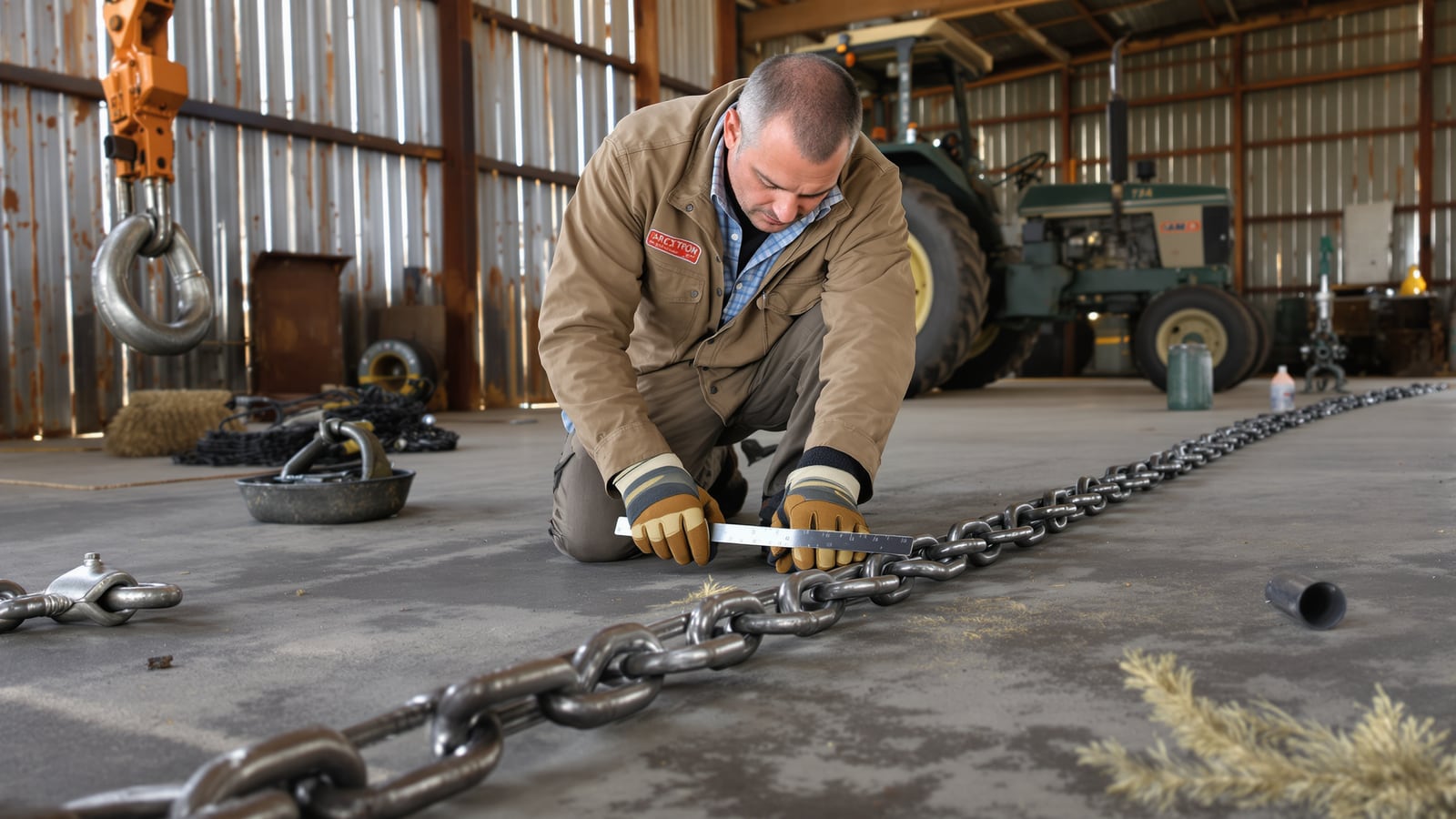
Quick answer: A chain carries the same pull through every link, so only the link with the least strength left matters. Clean the chain, run it through your hands one link at a time, measure stretch, and check the hooks and shackles on each end. One bad link retires the whole chain.
Every link feels the same pull
Pull on a chain with 3,000 pounds of force and every link carries 3,000 pounds. No link gets a break because its neighbor looks beefy.
Say 99 links could hold 12,000 pounds. The hundredth has a hairline crack from the day it was welded and quits at 7,000. The chain breaks at 7,000. The other 99 links never get a vote.
Engineers call this a series system. Compare it to ten strands of rope running side by side, a parallel system. If one strand frays, the other nine pick up its share. A chain has no backup. It's a single path, and the path is only as good as its worst stretch.
Longer chains are weaker chains
This one surprises people. Take two chains from the same maker, one ten feet long and one a hundred. On average, the long one breaks at a lower load.
The reason is plain odds. Every link is a draw from the factory's bin, and some draws are bad ones: a pocket in the weld, a spot where the steel cooled wrong. A hundred-foot chain gets ten times the chances to include one. The Swedish engineer Waloddi Weibull worked out the math of this in the 1930s, and "weakest-link theory" still bears his mark.
It's also why serious lifting chain carries a working load limit far below what it will actually break at. For overhead-rated alloy chain, that limit is commonly set around a quarter of the breaking strength. The margin is there for the link nobody can see.
The weak link rarely looks weak
On a new chain, the weak link is a hidden flaw. On a used chain, it's whichever link life has been hardest on.
That's usually the one that rides in the hook, drags on gravel, or takes the sharp bend around a bumper. Steel doesn't break from one bad day, either. It breaks from fatigue. Each time the load goes on and off, a microscopic crack at some tiny flaw grows a hair. Most of its life it's invisible. Then the leftover metal can't carry the pull, and the link lets go in an instant.
Look at a fatigue break afterward and you'll often see two zones: a smooth, almost polished area where the crack crept along for months, and a rough, grainy patch where the rest tore at once. The "sudden" failure wasn't sudden. It was just unobserved. The same logic keeps inspectors crawling around bridges with flashlights, and it's why aircraft get cycle-counted, not just age-counted.
Heat does damage too. Put a torch or a welder on a link and the steel beside the repair changes character, often getting harder and more brittle. A bolt shoved through a broken link is a weak link you chose on purpose, without knowing how weak.
How to find it
Take the chain off the hook. Wire-brush the dirt off and lay it out in good light. Then run it through your gloved hands, one link at a time, slowly. Your fingers catch what your eyes skip.
- Stretch. A link longer than its neighbors, or one that won't sit snug against them, has been yielded.
- Bends and twists. Every link should lie in the same plane as the one two over. A link that's rotated or bowed has been overloaded.
- Nicks and gouges. Check the inside curve where each link bears on the next. Wear there thins exactly the steel doing the work.
- Cracks. Look hardest around any weld seam.
- Pitting and color. Deep rust pits shrink the metal. Blue or straw-colored steel means it's seen real heat.
- Stiffness. Every link should swing freely. One that binds is worn, bent, or packed with rust.
If you find one bad link, don't cut it out and patch the gap with hardware-store parts. Replace the chain, or have the manufacturer or a qualified rigger repair it with a connector rated for that exact grade. For anything lifted overhead, over people, or past what you can afford to drop, those inspection rules aren't optional. Ask the chain's maker or a rigging professional.
The twelve-inch test on a bike chain
A bicycle chain is the easiest place to see this with a ruler.
A new chain has pins spaced exactly half an inch apart, so 24 links span 12 inches. Lay a ruler along the chain with a pin at the zero mark. If the pin at 12 inches sits about one sixteenth of an inch past the mark, the chain has grown roughly 0.5 percent. For most modern narrow chains, that's the point to replace it. A cheap chain-checker tool does the same job faster.
The chain isn't really stretching. The pins and bushings are wearing, so the spacing creeps open. The effect is the same, though. A stretched chain chews the teeth on your cassette and chainrings, and those cost far more than a chain. Replace it early and the expensive parts last.
Then flex the chain sideways and watch for a tight link. One stiff link will skip and clunk every revolution. It's the weakest link announcing itself politely.
Check what's on the ends
Often the chain is fine and the failure happens at the hardware. Hooks open their throats under load. Latches go missing. Shackle pins get swapped for a bolt of unknown strength. Inspect every piece in the line as if the chain's rating depends on it, because it does.
Then watch how you pull. A slow, steady tug and a truck taking a running start at a slack chain are different events. The jerk can drive the force far above the steady pull, and a chain that would have held a smooth 3,000 pounds can snap on the yank. Take up slack gently. Pull in a straight line. And stand well clear of the line, because a chain that lets go stores energy and throws it.
If you borrow somebody's chain, return it cleaner than you got it. If it took a hard jerk while you had it, say so. The next guy deserves to know which link has been through something.
Sometimes the weak link is the plan
Engineers sometimes pick the weakest link themselves. The shear pin on a snowblower auger is built to snap when a chunk of ice jams it, so the gearbox doesn't. A fuse in a panel does the same job for wiring.
When one of those breaks, replace it with the exact part. A stronger bolt from the junk drawer doesn't remove the weak link. It just moves it to a part that costs two hundred dollars.
The principle runs past steel. Any system with one path, whether a chain, a budget, a schedule, or a household running on a single paycheck, fails at its worst point. You want to be the one who finds that point, in daylight, with a say in what happens next.
Dean Shaw
Gear & Garage
Reads the warranty, the parts list and the long-term owner reviews before anything else. Trucks, tools, watches, and the cheap version that costs more.

Watch
Watch how it's done
Picked for this article.
From channels we rate. Plays on YouTube.
Ranger - Lifting Rigging Safety
How to inspect your lifting chain
Consolidated Rigging
Care, Use & Inspection of Chain Slings by Consolidated Rigging and Lifting
Read next