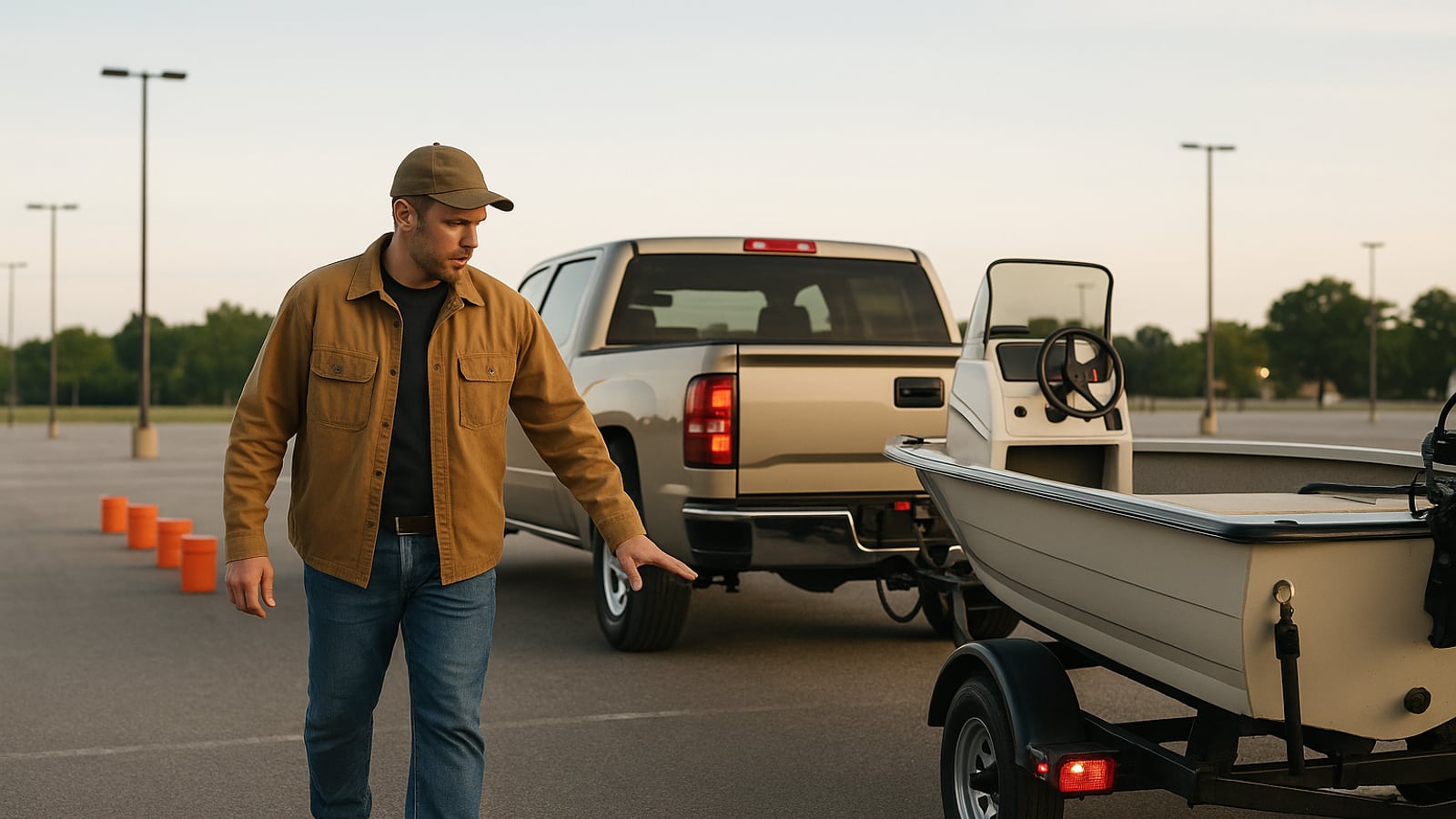
Find an empty parking lot on a Sunday morning. Bring four buckets, a full tank, and ninety minutes with nobody waiting on you. That's the whole curriculum. Everything else in this piece is detail.
The reason people never learn to back a trailer properly is that they only ever attempt it in front of a line of trucks at a boat ramp, with a spouse yelling directions from the tailgate and a stranger in a bass boat watching. Nobody learns anything under those conditions. They just develop a lifelong flinch.
So separate the learning from the performing. Learn it alone.
Before the truck moves at all
Walk the trailer. Every time, not just the first time.
Coupler seated on the ball and latched, with the pin or lock through it. Give the tongue a lift with your hand — if it pops off the ball, you found out in the driveway instead of at 45 on the highway. Safety chains crossed under the tongue, so they'd cradle it if the coupler let go. Breakaway cable clipped to the truck, not to the chains. Jack fully up and swiveled. Lights working: brake, turn, running, both sides.
Tires matter more on trailers than on trucks, because trailer tires sit for months and rot from the inside. Check pressure cold against the number on the sidewall. Look at the date code. A tire with plenty of tread and seven years on it's not a good tire.
Now walk the lot. Look for curbs, light poles, drainage grates, and anything low enough to disappear in a mirror. Then set your mirrors wider than you'd set them for normal driving. You want to see the full length of the trailer's side and the pavement beside the tire. You'll be steering off what those mirrors show you, so they're the instrument panel for the next hour.
The one rule that actually works
The trailer turns the opposite way from your steering wheel.
Every version of this instruction gets confusing the moment you're actually moving, so use the physical version instead. Put your hand at the bottom of the steering wheel. Move your hand the direction you want the back of the trailer to go. Left hand travel, trailer goes left. That's it. No mental translation, no reversing the image in your head.
Second rule, which is harder to accept: tiny inputs. A quarter turn of the wheel is a big correction. Most beginners saw the wheel back and forth in half-turn sweeps, the trailer responds late, they over-correct the correction, and forty feet later it's jackknifed. Small movement, wait, watch, adjust.
Third rule, which is free and nobody uses it: pull forward. Pulling forward straightens the trailer and gives you a fresh start. It costs you eight seconds. There's no prize for completing the maneuver in one continuous motion.
Drill one, the straight line
Back the trailer in a straight line for a hundred feet.
It sounds like the easy one. It isn't. A trailer in reverse is unstable by nature — it wants to wander off one way or the other, and the whole skill is catching that drift early and nudging it back before it becomes an angle.
Go slow enough that you're idling. Watch both mirrors. The moment you see more trailer in one mirror than the other, you've started to drift. Correct with a small movement of your hand at the bottom of the wheel, then straighten back immediately. Beginners make the correction and hold it, which just sends the trailer past straight and into a drift the other way.
Do it until you can go a hundred feet without touching the wheel more than three or four times. That's the foundation. Every other maneuver is this plus an intentional angle.
Drill two, into a space
Set your buckets as a parking space, roughly twice the width of the trailer to start. Narrow them later.
Here's the part that separates people who can do this from people who can't: the setup is most of the job. Pull past the space, swing wide, and put the truck and trailer at a decent angle before you ever select reverse. If you start straight and try to create the angle while reversing, you'll be fighting it the entire way in.
Always set up to back over your driver's side when you have the choice. You can lean out the window, see the trailer's whole side with your own eyes, and judge the gap. Backing to the passenger side — the blind side — means relying on a mirror that shows you the trailer disappearing behind the bed. It's a real skill and worth practicing, but in the real world, plan your approach so you don't need it.
Get the angle. Start moving. Watch the mirror on the side you're turning toward. When the trailer reaches the angle you want, straighten the wheel and let the truck follow the trailer in — that's called chasing it, and it's how you finish clean.
Drill three, the blind side and the ninety
Now do the same space from the passenger side. Then set up a tight 90-degree turn into a space off a narrow lane, which is what a campground site or an alley actually looks like.
On the blind side, your reference is the trailer fender in the mirror and the gap of pavement beside it. When you lose sight of the trailer entirely, stop. Get out and look. Truckers call it GOAL — get out and look — and nobody has ever damaged a trailer doing it.
Watch the front of the trailer too, not just the back. When the angle gets sharp, the tongue and the front corner of the trailer swing toward your truck. A jackknife doesn't just stop you — it dents the bed side or cracks a tailgate. If the gap between the trailer's front corner and the truck body starts closing fast, you're done reversing. Pull forward.
A backup camera helps. It's not a substitute for mirrors, because it can't show you the trailer's front corner or the pole beside you.
When there's an audience
There eventually will be. The boat ramp on a Saturday, the fuel island, the church parking lot with the food truck in the way.
Do your prep somewhere else. At a ramp, that means the staging lot — straps off, plug in, gear loaded, drain plug in the boat before you're anywhere near the water. Then you arrive at the ramp with nothing to do but back down it.
Slow down deliberately. Under pressure, everyone speeds up, and speed is exactly what makes a trailer uncontrollable. Roll down the window. Pull forward as many times as you need. The guy behind you has done this badly himself and isn't keeping score.
If you're using a spotter, agree on the signals before they walk back there. One hand showing the size of the remaining gap. A closed fist means stop and it means stop immediately. And the spotter stands where you can see them in a mirror the whole time — if they vanish, you stop until they reappear. No exceptions to that one.
Twenty years from now you'll back a boat down a ramp in the dark, in the rain, with a kid asleep in the back seat, and it'll be unremarkable. That morning in the empty lot is what buys it.
Wes Dunbar
Country & Skills
Grew up on an acreage and never quite left. Covers trucks, trades, land, and how to do the thing yourself.

Watch
Worth an hour of your evening
More from Skills.
From channels we rate. Plays on YouTube.
Read next