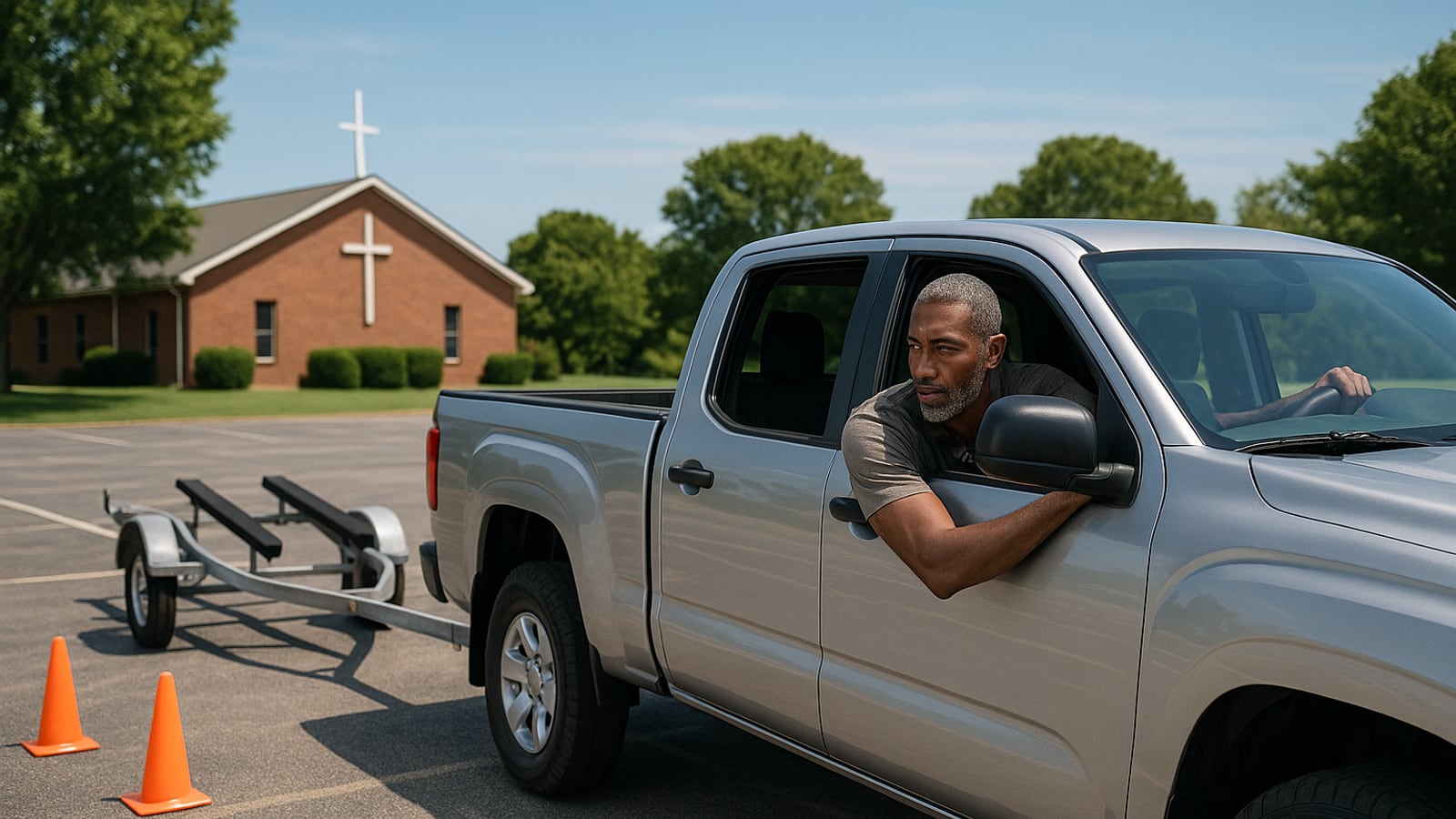
Find a big empty lot. A church parking lot on a Sunday afternoon, a closed school, a fairground in the off-season. Bring four orange cones from the hardware store, about four dollars each, or four gallon jugs with an inch of water in the bottom so they don't blow away. Give yourself two hours and don't tell anybody where you're going.
That's the whole secret. Nobody learns this at the boat ramp with six trucks in line behind them. They learn it alone, badly, over and over, until the wheel does what their hands mean.
Check the hitch before you check anything else
Every towing problem that actually hurts someone happens before the trailer moves.
Walk it in the same order every time. Coupler seated fully over the ball and latched, with the pin or lock through the latch so vibration can't lift it. Safety chains crossed underneath the tongue in an X, with enough slack to turn but not enough to drag. Crossed chains cradle the tongue if the coupler comes off the ball, which is the entire point of them. Jack fully raised and pinned. Breakaway cable clipped to the truck, not to the safety chain.
Then the lights. Brakes, left, right, running. Do it alone by backing up to a storefront window or a garage door at dusk and watching the reflection.
Tires last. Trailer tires rot before they wear out, and a trailer that's sat behind a shed for three years is riding on tires that look fine and are done. Check the pressure cold, to whatever's stamped on the sidewall, and look at the date code. Anything past six or seven years, replace it before you tow a loaded trailer at highway speed.
Load matters for backing too. The usual guidance for a conventional ball hitch is roughly ten to fifteen percent of the trailer's weight carried on the tongue. Too little and the trailer wanders and fishtails. Too much and your steering goes light. If you're towing anything heavy or unusual, ask the dealer or a trailer shop to look at your setup rather than guessing.
Set the mirrors for the trailer
Your mirrors are aimed for driving an empty truck. They're wrong now.
Adjust each side so the trailer's side runs along the inside edge of the glass and most of what you see is the lane beside it. You want to catch the moment the trailer starts drifting, and drift shows up as a change in how much of the trailer you can see. If you can only see the trailer, you can't see the drift.
If your truck has towing mirrors that extend, extend them. If it doesn't, clip-on convex mirrors cost less than thirty dollars and are worth every cent on a wide trailer.
Now put your window down. Both windows if you can. Half of backing a trailer is hearing it.
The first thing you practice is a straight line
Set two cones about fifteen feet apart, forming a gate, then two more cones sixty feet behind them. Your job is to reverse straight down that lane.
You won't be able to do it. Everyone discovers this in the first ninety seconds. The trailer picks a side and commits, and the harder you chase it, the faster it swings the other way.
The fix is smaller inputs and earlier ones. A trailer that's one inch out of line needs about a half-turn of correction. A trailer that's a foot out of line needs a fight. So you watch both mirrors and the instant more trailer appears in one of them, you correct, before your brain has fully registered why.
Go slow enough to idle. Foot off the gas, brake covering, maybe two miles an hour. Speed makes every error bigger before you can see it.
Put your hand at the bottom of the wheel
The oldest trick in trucking and still the best one. Rest your hand at six o'clock on the steering wheel. Whichever way you move that hand, the back of the trailer goes.
Trailer drifting left in your mirror? Move your hand left. That's it. No mental translation, no "reverse everything." The hand goes where you want the trailer to go.
It works because your hand at the bottom of the wheel mirrors the geometry. Believe it for an hour and you'll stop doing the math.
One warning. A short trailer, say a ten or twelve foot utility trailer, reacts almost instantly and will jackknife in a heartbeat. A thirty-foot travel trailer responds slowly and forgives a lot. Learn on whatever you actually own, because the timing doesn't transfer cleanly between them.
The 90-degree back, in pieces
Set four cones as a parking bay, a foot wider than your trailer on each side, and approach from the side.
Drive past the bay, then swing out a little so the truck sits at an angle to the opening. Backing is easiest when the trailer starts already bent toward where it's going, around thirty to forty-five degrees. Trying to start a 90 from dead straight means you have to create all the angle in reverse, and you'll run out of room.
Then back in three phases. Get the trailer swinging into the bay. Hold that angle and let it travel. Straighten the truck to catch it before it over-rotates.
That third phase is where people fail. They keep steering long after the trailer's pointed right, and it sails past the opening. Once the trailer is aimed where you want it, unwind the wheel and follow it in.
Pull forward. It costs nothing.
You're allowed to pull forward. Pull forward as many times as you like.
Nobody watching a man reset his approach thinks less of him. Everybody watching a man saw the wheel back and forth while the trailer folds toward his tailgate knows exactly what's happening. Pulling forward straightens the trailer and gives you a fresh start with better geometry, and it takes eight seconds.
If the trailer is jackknifed hard, don't try to back out of it. You can't. Pull forward until the truck and trailer line up, then begin again.
The blind side, and when to get out
Backing toward your driver's side is easy because you can lean out and see the whole trailer. Backing toward the passenger side, the blind side, is genuinely harder and you should practice it deliberately for the second hour.
Set the same bay on the other side and do it twenty times. In the real world, avoid it when you have a choice. Drive an extra lap of the lot to approach from the side that lets you see.
And get out and look. Truckers call it GOAL and they do it with thirty years of experience. Stop, put it in park, walk the whole path once. You're checking for the bollard you didn't see, the drop-off at the edge of the gravel, the kid's bike, the gas meter on the corner of the garage.
Spotters
One spotter, and you agree on the signals before anyone gets in the truck.
They stand where you can see them in a mirror, never behind the trailer. Their hands show you the distance remaining, closing as you get nearer. A raised fist means stop now. If you lose sight of them, you stop immediately, every time, no exceptions.
Skip the shouting. Skip the second spotter with a different opinion.
The two places it gets real
Boat ramps are steep, wet and public. Get the straps and the plug sorted in the staging area, not on the ramp. Then back down slowly with the window open so you can hear the water on the tires, and keep your corrections tiny, because gravity is helping the trailer do whatever it already wanted to do.
Driveways are tighter than any cone you set. Walk yours first and find your reference point, something fixed like the corner of the fence or a mark on the curb, and learn the spot where you start turning. After four or five times you'll stop measuring and just do it.
Go find the empty lot. In a year somebody will hand you their keys at a ramp because their wife is getting nervous, and you'll back their boat in on the first try and hand the keys back without saying anything.
Wes Dunbar
Country & Skills
Grew up on an acreage and never quite left. Covers trucks, trades, land, and how to do the thing yourself.

Watch
Worth an hour of your evening
More from Skills.
From channels we rate. Plays on YouTube.
Read next