If you can't find it with the lights off, it's in the wrong place
Organize the shop by where your hand goes, not by what the tool is, and you'll stop hunting for the tape measure.
Quick answer: Turn the lights off and try to put your hand on ten tools you use every week. Every miss goes somewhere closer, with one permanent address and an outline to prove it. Do that for a weekend and the shop fixes itself.
The breaker trips at 9 p.m.
You're halfway through a cut. The garage goes black. You know the panel is twenty feet away and you know a flashlight exists. You don't know where.
That's the whole argument. A shop you can work in blind is a shop where everything has a place, the place is predictable, and your hand learned it. Nobody gets there by buying more bins. They get there by deciding where each thing lives and then never negotiating with themselves about it again.
Start with the flashlight. Mount it, or hang it on a hook by the door, at the same height every time. It's the first tool with a fixed address, and the only one you'll ever need in a hurry.
Run the dark test
Pick ten tools you reach for most. Tape measure, pencil, combination square, utility knife, hammer, a screwdriver or two, pliers, a cordless drill, a block plane if you've got one. Shut the door, kill the lights, and try to put your hand on each one without a phone.
You'll find three or four on the first pass. The rest are in a coat pocket, under a rag, or in the wrong drawer because that's where they landed on a Sunday in March.
Write down what you missed. Those are your problem tools, and they're almost never the big ones. Nobody loses a table saw. It's the pencil, the tape, and the 10mm socket that cost you twenty minutes.
Sort by use, not by type
The tool chest instinct is to group by kind: all the screwdrivers here, all the pliers there. It looks tidy. It also means that one job pulls from four different drawers.
Sort by how often your hand goes there instead.
- Arm's reach of the bench: what you touch every session. Pencil, tape, square, knife, the two screwdrivers you actually use.
- One step away: weekly tools. Drill, saws, clamps, sanding block.
- Across the room or on a high shelf: the stuff you need four times a year. The pipe wrench. The oversized forstner bit.
Most small shops have this backward. The seldom-used tools sit on the best wall because they look impressive, and the daily tools live in a bucket. Flip it.
If you're building out a bench from scratch, the garage workshop you'll use on a Tuesday night is worth reading first. The layout is half of this problem.
One tool, one address
A place that is "about here" isn't an address. Give each tool a spot with edges.
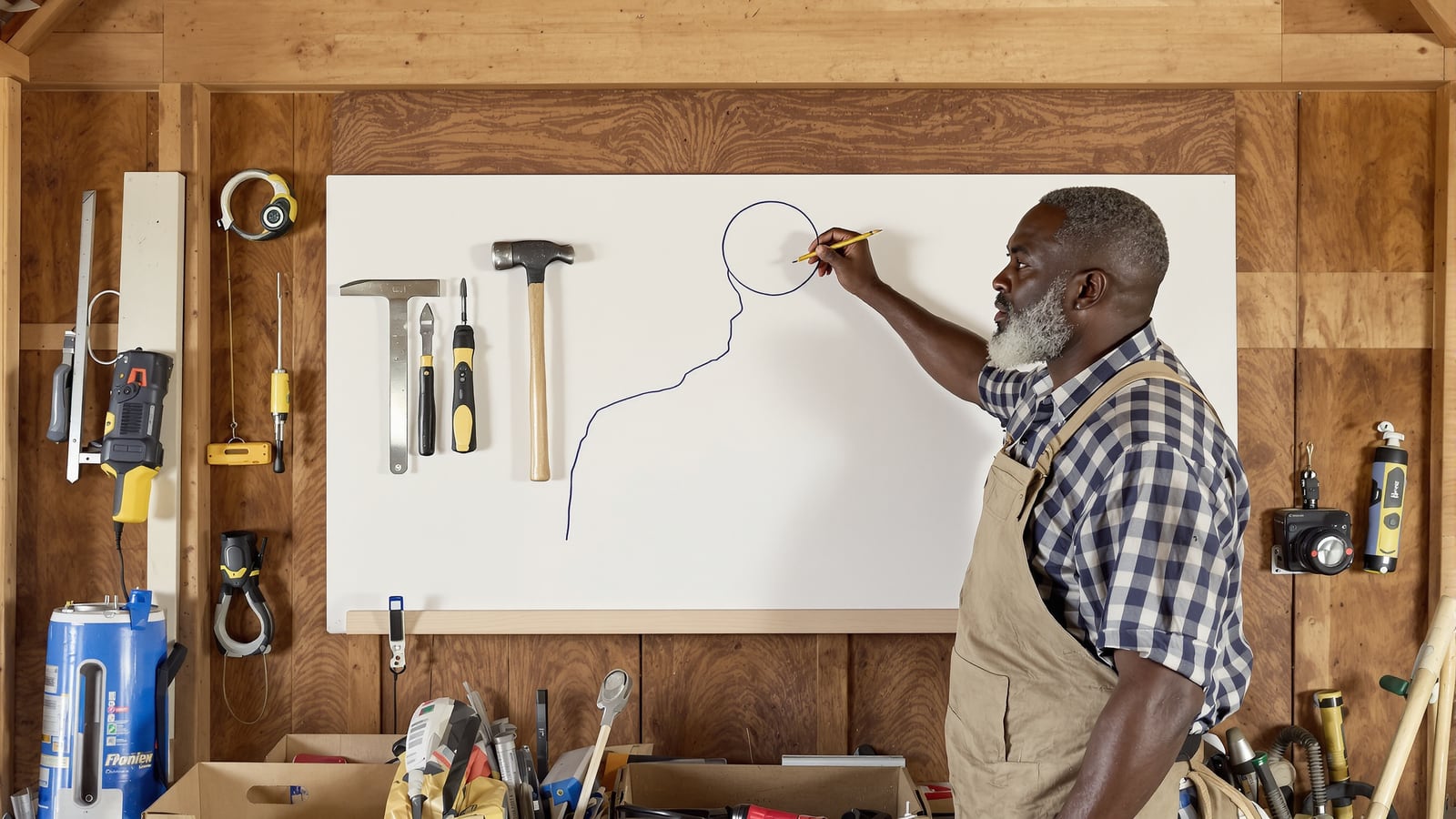
The cheapest way to do it's a pegboard or a plywood wall with a paint marker. Hang the tool, trace around it, step back. The outline does three jobs. Your eye finds the gap. Your hand learns the position. And when something's missing, you know exactly what and where, which settles a lot of arguments with teenagers.
Some other ways to give things an address:
- A magnetic strip for steel pliers, snips, and screwdrivers. Quick to mount, and your hand finds it by feel.
- A French cleat wall if you want to rearrange as your projects change. It's a weekend of ripping a 45-degree bevel in plywood, and it's the one system I'd build twice.
- Drawer dividers or foam cutouts for small precision stuff you don't want sitting in dust. A pencil outline on shelf liner works fine if you don't want to cut foam.
Pick one system per wall. Mixed systems look like a yard sale.
Make it work by feel
The dark test only works if your hand can tell things apart without your eyes. Some things help.
Keep your order consistent. Left to right, small to large. When the screwdrivers go in the same sequence every time, your hand learns it the way it learns a keyboard.
Put weight low and edges away from the reach path. In the dark, your hand sweeps. It shouldn't land on a chisel edge or the teeth of a saw. Chisels go in a rack, handles up and edges covered. Saws hang by the handle with the blade toward the wall. I learned that one the hard way, and everything I do differently after the shop hurt me covers the rest of that list.
Wrap a few turns of tape on the handles of tools that look alike and feel alike. A bit of rough tape on the Phillips, smooth on the flat. It sounds fussy. After two weeks you won't think about it.
And don't buy a chest with fourteen identical drawers unless you plan to label every one. You'll open six to find the nut driver.
Small stuff gets its own system
Screws, nails, anchors, and washers break more shops than any tool does. A coffee can of loose hardware is a punishment.
Screw the lids of clear jars to the underside of a shelf, fill them, and twist the jars on and off. Sort by type and length, one kind per jar. You see what's in them from below, and the shelf above stays free. It's a thirty-year-old trick that works for a reason.
Keep a small tray at the bench for what you're using right now. Everything in the tray goes back at the end of the night.
The honest trade-offs
Open storage collects dust. If you're sanding or cutting a lot of wood, the tools on the wall will wear a gray coat by the end of the month. Wipe them down on the same Saturday you sweep, or keep the finishing and precision tools behind a cabinet door.
Shadow boards also take time. Figure a full weekend for a decent wall, more if you're fixing the layout as you go. If you've got ten minutes a night and a small bench, a well-organized tote does ninety percent of it. Build a tool tote first and carry the right five tools to the job. There's no shame in that.
And some good woodworkers swear by drawers. They're right for them. The test is the same: can you find it blind?
The ten-minute reset
None of this lasts without a habit. At the end of the night, every tool goes back to its outline before you turn off the light. Sweep the bench. Wipe the blade you used. Put the cap back on the glue.
Leave the shop better than you found it, even though you're the only one who walks in. The next version of you will be tired, in a hurry, and in the dark.
And when the power does go out, you'll walk over, take the flashlight off its hook, and get back to work.
Wes Dunbar
Country & Skills
Grew up on an acreage and never quite left. Covers trucks, trades, land, and how to do the thing yourself.

Watch
Watch how it's done
Picked for this article.
From channels we rate. Plays on YouTube.
Adam Savage’s Tested
How to Organize a Chaotic Space
This Old House
How to Organize Tool Storage Drawers | Ask This Old House
Read next