

Peter failed Jesus twice in one night and still got the job
Asleep in the garden, then swearing he didn't know Him in the courtyard. What Jesus did next is the pattern for every man who's blown it.
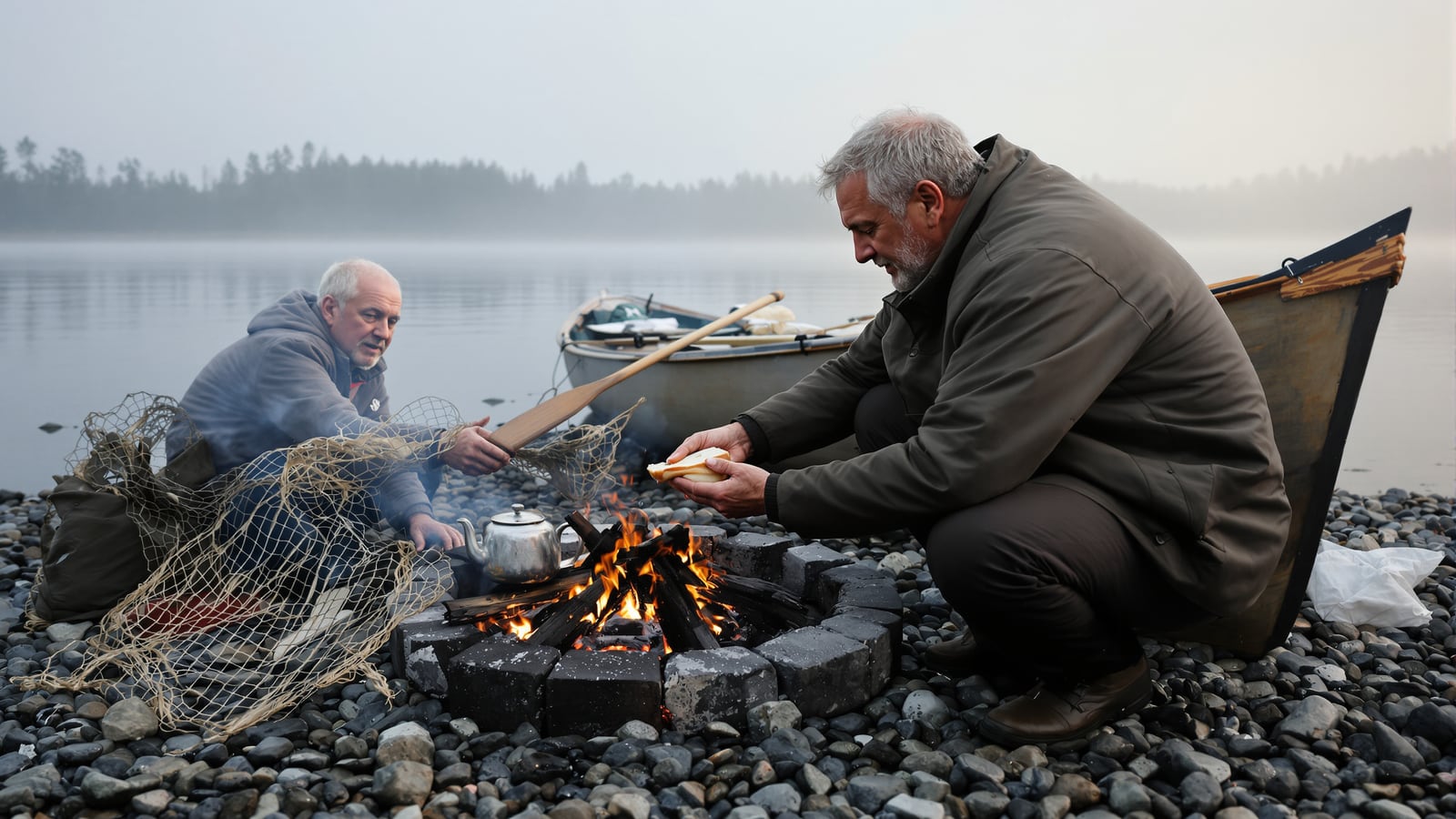
Quick answer: Jesus saw both of Peter's failures coming and prayed for him ahead of time. After the resurrection He sought Peter out, never raised the denials, and gave him the work back (John 21, ESV throughout). If you've failed Him, that's the pattern you can count on.
Two failures before sunrise
Before the rooster crowed, Peter had already failed Jesus twice.
Hours earlier he'd made a promise: "Though they all fall away because of you, I will never fall away" (Matthew 26:33). Then came Gethsemane. Jesus asked three men to stay awake with Him, and Peter fell asleep. Jesus woke him and said, "So, could you not watch with me one hour? Watch and pray that you may not enter into temptation. The spirit indeed is willing, but the flesh is weak" (Matthew 26:40-41).
Luke adds a detail that's easy to skip. He found them "sleeping for sorrow" (Luke 22:45). This wasn't laziness. The men were worn out and heartsick, and Jesus said as much in His rebuke. He named the weakness without calling Peter a fraud.
The second failure was worse. Peter followed the arrest at a distance and ended up in the high priest's courtyard. "Now the servants and officers had made a charcoal fire, because it was cold, and they were standing and warming themselves. Peter also was with them, standing and warming himself" (John 18:18).
A servant girl, then another person, then bystanders. Three times Peter said he didn't know Him. By the third he was swearing about it (Matthew 26:74). Then Luke gives us the moment: "And the Lord turned and looked at Peter. And Peter remembered the saying of the Lord... And he went out and wept bitterly" (Luke 22:61-62).
The man who said "I will lay down my life for you" (John 13:37) had just been undone by a girl at a fire.
What Jesus said beforehand
Read Luke 22:31-32 slowly. "Simon, Simon, behold, Satan demanded to have you, that he might sift you like wheat, but I have prayed for you that your faith may not fail. And when you have turned again, strengthen your brothers."
Jesus didn't pray that Peter would dodge the sifting. He prayed that Peter's faith wouldn't fail through it. And He said "when you have turned again," not "if." He'd already planned the comeback and the assignment before Peter had done anything wrong.
That should recalibrate how you think about your own worst night. You haven't surprised Him.
The man who went back to the boats
Easter morning, the angel's message at the tomb included three small words: "tell his disciples and Peter" (Mark 16:7). By name. Luke records that the disciples were saying, "The Lord has risen indeed, and has appeared to Simon!" (Luke 24:34). Scripture doesn't tell us what was said in that private meeting. It tells us only that it happened.
And yet in John 21, Peter is back at the lake. "I am going fishing," he says, and six others go with him (John 21:3). Nothing has been said about the denials, and he's quietly gone back to the old trade, as if the calling had expired.
Plenty of men do this. They don't walk away from Christ in a blaze. They just drift back to what they were before, because it feels safer than facing the question of whether they're still wanted.
The fire on the beach
Jesus calls from the shore. Peter swims in. And when the men get to land, "they saw a charcoal fire in place, with fish laid on it, and bread" (John 21:9).
Charcoal fire. John uses that word for the courtyard and for the beach, and it appears nowhere else in the New Testament. Peter's last memory of that smell was his worst moment. Jesus set the scene on purpose.
Then, after breakfast, He asks three times: "Simon, son of John, do you love me?" Peter answers three times, and the third time he is "grieved" (John 21:17). Each answer is matched by a task: "Feed my lambs." "Tend my sheep." "Feed my sheep."
Notice what He leaves out. There's no lecture and no list of what Peter did. Jesus doesn't say "I told you so." One question matches each denial, and the commission follows it. Then comes the line from years earlier by this same lake: "Follow me" (John 21:19; compare Matthew 4:19).
Where Christians read this differently
Two points, and good Christians land in different places on both.
The first is "do you love me more than these?" (John 21:15). Some read "these" as the other disciples, since Peter had claimed he'd outlast them all. Others read it as the boats and nets, the old life. Others hold both. The text doesn't settle it.
The second is the Greek. Jesus uses one word for love in the first two questions and another in the third, and Peter uses the lesser-sounding one each time. Some teachers build a lot on that shift. Others point out that John varies his vocabulary all through his Gospel and don't think the change carries the weight. You don't need to win that argument to see the heart of the passage.
Peter and Judas
Judas also felt remorse, and the Gospel says so (Matthew 27:3-5). Paul draws a line between two kinds of sorrow: "For godly grief produces a repentance that leads to salvation without regret, whereas worldly grief produces death" (2 Corinthians 7:10).
The difference wasn't how bad each man felt. It was where each took it. Peter went back to the Lord and sat at His fire. Be careful not to flatten the two stories, since they're different in nature, but the pattern holds. Guilt carried to Christ ends in restoration.
What to do with your own failure
- Stop hiding in the boat. Going back to the old life because you think you've forfeited the new one isn't humility. It's assuming you know His mind better than He does.
- Come to the fire. Swim, don't wait for the boat to dock. Pray plainly and tell Him what you did.
- Answer the question He's actually asking. It isn't "how badly did you fail?" It is "do you love me?"
- Take the work back. Don't make a career of apologizing. If He's said feed the sheep, feed them.
- Make things right with people. Restoration with Christ doesn't cancel what you owe the ones you hurt. Pay it back, own it, show up. Mercy doesn't excuse you from doing the right thing.
It all rests on the cross and the empty tomb. Peter was restored by a risen Savior who'd already carried the weight of Peter's sin. No other name under heaven does that for anyone (Acts 4:12).
If you want more passages to hold onto before a night like Peter's, start with thirty verses worth memorizing before the hard day arrives. And if you've never read the Gospel that early church tradition connects to Peter's preaching, start in Mark.
The sentence he wrote decades later
Weeks after the beach, Peter stood up in Jerusalem and preached to thousands (Acts 2:14). Years later he wrote to church elders: "shepherd the flock of God that is among you" (1 Peter 5:2).
The man who couldn't stay awake for one hour spent the rest of his life awake for everyone else. Jesus got His man back, and He'll do the same for you.
Josh Halloran
Christian Bro
Leads a mid-week mens group and has done for eleven years. Writes about faith as a practice rather than a position.

Watch
Worth an hour of your evening
More from Bible.
From channels we rate. Plays on YouTube.
Read next