
Quick answer: Forgiveness is a decision you make before God, and you can make it tonight without her. Reconciliation is a restored relationship, and it takes two willing women, honesty and usually more than one conversation. Don't confuse them, and don't skip the first one while you wait on the second.
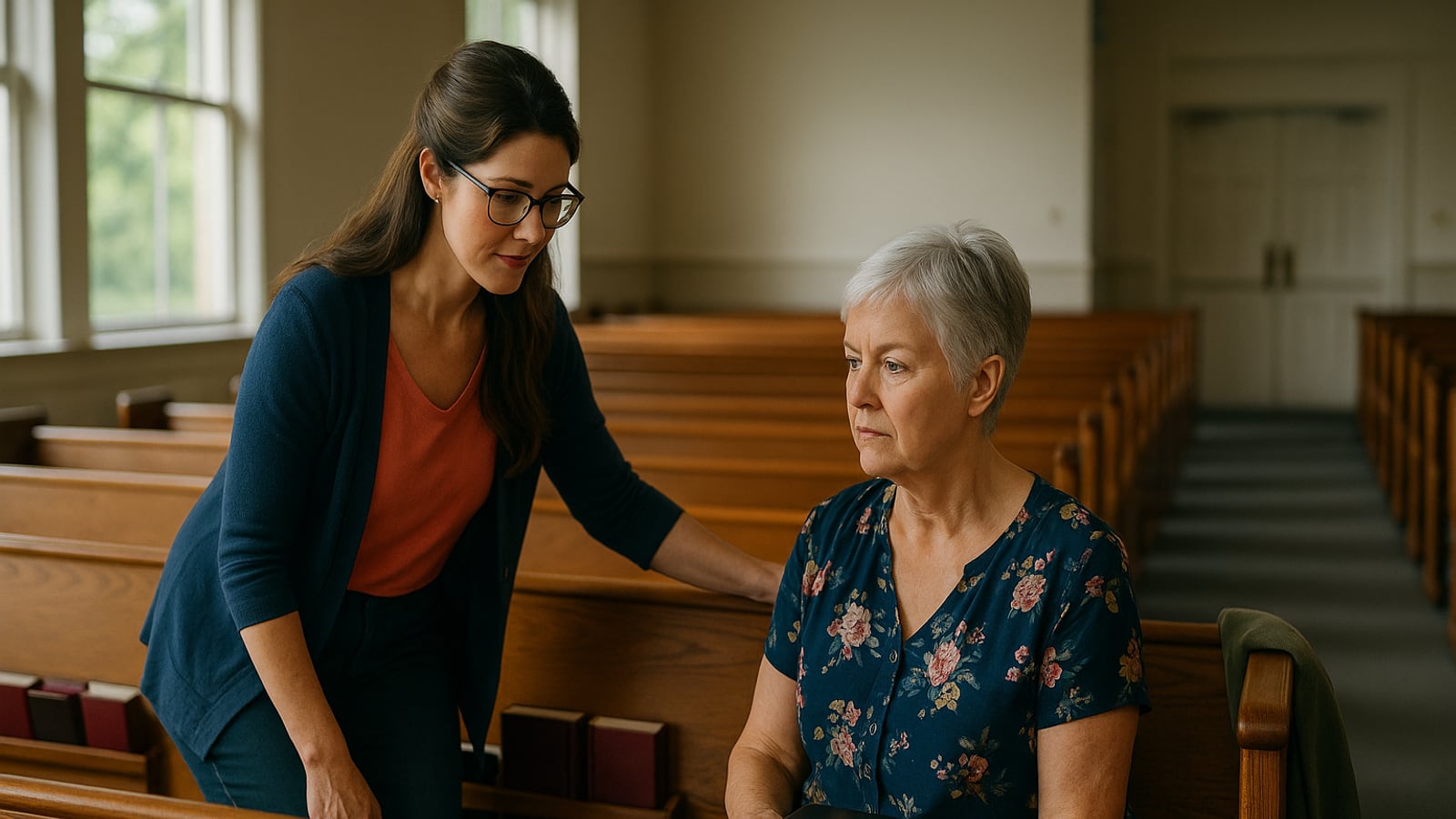
You know exactly where she sits. Left side, fourth row from the back, where she's sat for nine years. You used to sit next to her. Now you sit on the right, and you time your trip to the coffee station so you won't both reach for the creamer at once.
Nobody else has noticed. Or everybody has. You honestly can't tell anymore.
Paul named two women who couldn't get along
It's one of the most overlooked lines in the New Testament. In the middle of his warmest letter, Paul stops and writes this:
"I entreat Euodia and I entreat Syntyche to agree in the Lord. Yes, I ask you also, true companion, help these women, who have labored side by side with me in the gospel." (Philippians 4:2–3, ESV)
Notice what he doesn't do. He doesn't pick a side. He doesn't tell the church who was right. He doesn't treat them as troublemakers. He calls them co-workers in the gospel, and he asks someone mature to help them.
So if you're in a broken friendship at church, you aren't a bad Christian. You're in the book of Philippians. That's decent company.
But Paul also didn't let it sit. He named it, and he expected it to be dealt with.
Separate the two things before you do anything else
Most of the pain in these situations comes from mixing up forgiveness and reconciliation.
Forgiveness is releasing the debt. You stop demanding that she pay for what she did. "Be kind to one another, tenderhearted, forgiving one another, as God in Christ forgave you" (Ephesians 4:32, ESV). The measure isn't whether she deserves it. The measure is what Christ did for you on the cross, when you had nothing to offer Him but the sin that put Him there. You can forgive her on your knees in your kitchen at 10 p.m., and she never has to know it happened.
Reconciliation is rebuilding the friendship. It needs her. It needs honesty on both sides. It sometimes needs time, and trust that's earned back slowly.
You owe her the first one. You can't force the second one. When you make peace wait on her apology, you end up carrying a grudge and calling it patience.
Decide whether to cover it or go
Not every hurt needs a sit-down.
"Good sense makes one slow to anger, and it is his glory to overlook an offense" (Proverbs 19:11, ESV). A sharp comment at the baby shower, a forgotten birthday, a group text that read colder than she meant it. A lot of these are best covered with love and genuinely let go.
The test is simple. Can you drop it for real, or is it going to come out sideways in three weeks when she volunteers for the same committee? If you're still replaying the conversation in the shower, you haven't overlooked it. You've buried it. Buried things don't stay buried.
If it was a real wrong, or it's changed how you treat her, go.
Don't tell anyone first. Not even "for prayer."
This is where good women go wrong. You mention it to one friend in small group, softly, as a prayer request. Then another. By the time you finally talk to her, four women already know your side, and she can feel it in the room.
"Whoever covers an offense seeks love, but he who repeats a matter separates close friends" (Proverbs 17:9, ESV).
Jesus gave the order plainly: "If your brother sins against you, go and tell him his fault, between you and him alone. If he listens to you, you have gained your brother" (Matthew 18:15, ESV). Alone comes first. Before your husband gets the full story. Definitely before the prayer chain gets it.
You can ask one wise older woman or your pastor's wife for counsel on how to approach it. That's different from recruiting.
Before the conversation, do three honest minutes of homework
Sit down with a pen and write:
- What happened, in two sentences. Just facts, no adjectives.
- What it cost you. Be specific. "I felt left out of the planning for the retreat I've led for four years" beats "she always does this."
- What you contributed. There's almost always something. A tone. A silence that lasted too long. The way you pulled back instead of asking.
That third line is the one that changes the whole conversation. If you walk in with only her list, you're prosecuting. If you walk in with your own list too, you're reconciling.
How to actually have the conversation
In person, not by text. A text can't hear your voice crack, and she can reread it forty times looking for the knife. Ask for coffee. Pay for hers. Bring the good pastry, not the sad one from the gas station.
Open with the friendship, not the grievance. Something like: "I've missed you, and I think something went wrong between us. I'd like to fix it if you're willing."
Own your part first, with no "but" after it. "I pulled away after the retreat and didn't tell you why. That wasn't fair to you." Stop there. Let it sit.
Then name the hurt once, plainly. Not a speech. "When the planning happened without me, it really hurt. I didn't know how to say so."
Then ask, and actually listen. "Did I get that wrong? What was it like on your end?" You might learn something that rearranges the whole story. It happens more often than you'd think.
Don't demand a bow on it today. If she needs time, give it. A first conversation that ends with "Can we talk again next week?" is a win.
If you realize halfway through that you're the one who needs to apologize, don't dodge it. Jesus said that if you remember your sister has something against you, "leave your gift there before the altar and go. First be reconciled to your brother" (Matthew 5:24, ESV). Going first isn't losing. It's how grown women in Christ fight.
If she won't come back to the table
Sometimes you do everything right and she still says no, or says yes and then goes cold.
"If possible, so far as it depends on you, live peaceably with all" (Romans 12:18, ESV). That verse has two conditions in it, and Paul put them there on purpose. Some of it doesn't depend on you.
What does depend on you: saying hello in the lobby like you mean it. Signing up for the same meal train without making it weird. Refusing to trade stories about her. Praying for her by name, for good things, not for her to finally see the light about you. You can serve alongside a woman you're not close to anymore. The church has always been full of people doing exactly that.
If a real sin is involved and not just hurt feelings, Matthew 18 has a next step: bring one or two mature believers into it. Most friendship breaks never need to go there. Some do. Talk to your pastor if you think yours might.
When going back isn't the right thing
Forgiveness never requires you to put yourself back in harm's way.
If this "friendship" involved manipulation, intimidation, spiritual abuse, threats, or anything that left you afraid, safety comes first. Full stop. Talk to your pastor, and to a licensed Christian counselor, before you try any conversation on your own. You can forgive someone completely and still keep a firm, kind distance. That isn't bitterness. It's wisdom.
What restored actually looks like
It might not look like before. You may never sit next to her in the fourth row again. You might end up sitting two rows apart, genuinely glad to see each other, with a history that's been honestly dealt with. That's reconciliation too.
If you want a gentle way back in, invite her into something small and shared, like a study with a few other women. Six chairs and one book is plenty. It's also worth reading why real friendships don't form in the church lobby, because the fix for a broken friendship is usually the same thing that built it in the first place: time, on purpose.
We never find out how it ended for Euodia and Syntyche. Scripture doesn't say. What it does say, in the very next breath, is that their names are "in the book of life."
Whatever happened in the fourth row, that part was never in question. Start from there.
Nina Castellan
BRO for Her
Runs the women-facing desk. Same standard, same tools, written for a different reader — not a softer one.

Watch
Watch how it's done
Picked for this article.
From channels we rate. Plays on YouTube.
Proverbs 31 Ministries with Lysa TerKeurst
What Is the Difference Between Forgiveness and Reconciliation? | Therapy & Theology #lysaterkeurst
Ascension Presents
Forgiveness is Not the Same as Reconciliation
Read next