
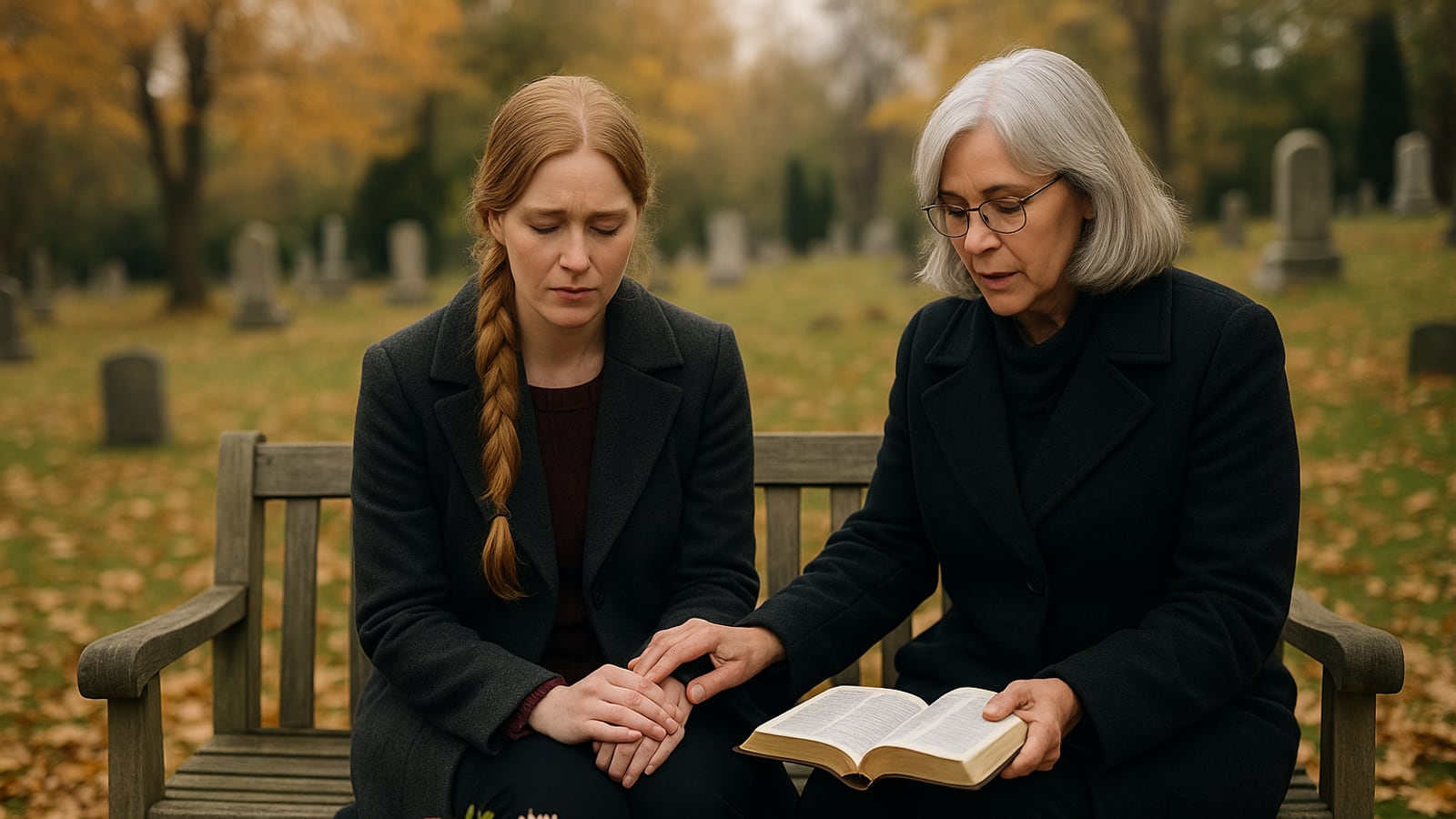
Quick answer: Read the lament psalms out loud, one a day, and don't skip the angry lines. Then give one woman from church the job of organizing everybody else, so you don't have to.
Three weeks after the funeral, the meals stop. You notice because the counter by the fridge is suddenly bare except for the dishes. A blue Pyrex with MARCY written on masking tape underneath. A foil pan nobody wants back. A slow cooker insert you can't place. The flowers are brown. The cards have slowed to one a week. Everyone else has gone back to their lives, as they should, and you're standing in the kitchen at 4:30 on a Tuesday realizing this is the part nobody brought a casserole for.
This is where the Psalms earn their place in your hands.
Start with the psalm that doesn't fix anything
Most lament psalms turn a corner. Psalm 13 opens with "How long, O LORD? Will you forget me forever? How long will you hide your face from me?" (ESV) and then, at verse 5, pivots on one small word: "But I have trusted in your steadfast love."
Psalm 88 never pivots. It's a prayer from Heman the Ezrahite, and it ends like this: "You have caused my beloved and my friend to shun me; my companions have become darkness" (Psalm 88:18, ESV).
That's the last line. No resolution. No "but."
And God put it in the Bible anyway. Think about what that means for you on the worst night. The Lord didn't just tolerate a prayer that ends in the dark. He preserved it, so that thousands of years later a woman sitting on her bathroom floor would know she isn't the first person to pray like this, and she isn't doing it wrong.
Look at how Heman starts, though: "O LORD, God of my salvation, I cry out day and night before you" (Psalm 88:1, ESV). He's furious and exhausted and he's still talking to God. You don't argue with Someone you believe isn't there. The complaint itself is an act of faith.
How to read when you can't concentrate
Grief wrecks your focus. You'll read the same paragraph four times and retain nothing. So don't start a reading plan with checkboxes. You'll only feel behind.
Keep it this small:
- One psalm a day, read out loud. Your ears hold on when your eyes won't. Start with 6, 13, 22, 31, 42 and 43 together, 77, 88 and 130.
- Underline the one line that fits, and write the date beside it. A year from now those dates will tell you a story you can't see yet.
- Don't skip the lines that make you uncomfortable. If Psalm 22:1 is exactly your heart, "My God, my God, why have you forsaken me?" (ESV), stay there. Jesus prayed those words from the cross.
- Write your own "how long" sentence. In a cheap notebook, finish it honestly: "How long, O LORD, will..." Nobody grades this.
If you already have a morning habit, Fifteen Minutes, One Psalm and a Cup of Coffee walks through a simple rhythm that works well in a season like this.
Some days you won't open your Bible at all. That's allowed. Psalm 56:8 says, "You have kept count of my tossings; put my tears in your bottle. Are they not in your book?" (ESV). He's keeping count on the days you can't.
Hope isn't the opposite of tears
Paul never told grieving Christians to stop grieving. He wrote, "that you may not grieve as others do who have no hope" (1 Thessalonians 4:13, ESV). The grief is assumed. The hope changes its shape.
At the tomb of Lazarus, Jesus wept (John 11:35), minutes before He called His friend out alive. He knew the ending and cried anyway. So can you.
And notice who heard the most famous promise in that chapter. Not a crowd. A grieving woman who'd just told Him, in effect, you're late. "Jesus said to her, 'I am the resurrection and the life. Whoever believes in me, though he die, yet shall he live'" (John 11:25, ESV). Martha got honesty and a Person, not a pep talk.
That's what Christian hope is. It isn't a mood you work up. It's Jesus, crucified and risen, the only One who has walked out of a grave and holds the keys for everyone who trusts Him. Because He lives, a believer's goodbye is a "see you later," and one day "He will wipe away every tear from their eyes, and death shall be no more" (Revelation 21:4, ESV).
If you're grieving someone whose faith you weren't sure of, that's its own heavy ache. You don't know everything that passed between them and God in their final hours. Leave them with the One who does: "Shall not the Judge of all the earth do what is just?" (Genesis 18:25, ESV). Then tell the gospel plainly to the people still here.
Let the church family carry what you can't
You're probably the woman who usually organizes the meal train. Now you have to let somebody else. That's harder than it sounds, and it's the whole assignment.
- Name one point person. One woman runs the calendar, answers the "what do you need?" texts, and returns the Pyrex dishes to their owners. That's her job now, not yours.
- Answer vague offers with specific yeses. "Can I do anything?" becomes "Could you take the kids Thursday after school?" Build Your Village by Asking for Tuesday, Not for Help is worth reading on exactly this.
- Give your small group the dates. Birthday, anniversary, due date, the first Thanksgiving. Ask them to text you that morning. They want to remember and they won't without help.
- Let people sit with you and say nothing. Job's friends did their best work before they opened their mouths: "they sat with him on the ground seven days and seven nights, and no one spoke a word to him" (Job 2:13, ESV).
- Go to church even if you cry through the hymns. Sit on an aisle near the back so you can step out. Nobody who matters is watching your mascara.
Now the annoying part. Someone will say the wrong thing. "God needed another angel." (People don't become angels. That isn't in the Bible.) "Everything happens for a reason." Forgive them quickly. They meant love and ran out of words. You don't owe anyone a theology lesson in the receiving line.
And someone you counted on will quietly disappear. It'll sting. Usually they're scared of saying it wrong, not indifferent. Somebody you barely knew will fill the gap, and that's often how God answers "weep with those who weep" (Romans 12:15, ESV).
When grief becomes something heavier
Grief and depression can look alike, and sometimes one turns into the other. If you haven't been able to get out of bed for weeks, you've stopped eating, or you're having thoughts of not wanting to be alive, safety comes first. In the US or Canada, call or text 988 any time, day or night. Tell your pastor today, not next week. Ask him to connect you with a licensed Christian counselor.
The same goes if your loss is tangled up with abuse, addiction, or a death that left you in danger or in legal trouble. Get a professional in the room.
Asking for help isn't a failure of faith. Elijah sat under a broom tree and asked to die, and God's first answer was sleep and food (1 Kings 19:4–8). Sometimes the most spiritual thing you can do is let someone drive you to an appointment.
If you're the one bringing the casserole
Use a disposable pan. Tape the reheat instructions to the lid. Don't expect a thank-you note, ever.
When you drop it off, take the trash cans to the curb and wash whatever's sitting in the sink. Leave her kitchen a little better than you found it. Then come back in month three, after everyone else has stopped showing up, and say her husband's name or her baby's name out loud. Grieving women almost always want to hear it. Most people are too afraid to say it.
Psalm 88 ends in the dark. But the book it lives in ends with Psalm 150: "Let everything that has breath praise the LORD!" (ESV). Right now you're somewhere in the middle. That's allowed. And you won't be there forever.
Josh Halloran
Christian Bro
Leads a mid-week mens group and has done for eleven years. Writes about faith as a practice rather than a position.

Watch
Watch how it's done
Picked for this article.
From channels we rate. Plays on YouTube.
Northland Mission Church
Friday: Psalm 88 - Lament as Life
Through the Bible with Pastor Paul
Psalm 88 • A Cry of Pain and Sorrow
Read next