What to Pray When You've Run Out of Words
Grief takes your language first. The Bible hands you words to borrow until your own come back.
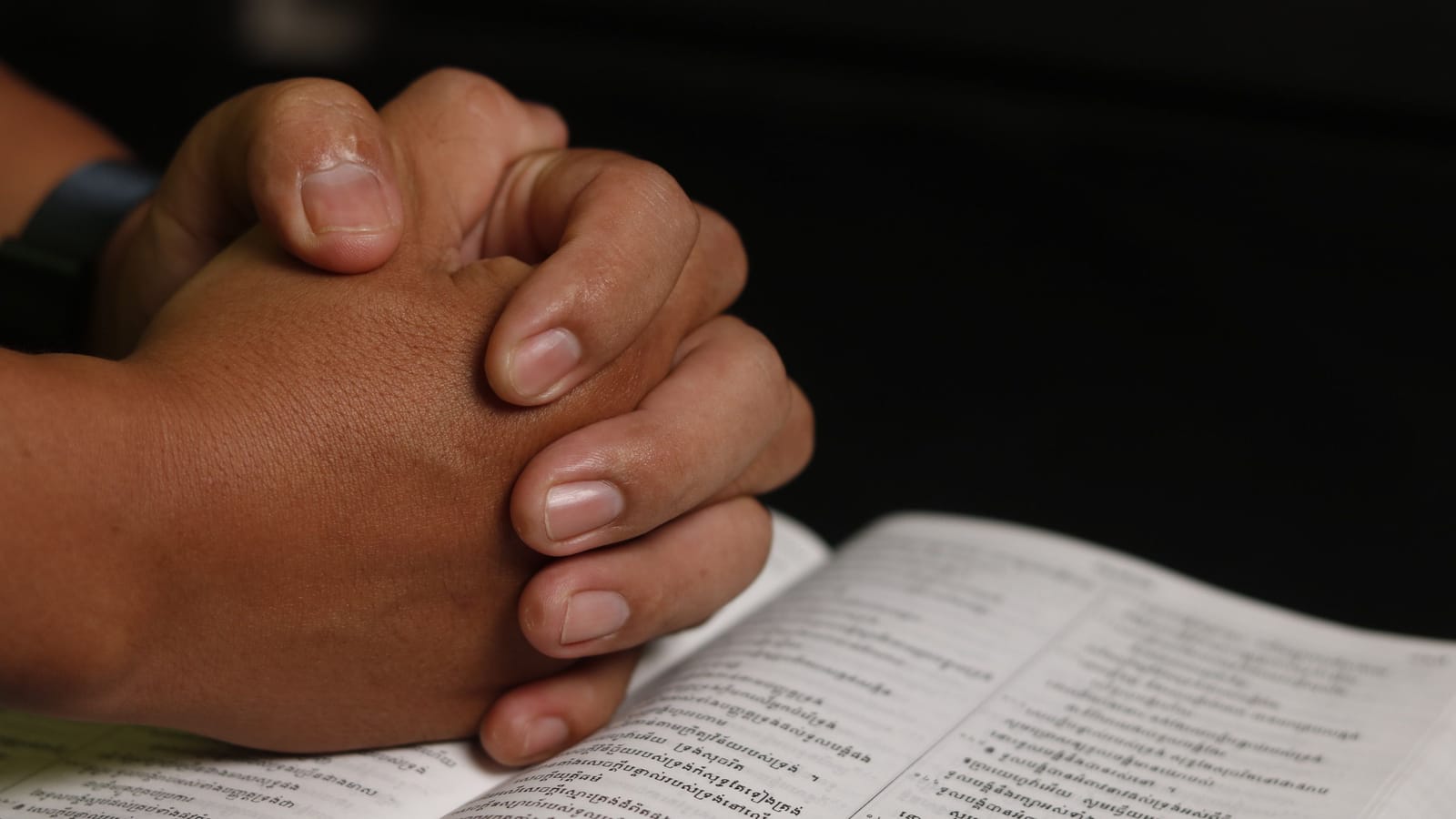
Borrow the words. That's the whole answer, and everything after this is just showing you where they are.
When the diagnosis comes, or the marriage cracks, or the phone rings at 2 a.m. and the voice on the other end says a name you love in a tone you've never heard, your prayer vocabulary goes first. The mouth won't work. You sit in a hospital parking garage with the engine off, and the best you can manage is a sound. Not a sentence. A sound.
God isn't waiting on your sentence.
The shortest prayers in the Bible are three words long
Peter, sinking in the Sea of Galilee, prayed this: "Lord, save me" (Matthew 14:30, ESV). That's it. Three words, shouted with his mouth half full of water. It worked.
The father of the demon-possessed boy prayed, "I believe; help my unbelief!" (Mark 9:24, ESV). He wasn't sure he believed. He said so, out loud, to Jesus, and Jesus healed his son anyway.
The tax collector in Luke 18 wouldn't even raise his head. He beat his chest and said, "God, be merciful to me, a sinner!" (Luke 18:13, ESV). Jesus said that man went home justified, and the eloquent one next to him didn't.
Say one of those tonight. Say it out loud in the truck. It counts.
The Psalms are the language God gave you for exactly this
About a third of the Psalms are laments. Complaints. Men in trouble telling God what the trouble is, sometimes with an edge in their voice.
Psalm 13 opens: "How long, O LORD? Will you forget me forever? How long will you hide your face from me?" (ESV). That's in the hymnbook. God put it there. Whoever told you that you have to be upbeat with God was working off a different book.
Psalm 88 is darker. It never resolves. The last line is "my companions have become darkness" (ESV), and then it just stops. No tidy ending, no silver lining. If you're in a season where nothing resolves, there's a psalm that sits down next to you in it and doesn't try to fix your face.
Here's the practical part. Open to Psalm 13, 42, 55, 77, 88, or 142, and read it out loud, slowly, in the first person. Put your own names in it. When the psalmist says enemies and you don't have enemies, say the word for the thing that's hunting you: the bills, the scans, the silence in the house. Psalm 62:8 tells you what you're doing: "Trust in him at all times, O people; pour out your heart before him; God is a refuge for us" (ESV). Pour out isn't a polite word. It's what you do with a bucket.
The Spirit handles the translation
Paul wrote something to the church in Rome that ought to take the pressure off permanently:
"Likewise the Spirit helps us in our weakness. For we do not know what to pray for as we ought, but the Spirit himself intercedes for us with groanings too deep for words" (Romans 8:26, ESV).
Read that again. We don't know what to pray for as we ought. That's not a confession from a struggling new believer. That's the apostle Paul, describing normal Christian life. The assumption baked into the verse is that you will regularly not know what to say.
So the groan on the hospital bench isn't a failed prayer. It's raw material, and there's Someone inside you who speaks the language on both ends.
Jesus prayed with a shaking voice
If you think a real man prays calmly, read Hebrews 5:7: "In the days of his flesh, Jesus offered up prayers and supplications, with loud cries and tears, to the one who was able to save him from death, and he was heard because of his reverence" (ESV).
Loud cries. Tears. And the writer calls it reverence.
In the garden, He prayed, "My Father, if it be possible, let this cup pass from me; nevertheless, not as I will, but as you will" (Matthew 26:39, ESV). Notice the order. He asks for the thing He wants first, plainly, with no spiritual hedging. Then He submits. You're allowed to want what you want. Say it. Then say the second half.
That two-part prayer is a good one to carry when the outcome isn't up to you. Father, I want this. Not my will, but yours. Ten seconds. You can pray it on a loop in a waiting room.
Five things to actually do this week
- Pray with your body. Kneel, or sit on the floor with your back against the bed. Posture does something when words won't come.
- Pray out loud, even badly. Silent prayer tends to dissolve into worry. Spoken prayer stays a prayer.
- Write one card. Psalm 34:18 on an index card in the wallet: "The LORD is near to the brokenhearted and saves the crushed in spirit" (ESV). You will need it somewhere you can't get to a Bible.
- Pray the Lord's Prayer when you've got nothing. Jesus gave it to men who asked for help praying (Matthew 6:9–13). Use it as a frame and fill in the blanks as you go.
- Let somebody else carry it. Text one man from church tonight: "I can't pray right now. Pray for me." That's not weakness. That's how the body works.
Where good-faith Christians land differently
Some believers reach for written prayers in a crisis: the Psalter, the Book of Common Prayer, an old hymn. Others hear Matthew 6:7, where Jesus warns against heaping up "empty phrases," and want every word to be spontaneous. Both camps love Jesus. My read is that Jesus is aiming at prayer performed to impress, not at borrowed words prayed sincerely, and the Psalms themselves are borrowed words. But a brother who disagrees isn't wrong about the danger of praying on autopilot.
Christians also differ on how boldly to pray for healing, and on whether lament ought to end in praise. Most psalms do turn a corner. Psalm 88 doesn't. If you can't get to the corner yet, you're still inside the biblical pattern.
The part nobody tells you
Praying like this often doesn't feel better. You may get up off the floor with the same knot in your chest you had when you knelt down. There are seasons where the only evidence that God is near is that you keep showing up to talk to Him, which is itself a thing you couldn't do on your own.
Jeremiah wrote Lamentations while the smoke was still rising off Jerusalem. Midway through the third chapter he says, "The steadfast love of the LORD never ceases; his mercies never come to an end; they are new every morning; great is your faithfulness" (Lamentations 3:22–23, ESV). He didn't write that from a comfortable study. He wrote it from the rubble, and he wrote it before anything got better.
Tomorrow morning, before the day starts swinging, say the three words. Lord, save me. Then go make the coffee.
Cal Brennan
Fitness
Strength coach. Trains fathers, tradesmen and desk workers, which means programs that survive a bad week.

Watch
Watch how it's done
Picked for this article.
From channels we rate. Plays on YouTube.
Chad Bird
Learning to pray raw, honest, painful prayers of lament.
Coffee and Bible Time
How to Create A Lament Psalm! The language of Suffering
Read next