

Six farm novels where the land gives the orders
Six novels about farmers, with the mature content flagged, and what each one teaches a man about work, debt, patience and ground he doesn't really own.
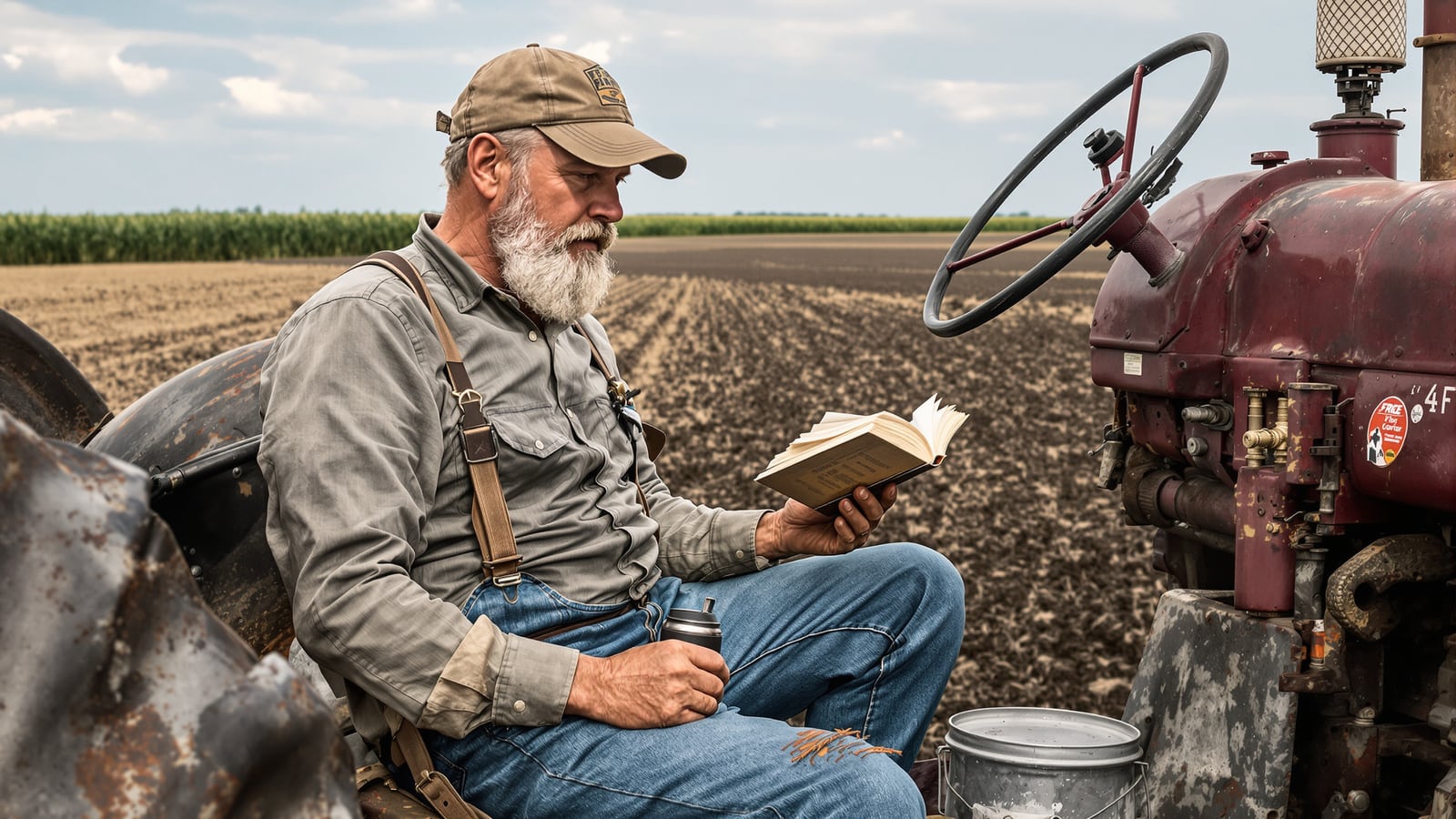
Quick answer: Start with Farmer Boy if you want something easy and clean. Start with O Pioneers! if you want one great novel. Save Plainsong for when you can handle some rough language. Content notes are on every title.
The boy who wanted a colt
Almanzo Wilder is nine years old and he wants a colt. His father doesn't say no. He hands him a pair of calves to train first.
That's the engine of Laura Ingalls Wilder's Farmer Boy (1933), set on a farm in upstate New York. Nothing is handed over. Every privilege is a job first, and a boy who wants a horse has to show he can finish a smaller task without being told twice. If you read it aloud to your kids, you'll also notice you've gone hungry by chapter three. The food descriptions are unfair.
Suits: fathers with kids from about six up, and any grown man who's forgotten how a boy earns trust. Mature content: none. There's a schoolroom fight and a few hard winters, nothing more. It's a natural pick from our list of what to read aloud to your kids, age by age.
The woman who bought the land everyone else fled
In Willa Cather's O Pioneers! (1913), a drought and hard years push Nebraska farmers off the Divide. Alexandra Bergson looks at the same ground and sees it'll pay. She starts buying.
Her brothers think she's reckless. She isn't. She's patient and she's paying attention, which are the two things the land rewards and the two things most of us skimp on. The book has no villain named Weather. It has people who quit and people who didn't, and Cather doesn't sneer at either.
Suits: anyone who wants a short, beautiful novel about nerve. It's free from your library or in the public domain. Mature content: a love triangle ends in a double killing near the close. It's handled without detail, but it's there. Fine for an adult, a judgment call for a young teen.
The man who lost everything and started over
Gabriel Oak, the shepherd in Thomas Hardy's Far from the Madding Crowd (1874), builds a flock on borrowed money. A young dog he'd trained herds the whole lot over a chalk pit in one night. He's ruined.
What he does next is the point of the book. He hires on as a hand at somebody else's farm, works hard, and keeps his mouth shut. When a storm threatens the harvest, he's the one up on the ricks in the dark. Everyone else in the story is clever, vain or in love. Oak is reliable, and Hardy lets you watch what that's worth over the long run.
Suits: men who've failed at something and are rebuilding. Mature content: a seduced and abandoned young woman, a death after childbirth, and a murder. Nothing explicit. Hardy is also slow in the first fifty pages. Push through.
The prairie that breaks people
Ole Rølvaag came to South Dakota from Norway as a young man and wrote Giants in the Earth about the settlers who followed. Per Hansa looks at the open prairie and sees possibility. He works like three men.
His wife, Beret, looks at the same prairie and sees a place with nothing to hold onto. The book is brave enough to let both of them be right. It's the honest counterweight to every sunny story about homesteading. The land costs, and sometimes a family pays in ways that don't show up in the ledger.
Suits: readers who want the full price list. Mature content: childbirth, deep despair, a hard death, and a bleak ending. It's not graphic, but don't read it the week you're already low.
The farmer who owed everything to the place
Wendell Berry's The Memory of Old Jack (1974) is set in the fictional Kentucky town of Port William. Jack Beechum is in his nineties and spends one day walking through his life. He's a man who built his farm, nearly lost it to debt, and learned that you can own land on paper and still be working for it.
Berry's stewardship idea runs quietly through every page. You take the place from the people before you and hand it to the people after you in better shape. It's the old rule about returning the borrowed truck washed and with a full tank, scaled up to a hundred acres and a century.
Jack's story is slow. It's meant to be. Read twenty pages in the evening, not a whole chapter on the way to work.
Suits: men past thirty, anyone who's inherited something or hopes to leave something. Mature content: mild. Marriage troubles and a few adult references, nothing explicit. If you like it, Hannah Coulter tells the same town through a widow's eyes and is just as clean.
The two old bachelors who took somebody in
Kent Haruf's Plainsong (1999) takes place in the plains town of Holt, Colorado. Harold and Raymond McPheron are aging bachelor cattlemen who've never needed anything from anyone. When a pregnant teenage girl has nowhere to go, they give her a room.
What follows is a lesson in what gruff, quiet men can do when they decide to. It's one of the better portraits in American fiction of men whose love shows up as chores.
Suits: readers who like Westerns but want something contemporary. Mature content: this is the one to flag. There's coarse language, some references to sex, a teenage pregnancy, and a violent father. A man who wants a clean read should preview a few chapters first. If you like the quiet, dry end of the shelf, the Westerns worth reading when it gets dark at five is a good next stop.
What to skip
A Thousand Acres by Jane Smiley gets assigned and praised often. It's built on abuse and bitterness toward the farm family itself. It's well written and it doesn't belong on this list. The books above look at the same ground and find something worth keeping.
How to read them
Don't buy all six. Check your library first, since four of these are on most shelves and O Pioneers! is free online. If you need help getting the most out of your card, we've covered what your library card is actually worth.
Pick one. Read twenty pages a night. If it's slow, that's the genre, and the slowness is part of the lesson. These are books about people who couldn't hurry a crop.
When you finish one, walk outside and look at whatever patch of ground you've got, even a yard. You'll see it differently. It's still a small piece of the place you're supposed to leave better than you found it.
Marcus Vale
Editor-in-Chief
Twenty years in magazines, most of it deciding what to cut. Writes about work, discipline and the decisions that compound.

Watch
Worth an hour of your evening
More from Books.
From channels we rate. Plays on YouTube.
Read next