
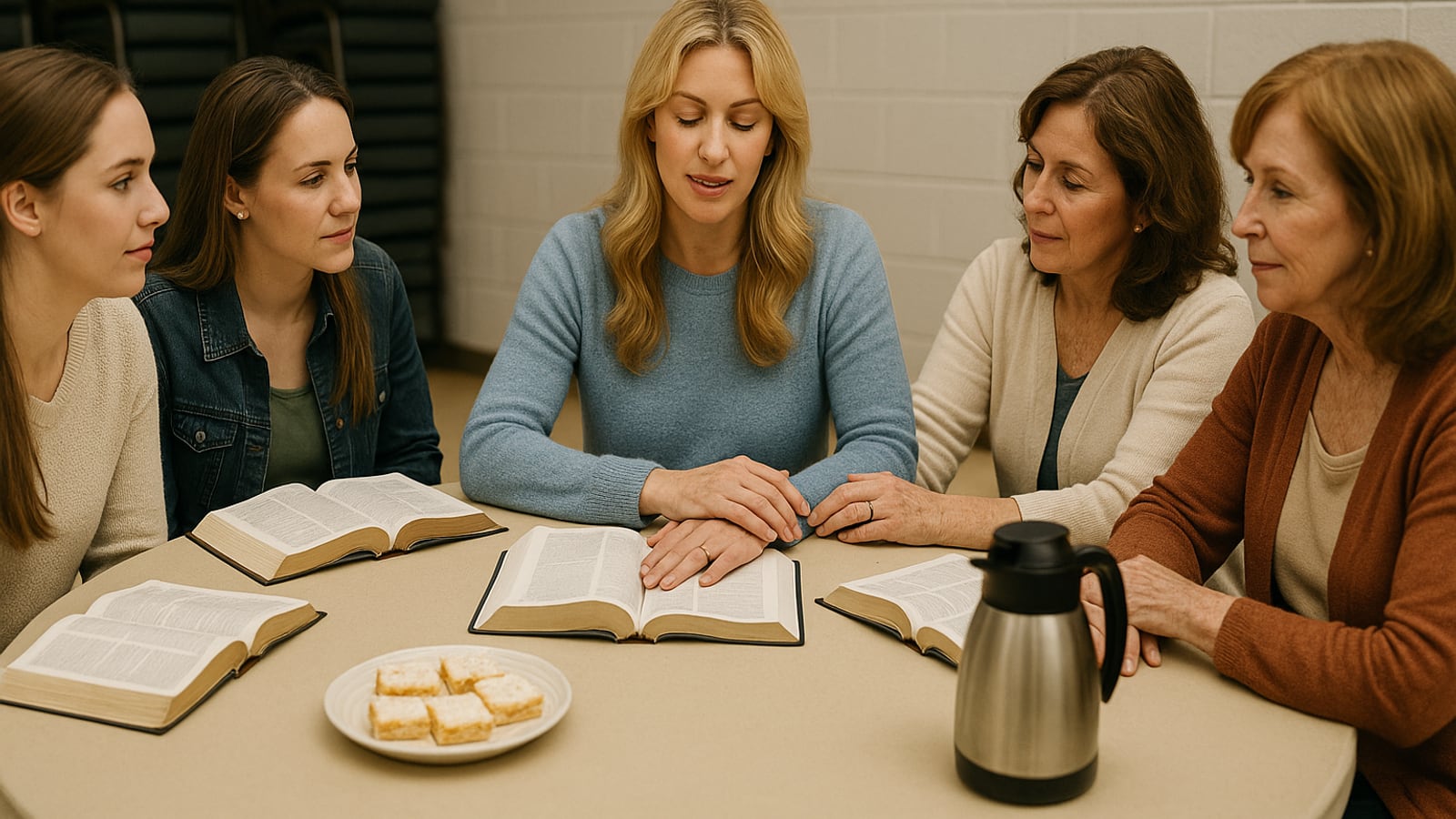
Quick answer: Start with Ruth. It's four chapters and 85 verses of grief, loyalty and redemption, and it teaches your group to be honest with each other. Then take James, all 108 blunt verses of it, to a room that already knows it's safe.
Picture week two of a James study. Chapter 2, the part about faith without works. The woman who always brings lemon bars goes quiet, then stops coming. Nobody said anything unkind to her. James did. And she didn't yet trust the other seven women enough to say, "This one's landing hard on me."
That's the whole case for the order. James is the most practical letter in the New Testament, which is exactly why leaders reach for it first. It's also the one most likely to turn a new group into a guilt session. Ruth builds the trust James needs.
Why Ruth goes first
Ruth is a story, and stories let people talk about themselves without saying so. A woman who'd never admit she's angry at God will say a lot about Naomi being angry at God. You'll learn more about your group in four weeks of Ruth than in a year of icebreakers.
It's also short enough to finish. That matters more than it sounds. A new group that completes a whole book gets a small, real win. A new group that stalls in week seven of Romans quietly dissolves.
If you haven't started the group yet, Start a Women's Bible Study With Six Chairs and One Book covers the logistics. This piece picks up once the chairs are full.
Four weeks in Ruth
One chapter a week. Read the whole chapter aloud at the start, every time, even though it takes a few minutes. Half your group won't have done the reading, and that's fine. Nobody should feel behind in a story that short.
- Week 1, chapter 1. Loss, a hard road home, and a daughter-in-law who won't leave. Ask: "Who has stayed with you when they didn't have to?"
- Week 2, chapter 2. Gleaning, work, and a man who goes beyond what the law requires. Ask: "Where have you seen kindness that cost somebody something?"
- Week 3, chapter 3. The threshing floor. Handle it plainly as what the text presents: a bold, honorable request for Boaz to act as kinsman-redeemer, and Boaz praising her character. Ruth 3:11 (ESV) has him say, "all my fellow townsmen know that you are a worthy woman." The Hebrew phrase there's the same one used for the woman in Proverbs 31:10. That's a good moment to read Proverbs 31 Is a Poem, Not a Performance Review, because Ruth is a widowed foreign field worker and Scripture calls her that same kind of woman.
- Week 4, chapter 4. Redemption at a cost, a baby, and a genealogy that ends with David. Then turn to Matthew 1:5 and show them Ruth's name in the family line of Jesus.
One Hebrew word is worth teaching: hesed, loyal, covenant love. It shows up at 1:8, 2:20 and 3:10. Once your group knows it, they'll spot it everywhere.
Let Naomi be bitter
This is where most leaders flinch. Ruth 1:20-21 (ESV): "Do not call me Naomi; call me Mara, for the Almighty has dealt very bitterly with me... I went away full, and the LORD has brought me back empty."
Don't rush to fix her. The book doesn't. God doesn't rebuke Naomi in chapter 1. He answers her in chapter 4, when the women of Bethlehem place a grandson in her arms.
Somebody in your circle is Naomi right now. A miscarriage. A husband who left. A diagnosis. If you jump straight to "but God is good," she learns that honesty isn't welcome here. Let the silence sit a moment. Then say, "Scripture let her say that out loud. So can you."
That single moment is what earns you the right to teach James.
Take a week off
Between the books, skip the study and eat together. Potluck, somebody's back porch, kids running around the yard. It resets the room and gives the women who joined mid-Ruth a clean start.
Whoever hosts, leave her kitchen cleaner than you found it. Wipe the counters, take the trash out, stack the chairs. Your group will copy whatever you do.
Six weeks in James
Five chapters, but give chapter 2 two weeks. It earns them.
- Week 1: 1:1-18, trials and temptation. "Count it all joy" (1:2, ESV) is hard to hear if someone's in a hospital waiting room. Read it as a promise about where trials lead, not an order to smile through them.
- Week 2: 1:19-27, hearing and doing.
- Week 3: 2:1-13, favoritism. Ask quietly, "Who would we be tempted to seat in the back?" Answer honestly as the leader first.
- Week 4: 2:14-26, faith and works.
- Week 5: chapter 3, the tongue.
- Week 6: chapters 4-5, pride, plans, patience, prayer.
The question someone will ask in week four
"Doesn't Paul say we're saved by faith, not works?" Somebody will raise it. Be glad when they do.
James 2:17 (ESV) says, "So also faith by itself, if it does not have works, is dead." Ephesians 2:8-9 says salvation is by grace through faith, "not a result of works." Both are true, and they don't contradict. Paul is talking about how a person is made right with God: by grace alone, through faith in Christ alone, who alone is the way to the Father (John 14:6). James is talking about what real faith looks like once it's alive. Works are the fruit, not the root.
Here's why Ruth pays off. Boaz redeemed Ruth at his own expense. She couldn't earn it and didn't try. Christ redeemed us the same way, at infinitely greater cost. James is simply describing how a redeemed woman lives. Tie the books together and the "hard" letter suddenly reads like good news.
Week five, and the group chat
James 3:5 (ESV): "How great a forest is set ablaze by such a small fire!"
Every women's group has a group chat, and every group chat has a moment where a prayer request turns into a news bulletin. Use this week to set one rule, out loud: nobody's request leaves the room without her permission. Not to your husband, not "just so you can pray too."
Then hold that line when it's tested. Being kind doesn't mean letting it slide. If a woman starts retelling someone else's hard week, stop her gently and move on. It'll feel awkward for about four seconds. The women watching will trust you for a year.
When someone says more than a study can hold
Both books open doors. Ruth surfaces grief. James 5:16, "confess your sins to one another," can surface things a Tuesday-night circle isn't built for.
Don't turn James 5 into a group confession. Pair women up to pray instead, two by two.
And if anyone tells you she isn't safe at home, or is struggling with addiction, or is thinking about hurting herself, safety comes first. Stop being her Bible study leader and start being the friend who helps her call someone. Loop in your pastor that week, and point her to a licensed counselor or, if she's in immediate danger, emergency services. Compassion there's action, not a follow-up question next Tuesday.
What you'll notice by the end
The woman who went quiet in week two of the hypothetical James study? In a group that did Ruth first, she's the one who says, "I've been Naomi this year," and then, six weeks later, reads James 2 and says, "Okay. So what do I actually do about it?"
That's a different woman. Or rather, the same woman in a room that finally earned her.
Nina Castellan
BRO for Her
Runs the women-facing desk. Same standard, same tools, written for a different reader — not a softer one.

Watch
Watch how it's done
Picked for this article.
From channels we rate. Plays on YouTube.
BibleProject
Book of Ruth Summary: A Complete Animated Overview
zondervan
The Cultural Context of the Book of Ruth --- Marion Ann Taylor
Read next