
Quick answer: The First Amendment restrains government, not your neighbor or your boss. You defend it by knowing which kind of government space you're standing in, reading the rules before you speak, getting everything in writing, and calling a lawyer early when an official crosses the line.
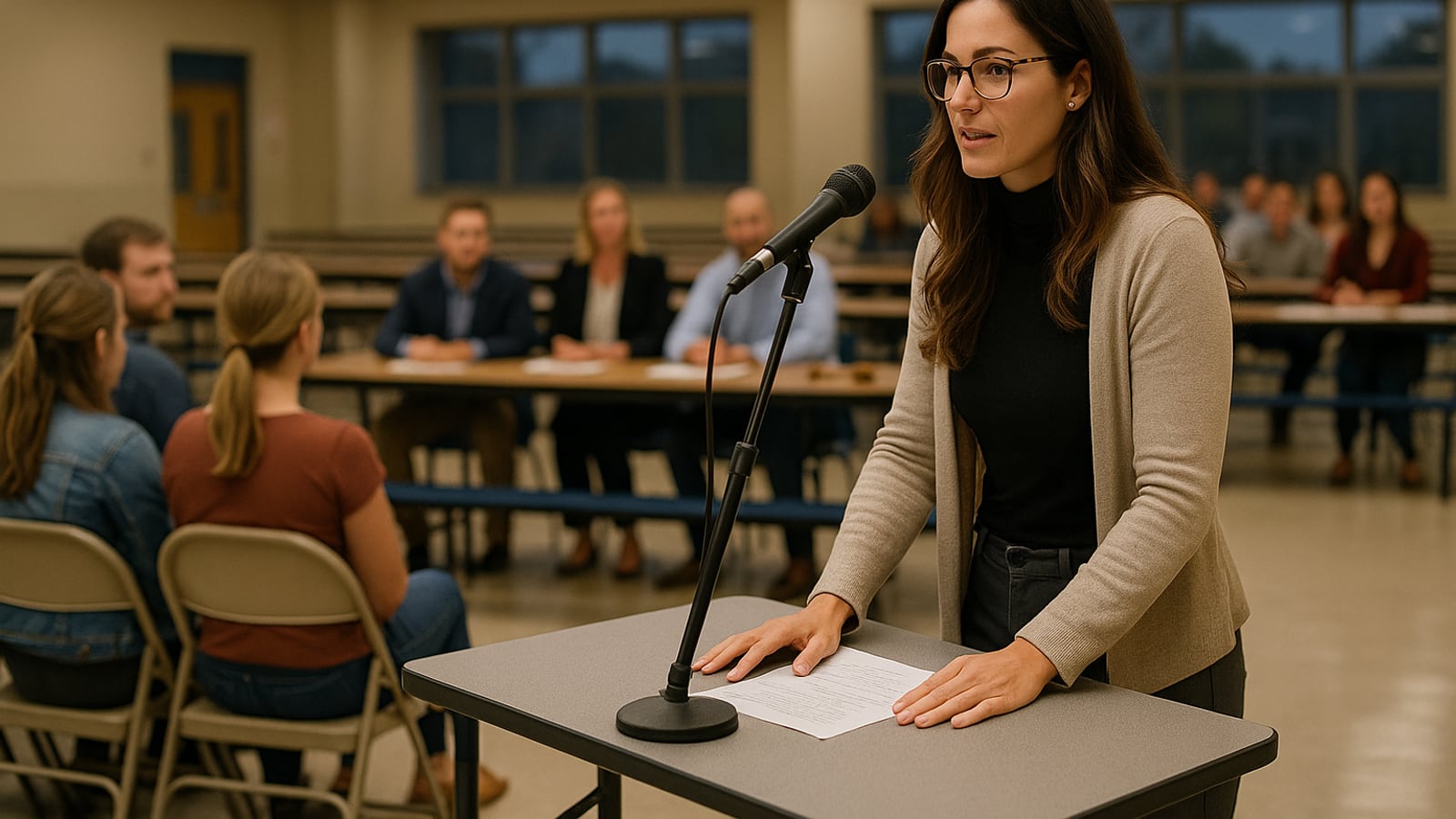
A mother signs up for public comment at a Tuesday school board meeting. She has three minutes. At minute two she criticizes the superintendent by name for a curriculum decision, and the board president bangs the gavel. "No personal attacks. Your time is up."
Was that legal? Maybe not. And almost nobody in that room knows the answer, including the board president. That's where most First Amendment fights actually happen. It isn't a marble courtroom. It's a cafeteria with a microphone on a folding table.
Forty-five words, and who they bind
The whole thing reads: "Congress shall make no law respecting an establishment of religion, or prohibiting the free exercise thereof; or abridging the freedom of speech, or of the press; or the right of the people peaceably to assemble, and to petition the Government for a redress of grievances."
Notice the first word. Congress. As written, it bound only the federal government. After the Fourteenth Amendment, the Supreme Court applied each clause to the states and everything under them: speech in Gitlow v. New York (1925), assembly in De Jonge v. Oregon (1937), free exercise in Cantwell v. Connecticut (1940), establishment in Everson v. Board of Education (1947).
So your school board, city council, county clerk and state university are all bound. Your employer, your homeowners association and the social media company generally aren't. A handful of states do protect employees' off-duty political activity by statute, so check yours if that's your situation.
The narrow categories of unprotected speech, like true threats, incitement to imminent lawless action and defamation, are covered in What the First Amendment Actually Protects, and What It Doesn't. Everything below assumes you're speaking lawfully and somebody with a badge or a gavel is trying to stop you anyway.
The podium: know what kind of forum you're in
Courts sort government property into forums, and the rules change with each one.
A public comment period at a board meeting is usually a limited public forum. The board can limit the topic to school business, set a time limit and require you to sign up. What it can't do is discriminate by viewpoint. Praise and criticism of the same policy have to get the same three minutes.
This is exactly where many "decorum" rules fall apart. In Ison v. Madison Local School District (2021), the Sixth Circuit struck down a board policy banning "abusive," "personally directed" and "antagonistic" comments. The court's reasoning: rules like that let officials silence speech because it's critical of them. That decision binds only the Sixth Circuit, but the logic travels, and boards across the country have rewritten policies in response.
Going over your time is a different matter. So is shouting over the next speaker, or refusing to leave the microphone. A board can enforce order. It just can't pretend that "you made us look bad" is disorder.
Before the meeting:
- Find the public comment policy on the district or city website. Print it.
- Write your comment out. Read it in under three minutes. Time it at home.
- Submit a written copy for the record, either by email beforehand or by hand to the clerk. A gavel can cut off your voice. It can't erase an email.
- Most states' open-meetings laws let you record a public meeting. Confirm yours does before you count on it.
The sidewalk and the permit office
Streets, sidewalks and parks are traditional public forums, places the Court in Hague v. CIO (1939) said have been used "time out of mind" for assembly and debate. Government can impose time, place and manner rules there, but under Ward v. Rock Against Racism (1989) those rules have to be content-neutral, narrowly tailored and leave you other ways to reach your audience.
In practice, a few people with signs on a public sidewalk usually don't need a permit. A march that closes a street usually does. Ask the city what it requires, in writing, weeks ahead.
One thing to watch for is a fee that climbs because officials expect counter-protesters. In Forsyth County v. Nationalist Movement (1992), the Court held that a permit fee can't be based on how hostile the crowd might be. Otherwise the loudest opponent gets to price you off the street. Lawyers call that a heckler's veto, and it's unconstitutional.
The church and the zoning board
Religious liberty gets squeezed in the most boring room in town. A congregation wants to meet in an old storefront, and suddenly the parking requirements are twice what the gym next door faced.
Two tools matter here. The Religious Land Use and Institutionalized Persons Act (2000) is a federal law that bars land-use rules from substantially burdening religious exercise without a compelling reason, and requires religious assemblies to be treated on equal terms with secular ones. And Reed v. Town of Gilbert (2015), which began with a small church's temporary directional signs, held that a sign code treating messages differently based on content faces strict scrutiny. The town lost 9-0.
In Kennedy v. Bremerton School District (2022), the Court sided with a high school coach who prayed quietly at midfield after games and set aside the old Lemon test for reading the Establishment Clause through history and tradition. The details are in What the Courts Have Actually Held on Religious Liberty.
If you're on a church building committee, bring the secular comparison to the hearing. "The fitness center two doors down got approved with forty spaces. We're being told eighty." That sentence does more work than any speech about liberty.
Your membership list is protected too
Assembly includes association, the right to join with others and keep that membership private. In NAACP v. Alabama (1958), the Court blocked the state from forcing the group to hand over its member list, because exposure invited retaliation. In Americans for Prosperity Foundation v. Bonta (2021), it struck down California's blanket demand that charities file their major donors' names with the state.
If a government office asks your club, ministry or advocacy group for a donor or member list, don't just comply. Ask what law requires it, in writing, and talk to a lawyer.
Commentary: the threat now is the quiet phone call
This section is opinion.
The old censor passed a law you could read and challenge. The new one makes a call. An official leans on a bank, an insurer or a platform, and the speech disappears with no statute, no hearing and no fingerprints.
The Supreme Court saw this clearly in NRA v. Vullo (2024). A unanimous Court held that a New York official could not coerce insurers and banks into punishing the NRA for its advocacy. Justice Sotomayor wrote the opinion. That's about as bipartisan as constitutional law gets. In Murthy v. Missouri the same year, the Court threw out a challenge to federal pressure on social media companies for lack of standing, without deciding whether the pressure itself was lawful. That question is still open.
We think the principle ought to be simple. If the government couldn't ban the speech directly, it shouldn't get to outsource the job. Campus speech codes, "misinformation" boards and regulatory nudges all share the same flaw: they put a bureaucrat in charge of which ideas are safe to hear. The Court said in Matal v. Tam (2017) that speech can't be banned because it offends. A free people doesn't need a permission slip to disagree, and the folks on the other side of an argument are better served by that rule too. Rights you'd deny your opponent aren't rights you'll keep.
When it goes wrong, do this
- Write it down that night. Date, time, who said what, who saw it. Get the meeting video link.
- Request the records. Every state has an open-records law. Ask for the policy, any emails about your comment, and the approval history for comparable permits.
- Put your objection in writing to the board or office. Keep it calm and specific: the rule, the action, why it's viewpoint-based.
- Call a lawyer early. Several nonprofit legal groups take First Amendment cases, often at no cost, including Alliance Defending Freedom, First Liberty Institute, the Becket Fund and FIRE. This article is general education, not legal advice. Your facts and your state matter.
- Go back to the next meeting. Same tone, same three minutes.
That last step is the one that counts. Boards change policies when the same polite, prepared person keeps showing up. Your state lawmakers can also rewrite open-meetings and public-comment rules, which is one more reason your state legislature runs more of your life than Congress does.
The Founders put these rights first, and ahead of everything else in the Bill of Rights. They hold up because people use them out loud. The mother with the gavel coming down on her doesn't need a law degree. She needs the policy printed out, a written copy for the clerk, and the nerve to come back in two weeks.
Josh Halloran
Christian Bro
Leads a mid-week mens group and has done for eleven years. Writes about faith as a practice rather than a position.

Watch
Watch how it's done
Picked for this article.
From channels we rate. Plays on YouTube.
My UP Now
Man's backwards hat spurs likely 1st Amendment lawsuit against county board, sheriff
Read next