Pick a Booth, Pick a Day, and Never Send a Reminder
Most weekly breakfasts die by week four, and the group text is usually the killer. Build a standing table instead, and watch men start showing up.
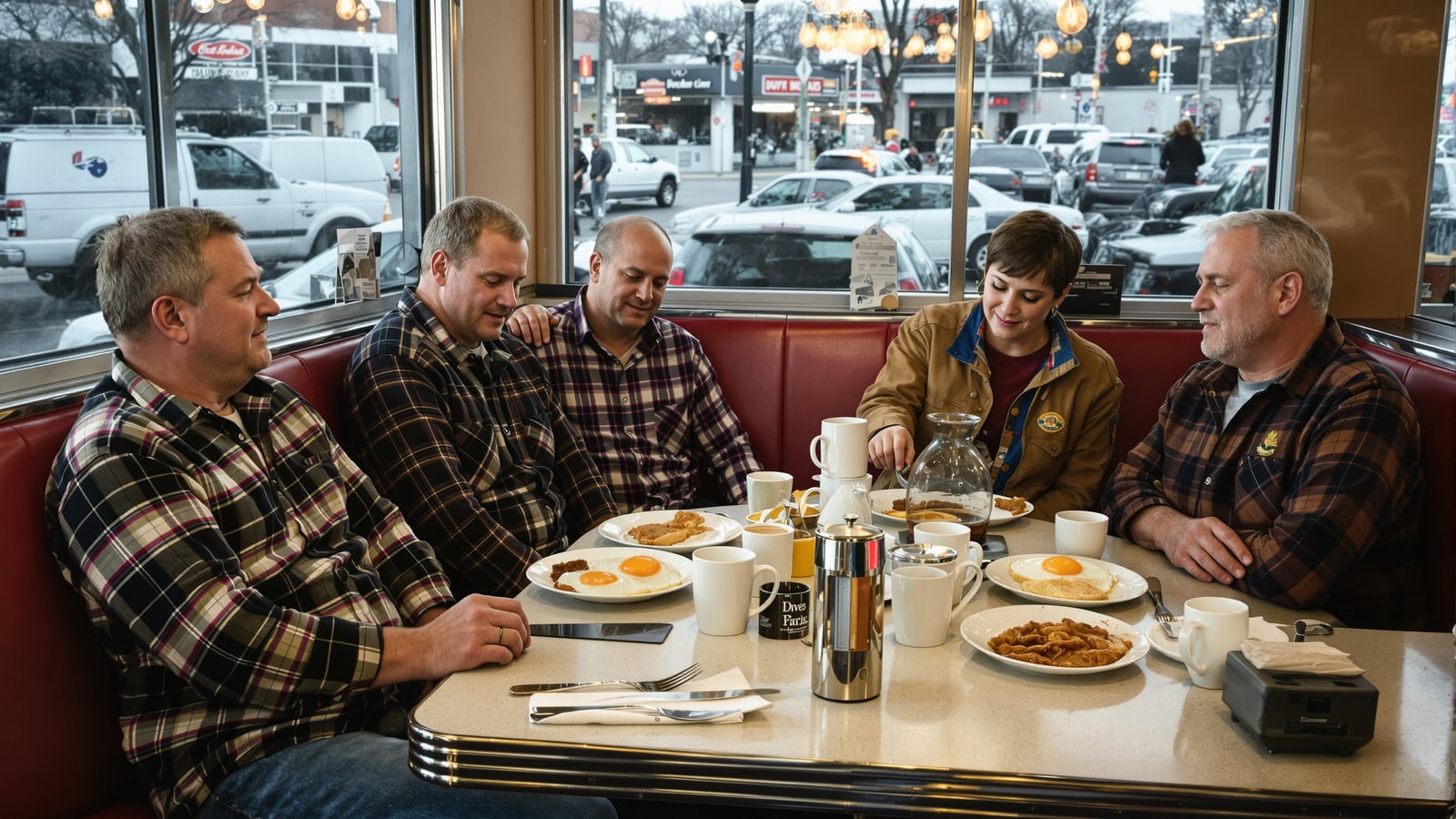
Quick answer: Pick one day, one time and one place, then show up every week whether two guys come or eight. No invitations, no polls, no reminders. The standing table is the whole system.
You've seen how this dies. Somebody texts "Who's in for breakfast Thursday?" Four people reply. One says maybe. Another suggests a new place across town. By Wednesday night nobody knows where they're going, so nobody goes.
Kill the poll. A breakfast that needs organizing every week will stop being organized by week four.
Make it a place, not an event
An event has to be planned. A place just has to be open. Tell people: "I'm at the diner on Route 9 at 6:30 every Thursday. Come when you can." That sentence is the whole invitation.
Early on a weekday beats Saturday for a reason. Saturday belongs to your kids' games and your wife. A 6:30 breakfast is done by 8:00, you're at work on time, and nobody at home pays for it.
Work nights? Run it as lunch instead. Noon, one hour, same booth. A lunch group works fine if the guys work within ten minutes of the restaurant.
Pick a place with a few traits:
- A booth or a table that seats six without anyone shouting.
- Coffee refills without asking.
- Quiet enough to talk at 6:30 in the morning.
- A manager who doesn't mind you staying put for ninety minutes.
Walk in on a weekday a week early and look. A family-owned diner is better than a chain because the owner will learn your faces, and that's the sort of place worth your regular money. I wrote about picking three local businesses to back, and the diner that hosts your table belongs on that list.
Ask in person, and ask few
Don't blast your contact list. Ask four to six men, face to face, in one sentence. The neighbor who always waves. The dad you stand next to at practice. The guy at work you'd like to know better. A retired man with time and forty years of mistakes he's willing to share.
Mix the ages on purpose. Younger men bring energy and questions. Older men bring answers and patience. A table of men who are all the same age and in the same stage of life talks about the same three problems.
You don't need a crowd. You need three men who'll show up most weeks. Past eight, the table splits into two conversations and half the men feel left out. If you hit nine, start a second table on a different morning. Don't grow one into a banquet.
If you coach, the sideline is the best recruiting ground there is. Coaching your first youth team puts you next to a dozen fathers who'd probably like a reason to talk to one another.
The rules that keep it alive
You show up every week. Alone, if it comes to that. Bring a book. For the first two or three months, the host is the table. Sit down at 6:30, order, read. You'll have a lonely Thursday or two. By week three or four, somebody walks in and says "mind if I sit?" and that man will come back, because he saw you were there when nobody else was.
No RSVP. Nobody has to say they're coming. Nobody has to apologize for missing. Come when you can.
A hard end time. Ninety minutes is plenty. Say it plainly at the start: "I've got to be at work by eight." A fixed end keeps the men with real jobs and real families in the group.
Phones in pockets. Not face down on the table. In pockets. One man checking email gives the other five permission to do it too.
Separate checks, big tips. Nobody should do math at the end. Tip twenty-five percent at least. The waitress who holds your table at 6:30 every Thursday is doing you a favor, and you should pay like a regular. Stack the plates. Push in the chairs. Leave the booth cleaner than you found it.
What to talk about
Nothing. That's the plan. A breakfast with an agenda is a meeting, and men don't line up at dawn for meetings.
If conversation stalls, one question does a lot of work: "What's the best thing and the hardest thing this week?" Ask it once in a while, not every time. It gets men talking about their actual lives without anyone sitting in a circle.
Keep it from turning into a grievance club. Politics comes up, and it should be fine when it does. But if every week is forty-five minutes of complaining about the boss, the government and the neighbors, the man who leaves feeling worse stops coming. Steer back to the work, the truck, the kids, the project in the garage. Ask a man what he's building.
The parts nobody warns you about
Summer, hunting season and flu season will gut your attendance. Some weeks it's two guys. Don't cancel. Two men and a pot of coffee is a perfectly good breakfast, and the table is still there when the others come back.
One man will talk too much. Ask the quiet guy a direct question. "Dave, how's the new job?" Do it kindly and do it early.
Somebody will vanish. Three weeks without a word? Call him. Don't text. "Table's missing you" is plenty. Most of the time it's a schedule change or a rough patch he didn't want to bring up. Sometimes it's a lot worse. Either way he'll know somebody noticed, and that matters more than whatever you say next.
Somebody will lose a job or a marriage will crack. You'll hear it at the table first, because men say hard things to other men over eggs more easily than they do anywhere else. Don't offer "let me know if you need anything." Offer a specific thing. That phrase is mostly a way of leaving, and a man in trouble won't call you. Say "I'll bring a truck Saturday and we'll move the boxes." Then do it.
What it gives back
A weekly table pays off in small, practical ways that add up. Somebody's truck dies and by Friday three men have offered rides. A guy needs a roofer and somebody has a number. Another needs a job lead, and the table knows who's hiring. A son needs a first-job reference, and five men know the family well enough to give one.
Men used to get this from a lodge, a shop floor, a barbershop. Most of that's gone, and a lot of men are lonelier than they'll admit. A diner booth fixes it for about eleven dollars a week.
Give it six months. Order the same thing every Thursday. Sooner or later the waitress will put your coffee down before you've sat, and that's how you'll know it's a table.
Sam Ortiz
Dads & Family
Father of three. Writes about presence, discipline and the long game, without pretending any of it's tidy.

Watch
Worth an hour of your evening
More from Community.
From channels we rate. Plays on YouTube.
Read next