
Quick answer: Skip the city council and find the recreation manager. Bring one page that names the court, the layout, who pays and who does the work, plus a signed note from the tennis regulars. Then ask when the courts are due for resurfacing, because that's your cheapest window.
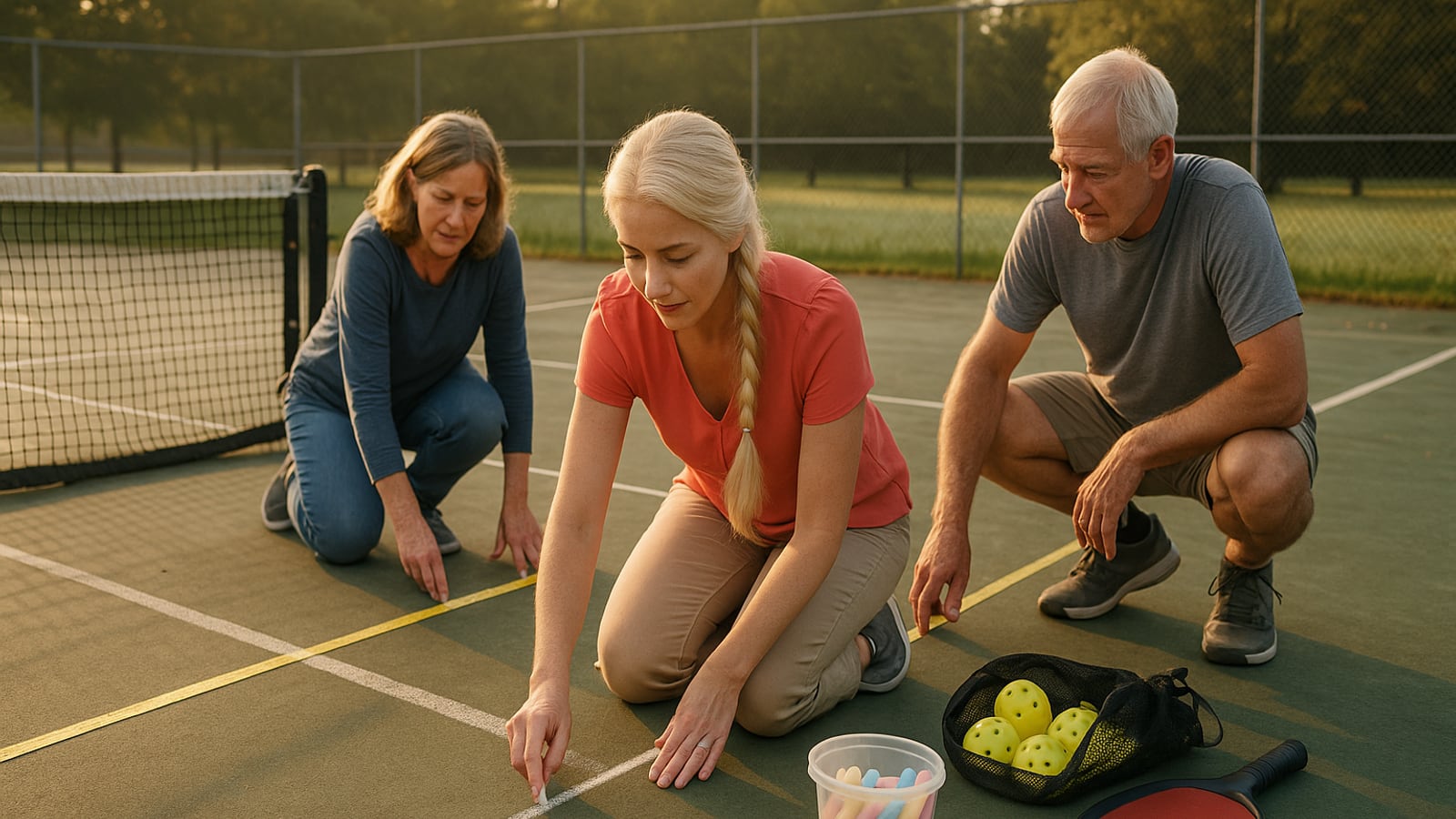
You've seen it. Saturday, 7 a.m., a handful of people on their knees on a tennis court with sidewalk chalk and a tape measure. They're redrawing a 20-by-44-foot rectangle that the sprinklers washed off on Tuesday. They'll do it again next week. They've been doing it for two years.
Every one of them has complained to the city. None of them has asked for anything specific. That's the whole problem.
Find the person who can actually say yes
The instinct is to go big. Email the mayor, speak at a council meeting, start a petition. Mostly that gets you a polite reply saying your concern has been forwarded to Parks and Recreation. It lands on the desk you should have started at, and now it arrives as a complaint.
Call the parks department and ask who manages the courts at your specific park. Depending on the town, it's a recreation supervisor, a parks superintendent or somebody in facilities maintenance. Ask for fifteen minutes in person. Ask whether the city has a parks advisory board, too. Those boards are usually volunteers who meet monthly, and a board member who plays is worth ten signatures.
One thing to keep in mind as you walk in. The city isn't a vending machine. It's your neighbors with a budget and a to-do list, and your lines are competing with a broken water fountain and a playground inspection. Make your request the easiest yes on that list.
Write the one page
This is where most groups fall down. They show up with enthusiasm and no details, and the manager has to do all the thinking. Do the thinking for them. Your page should answer:
- Which court. Name it. "Court 3, the east one" beats "one of the tennis courts."
- What layout. Blended lines (a pickleball court painted over an existing tennis court) or a dedicated conversion. More on that below.
- The dimensions. 20 by 44 feet including lines, 2-inch lines, non-volley zone 7 feet from the net on each side. A doubles tennis court is 36 by 78, so one pickleball court fits inside it with room to spare.
- The color. Pick a line color that contrasts with the surface but isn't louder than the tennis lines. Tennis players will ask. Have an answer.
- The net. Pickleball nets sit at 34 inches in the center, lower than tennis. Say whether your group will bring portable nets and take them home, or whether you're asking for something permanent.
- Who pays. Your group, a sponsor, the city or a split.
- Who does the work. City crew, a court contractor or volunteers under whatever agreement the city requires.
- Who's asking. Names and phone numbers of five or six people who'll actually answer.
Keep it to one page. If they want more, they'll ask, and a follow-up question means you're in the conversation.
Blended lines or a dedicated court
Blended lines are the cheap, fast, low-drama option. Tennis keeps its court. Pickleball gets real lines. The downside is visual clutter, and some tennis players hate it. Serious ones especially.
A dedicated conversion is better pickleball. A standard fenced tennis court footprint can hold up to four pickleball courts, which turns one waiting line into sixteen people playing. But it takes a tennis court away, and that's where these fights get ugly in a lot of towns.
If you're asking for the first time, ask for blended lines on one court. It's a smaller yes, and it builds the track record you'll need for the bigger one. The exception: if one court is so cracked that nobody plays tennis on it anyway, ask for that one to be converted outright. Fixing a neglected court is an easier sell than splitting a busy one.
Make peace with the tennis players before you walk in
Don't skip this. If the tennis regulars hear about your plan from the parks department, you're the people trying to take their court. If they hear it from you first, you're neighbors working something out.
Go to the courts when they play. Introduce yourself. Ask which court they use least and what hours they need. Offer a schedule: pickleball on Court 3 weekday mornings, tennis gets it after 4 and all weekend. Then ask two or three of them to sign a short note saying they're fine with it.
That note is the most powerful thing on your page. The biggest worry a parks manager has about pickleball is the phone call from the tennis crowd. You've just made that call go away.
Same goes for anyone whose backyard borders the courts. Pickleball is loud. The pop of a hard paddle carries farther than a tennis ball, and in some towns it's turned into a real fight. If the court sits next to homes, knock on those doors and offer reasonable hours. If you don't know those people yet, learn your neighbors' names before you need them. This is exactly the kind of moment that advice is for.
Ask when the courts get resurfaced
This is the question almost nobody asks, and it can decide everything.
Tennis courts get resurfaced on a cycle, every several years depending on the surface and the weather. When the contractor is already on site repainting tennis lines, adding pickleball lines is a small add-on to a job that's already scheduled and budgeted. Painting lines on a worn surface in between is its own project, and it'll look shabby within a season.
So ask the manager straight out: "When is this court next due for resurfacing, and can pickleball lines be added to that job?" If it's next spring, your whole campaign might be one meeting and one follow-up email. If it's three years out, you'll know to push for the interim option.
Ask about budget timing too. Cities usually set next year's budget months ahead. A request that shows up in June may fit next year. One that shows up the week after the budget passes waits a full cycle.
Offer to carry the load
The strongest version of your ask is "we'll handle it." In practice, that comes down to three things:
Money. Pass the hat among your players. Ask a local business to sponsor the lines or a set of portable nets in exchange for a thank-you on your group's page. The sporting goods shop, the physical therapy office and the diner where everybody goes after morning play are natural fits. If you already give a few local businesses your regular money, you have a head start on that conversation.
Labor. Some cities let volunteers paint under a signed agreement and a waiver. Some require a licensed contractor or their own crew for liability reasons. Ask which it is. Don't show up with a can of paint and good intentions. Painting a city court without permission is how a friendly request becomes a code enforcement problem. If you're unsure what an agreement commits you to, have someone who handles that kind of document for a living read it.
A trial run. If they're hesitant, propose a 60-day trial with chalk or removable court tape, if the surface allows it. Ask first, because some surfaces don't take tape well. Keep a simple count of how many people show up each session. Numbers from a trial will beat any argument you make in a meeting.
If they say no
Usually it's "not now," not "no." Ask what would change their answer. Maybe it's money, maybe the tennis crowd, maybe the resurfacing schedule. Write that down and go fix it. Then send a short, friendly thank-you email with a note to check back in three months. Put the date in your calendar and actually do it.
Persistence wins these more often than passion does.
Once the lines are down, act like guests
Getting lines painted means the city trusted you. Keep that trust by leaving the court better than you found it. Sweep it before you play. Pick up the water bottles, including the ones that aren't yours. Roll the portable nets up and take them home. Post the shared schedule on the fence and stick to it, especially when the tennis players show up two minutes early.
Save a spot for the new guy who's standing at the gate holding a paddle he bought yesterday. Teach him the kitchen rule. Put him on your team.
And find one or two people to own the upkeep, so nobody's still chalking lines in five years because the paint wore off and no one called. If you're wondering whether that should be you, pick the volunteer job you'll actually show up for. If it's a 7 a.m. court on a Saturday, you already know you'll show up.
The chalk people had the dedication all along. What they didn't have was the page.
Cal Brennan
Fitness
Strength coach. Trains fathers, tradesmen and desk workers, which means programmes that survive a bad week.

Watch
Worth an hour of your evening
More from Community.
From channels we rate. Plays on YouTube.
Read next