

Your Neighbor's Leaf Pile Is Your Free Mulch
Half your street pays to haul yard waste away while the other half pays to buy it back as mulch. Here's how to close that loop with a driveway and a sign.
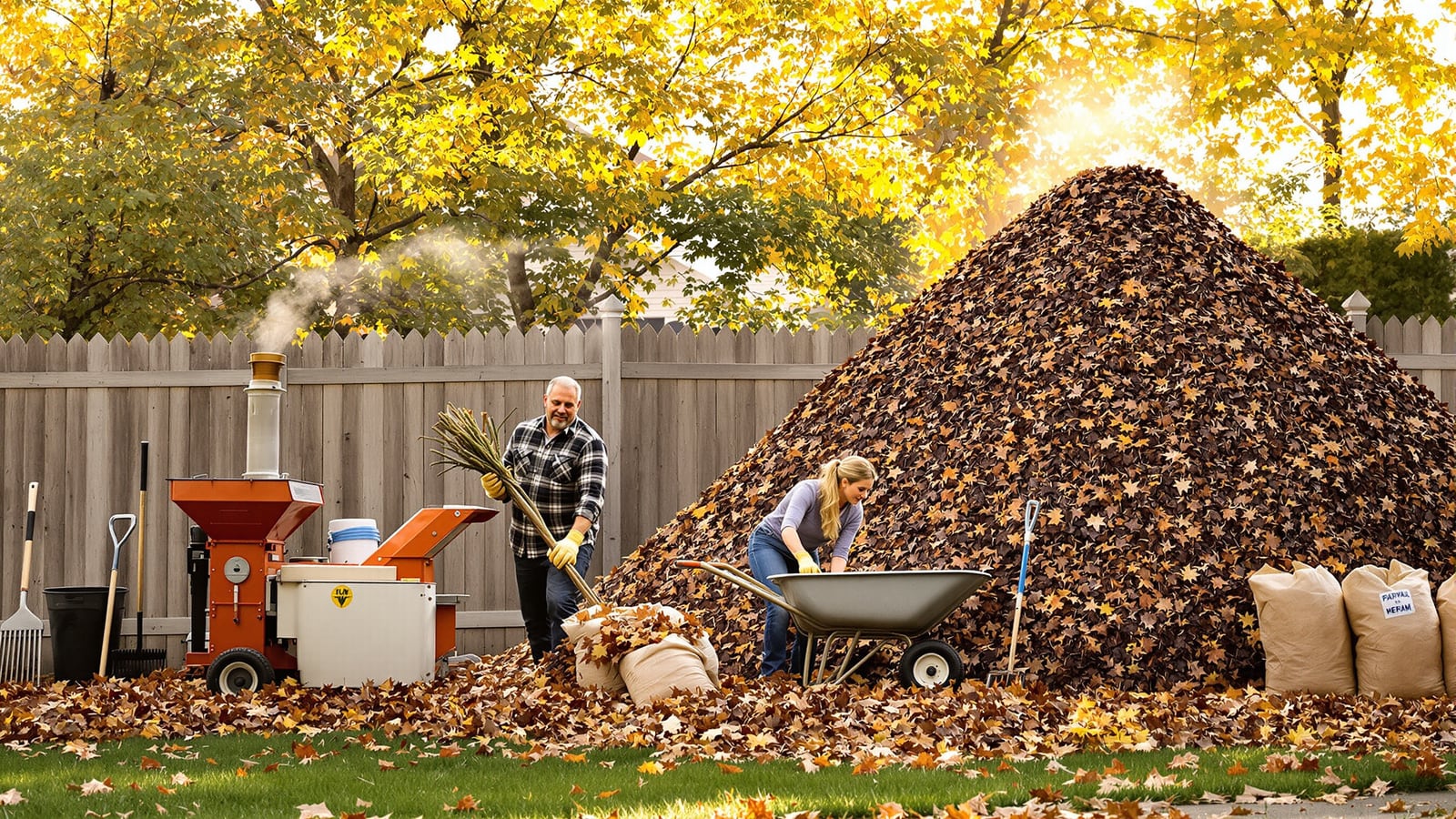
Quick answer: Pick one driveway as the drop spot. Set a short list of what's in and what's out. Share one shredder or chipper among a few houses. Text the street when a pile is ready. That's the whole system, and you can have it running in a weekend.
The street is already doing this backwards
Walk your block on a Saturday in late October. One guy is bagging leaves and dragging forty paper sacks to the curb. Two doors down, another guy just loaded his trunk with bagged mulch from the hardware store. He'll do it again in spring.
Nobody's doing anything wrong. They just haven't talked.
A neighborhood mulch share fixes that. Raw material goes one way, finished mulch comes back the other, and the only cost is a little coordination. It's one of the easier ways to turn a street full of people who wave at each other into neighbors who actually do something together.
Start with three houses, not the whole street
Don't announce a program. Don't make a flyer with clip art. Ask the two neighbors you already get along with.
"I'm going to start a mulch pile at the side of my garage. Want in? You drop branches and leaves, you take what's finished."
If you haven't met them yet, do that first. Learn your neighbors' names before you need them and this part takes five minutes instead of five awkward months.
Three households is enough to learn what breaks. Add the rest of the street once the first season works.
Pick the spot and keep it small
Choose one host house. It should have a side yard or the edge of a driveway, a flat spot, and a host who's happy to see people stop by.
Some ground rules for the spot:
- Keep piles away from the house, fence and shed. A big, deep pile of mulch or damp leaves can heat up on its own and, in the worst case, smolder. Keep them modest and turn them.
- Use two zones. One marked "raw," for leaves, branches and clippings that need processing. One marked "finished," for mulch ready to take.
- Put up a plain hand-lettered sign. Something like "Neighborhood Mulch. Take what you need. Read the rules."
- Mind the sightline from the street. A tidy pile earns goodwill. A sprawling one gets a letter from the city.
Check your local ordinances and any HOA rules before you start. Some towns limit how large a pile can get or where it can sit. A five-minute call to the town office beats a fine.
The rules that keep it from becoming a dump
This is where the system lives or dies. The first time somebody drops a broken lawn chair in the raw pile, you'll understand why.
Post these and enforce them kindly:
- In: Leaves, small branches, grass clippings in thin layers, pruned shrub trimmings, untreated wood chips.
- Out: Anything with poison ivy, oak or sumac. Pet waste. Treated or painted lumber. Anything sprayed with weed killer. Trash, plastic, and bags (empty the leaves out of them).
- Check first: Black walnut. Fresh walnut chips can stunt some garden plants, so keep them separate and let them age. Ask the host before dropping them.
- Diseased trees: If a tree came down sick, don't add it. Some areas restrict moving ash and other wood because of pests, so check with your state forestry office or extension service.
Be the servant with a backbone here. You're giving freely to everyone on the street, and you're also allowed to say, "Sorry, that can't go in the pile." Say it once, say it warmly, and move the junk out yourself if you have to. A system that tolerates one bad drop gets ten more.
Share the machine, not just the material
Raw leaves and sticks are barely mulch. Shredded leaves and chipped branches are the real thing. They break down faster, stay put better and look finished.
A decent chipper-shredder costs more than most of us want to own alone. Three or four households can split one, or you can rent one for a Saturday from a hardware or equipment rental store. For leaves alone, a mulching mower run over a pile a couple of times does the job for free.
If you're running a chipper:
- Wear eye and ear protection, gloves, and snug sleeves. No loose cuffs, no dangling cords of any kind.
- Read the manual for feed direction and branch diameter. Don't push your luck on thick limbs.
- Keep kids and dogs well back. A chipper is loud, and it's not a spectator sport.
- Shut it off and let it stop completely before you clear a jam. Always.
Have the owner or a designated host run it at set times. A first Saturday of the month works. People show up with a rake and a coffee, and the shredder becomes the reason to stand in a driveway for an hour.
Use it right when you take it
Hand people the one-minute instructions with the mulch.
Spread it two to three inches deep. Pull it back a few inches from tree trunks and house siding, because piled-up mulch against bark invites rot and pests. Fresh chips are fine on top of beds. Don't dig raw wood chips deep into vegetable soil.
Leaf mulch is gold in a garden bed over winter. Shredded, it mats less than whole leaves and holds moisture.
Leave it better than you found it
The old code works here. If you borrow a wheelbarrow, bring it back clean. If you borrow a rake, bring it back with a tight handle. If you use the chipper, refill the gas and clear the chute before you hand it off. Sweep the drop spot when you leave, even if it was messy when you got there.
Bring something when you come. A thermos of coffee. A bag of donuts for the host. Five dollars of gas for the chipper owner, handed over before he asks.
That's what turns a free mulch pile into a good reason to keep showing up.
Keep it going past the first fall
Most community projects die in year two. The enthusiastic starter moves, gets busy, or burns out. Spread the load now.
- Give every household one small, steady job: shredder keeper, sign keeper, group-text keeper.
- Set a rhythm. Fall leaf weekend. Early spring trim weekend. One light cleanup in between.
- Text the street when a new batch is ready: "Finished mulch at the Hendersons' side yard. Take as much as you can haul."
- Welcome the new family on the block with the sign and a pitchfork-full of mulch for their first bed.
If that sounds like more commitment than you want, read Pick the Volunteer Job You'll Actually Show Up For. The best role in a neighborhood system is usually the one that fits what you already do on Saturdays.
What it gives back
You save money. That's the easy part. The more valuable return is quieter: the man two doors down who always kept to himself, now leaning on your fence and asking about your tomatoes. The widow on the corner who can't haul her own branches, now getting a text offering a hand. A street where somebody notices when a porch light stays off.
It's the practical version of what people mean when they say, "Let me know if you need anything." Skip the vague offer. Stop saying it and put a wheelbarrow in the driveway instead.
Start with a pile and a sign. The neighbors will do the rest.
Sam Ortiz
Dads & Family
Father of three. Writes about presence, discipline and the long game, without pretending any of it's tidy.

Watch
Worth an hour of your evening
More from Community.
From channels we rate. Plays on YouTube.
Read next